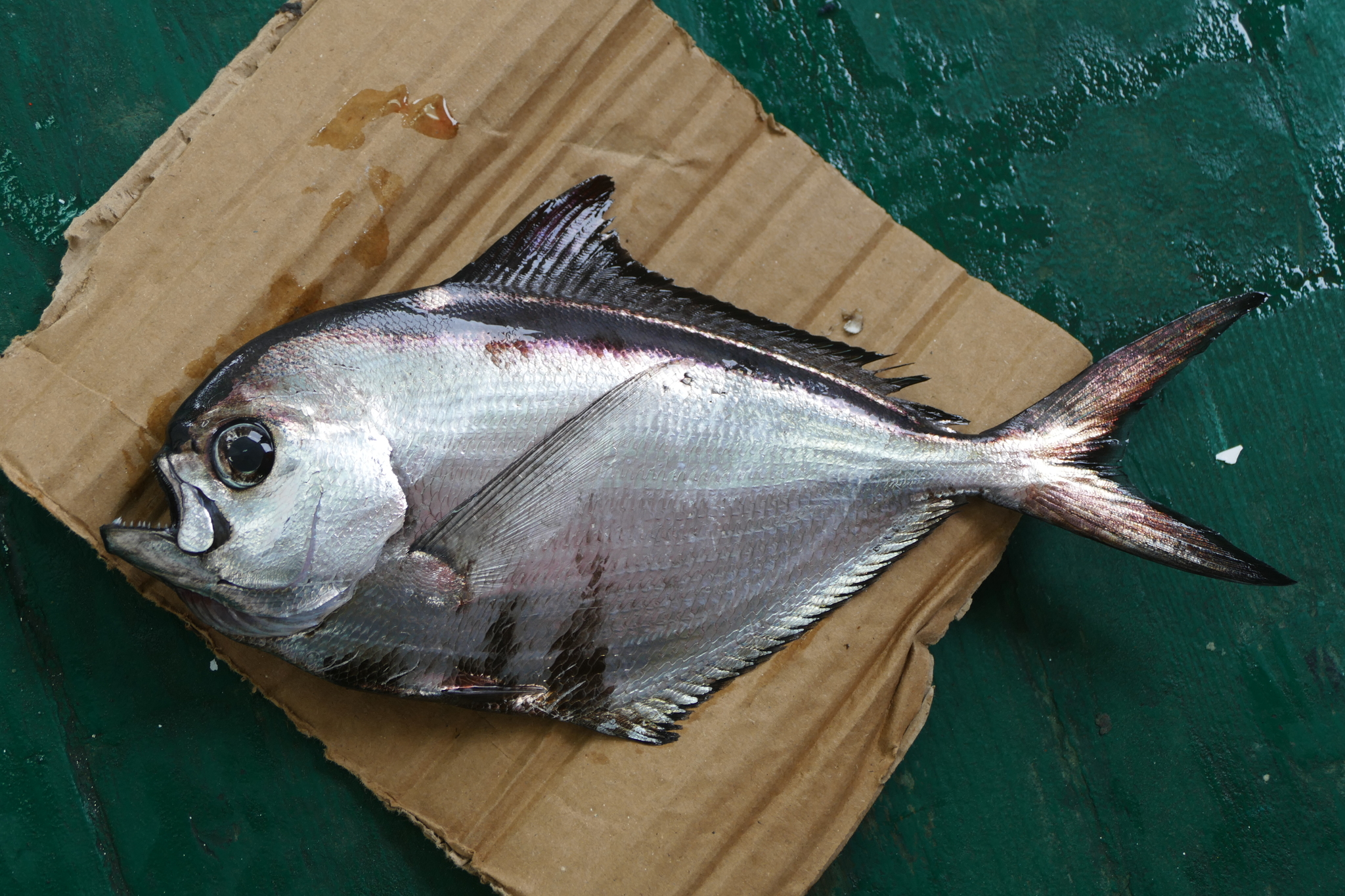
Brama brama, the Atlantic pomfret, is a deep-bodied, silvery pelagic fish of the family Bramidae. It ranges through the Atlantic, Indian and South Pacific oceans from the surface down to about 1,000 m, usually staying in the upper 200 m, and it is caught both by trolling and as by-catch of tuna and swordfish gear.
Identification
Brama brama is a pomfret of the family Bramidae, order Scombriformes. The counts run 35 to 38 dorsal soft rays and 29 to 32 anal soft rays, with no anal spines and 41 to 45 vertebrae. It is a deep-bodied, silvery pelagic fish, and the body shape is the first thing that separates it from the mackerel-like fishes it swims with.
The size record is a mixture of measures. Maximum length is 100 cm TL, common length is 40 cm SL, maximum published weight is 6 kg, and maximum reported age is 9 years. Length at first maturity is not recorded at all: the field reads Lm ? and the range reads ? - ? cm. So the page can tell you the biggest fish and the usual fish, but not the length at which the species reproduces.
The two length figures are also not the same kind of number. One is total length, the other standard length, and the common figure is well below the maximum. A 40 cm SL fish and a 100 cm TL fish are not points on a single ruler, and no conversion is supplied.
One fish, several market names
The English table gives Atlantic pomfret as the main name and Ray's bream as the usual alternative, and Wikipedia uses the same pair. Everything else in the table is a market label. Black sea bream names sparids in some places, angelfish several unrelated groups, and pomfret more than one family. Vernacular names are regional property, so the table itself is not wrong, but the label on a fish box cannot identify this species. For regulations, use the scientific name.
Depth and ground
The environment line reads marine, pelagic-neritic, oceanodromous, 0 to 1000 m, mostly the top 200 m, subtropical at 12 to 24°C, between 65°N and 70°S. A surface minimum of 0 m and a maximum of 1000 m describe a fish that uses the whole upper column and occasionally goes deep, not one tied to a bottom.
The diet is fishes and molluscs, and nothing on the page attaches the fish to a bottom. For a boat that means trolling or drifting in open water rather than anchoring over structure, and baits that keep moving. Wikipedia puts the species at depths down to 1000 m, matching the FishBase maximum. The distribution text goes further and calls it a highly migratory species, which fits a pelagic fish with a temperature band and a circumglobal range.
Seasonal window
Spawning is recorded for August and September, in a single row whose locality is the Mediterranean. There is no second row, no Atlantic record and no southern-hemisphere record on the page.
That is a narrow basis for a season. The Mediterranean in August and September is late summer; the same months in the southern hemisphere are late winter, and the page says nothing about spawning there. Treat the window as a Mediterranean statement, not a global rule.
Gear and approach
Maximum weight is 6 kg and maximum length 100 cm TL. That is medium tackle rather than heavy: a 20 to 30 lb braid outfit, a fluorocarbon leader, and a reel whose drag stays smooth under load will handle the top end. The mouth is not built for heavy wire, so a light leader fishes better.
The missing maturity figure is the gear-relevant gap. Without an Lm there is no defensible release length, and the 40 cm SL common length is a description of the catch, not a threshold. If release matters, measure and photograph rather than guess.
Edibility and regulations
The only human use FishBase lists is commercial fishing; there is no gamefish status, no aquaculture and no aquarium trade. It is a food fish taken in mixed pelagic landings, and the page gives no separate market category for it.
A pomfret is mostly a by-catch fish, so the rule that binds it is rarely written for it. Whether a fish can be kept is settled by the size and bag limits of the jurisdiction where the boat is working; whether the boat sails is settled by closure dates in another document, usually the one covering the target stock. A mixed landing does not excuse either rule, and FishBase reproduces neither.
Where to look
The distribution text covers the Atlantic, Indian and South Pacific oceans. In the western Atlantic it runs from Nova Scotia and Bermuda to Belize and the Antilles, with records from Brazil and Argentina; in the eastern Atlantic from central Norway south to Algoa Bay in South Africa. The country list traces the same arc across Europe, Africa, the Americas, Australia, New Zealand and the Kermadec Islands.
GBIF returns sixty-five rows, and most of them are European marine-region rows and national checklists that restate the same water bodies instead of adding a place. A Brazilian catalogue repeats its countries, and a handful of rows are flagged doubtful or irregular by the publishers themselves. A distribution row records where a record exists, not where a boat should go.
OBIS gives the independent count: 5,074 records from 77 datasets, spanning 1908 to 2026, with the sampled rows dominated by South African records. Records in the sample reach 1,800 m, deeper than the 1,000 m maximum on FishBase, so the two databases do not close the range at the same point.
Regulations before you keep it
These are the published regulations for this fish. Read the number first. The notice below it is the actual regulation.
Minimum size1
The minimum size for Atlantic pomfret in Spain is ≥16 cm.
| Palometa negra o japuta (Brama brama) | 16 |
Every record above names its source and the date it was retrieved. See the regulation register for the full list, or how to read these regulations.
Where these facts come from
Check these pages before you rely on a size, range or protection status.
-
FishBase — Brama brama
— FishBase · T2
-
GBIF — Brama brama occurrence records
— GBIF · T2
-
IUCN Red List — Brama brama
— IUCN · T1
-
Photo record — iNaturalist
— iNaturalist · T3