
Peacock grouper
This grouper carries a Least Concern listing from 2017, a ciguatera warning, a commercial aquarium trade, and a climate vulnerability score of 72 out of 100. None of those labels is wrong and none cancels another. The contradiction is the useful part: a fish can be globally secure, locally prized, sold alive to a tank, and risky to eat, all at once.
This grouper carries a Least Concern listing from 2017, a ciguatera warning, a commercial aquarium trade, and a climate vulnerability score of 72 out of 100. None of those labels is wrong and none cancels another. The contradiction is the useful part: a fish can be globally secure, locally prized, sold alive to a tank, and risky to eat, all at once.
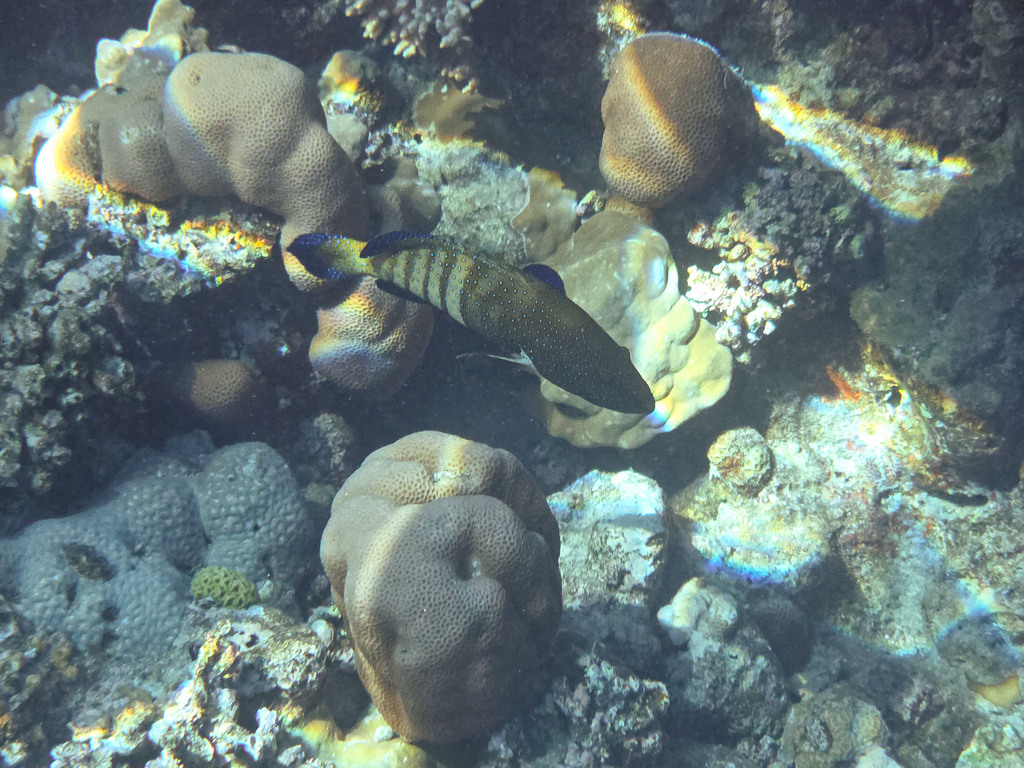
Brown fish, blue dots, pale bars
Nine dorsal spines with fifteen to seventeen soft rays, three anal spines with nine soft rays, 95 to 110 scales in the longitudinal series, a rounded tail. Body depth sits between 2.7 and 3.3 times in standard length. The colour is dark brown crowded with small blue spots that carry black edges; the rear half often shows five or six pale bars, and the chest holds a large pale patch. Cephalopholis cyanostigma is the species most often mistaken for it, so the bars and the chest patch are worth a second look before the fish goes in the box.
Tide pools to forty metres, mostly the first fifteen
Depth is recorded from 0 to 40 m, with a usual range of 1 to 15 m. Adults are benthic to benthopelagic across a spread of coral habitats, preferring the 1 to 10 m reef zone; juveniles sit in shallow, sheltered coral thickets. The species does not migrate. Its horizontal range runs from the Red Sea to Durban and on to French Polynesia and the Pitcairn group, with the Ryukyu and Ogasawara islands at the north and northern Australia and Lord Howe Island at the south.
For a visiting angler the 1 to 15 m band is the whole game. It is wading depth in places, snorkelling depth in most, and it means the reef you can see from the beach is the reef that holds the fish.
A harem with a property line
Adults live in units of up to twelve, one dominant male and several females, on a territory that can reach 2,000 square metres. The male defends the whole area and subdivides it into secondary territories, each held by a single female; some individuals are solitary. That social structure is the most practical thing on this page. A coral head with a resident group produces again next season, because the fish that live there do not move.
Seventy-five per cent fish
Stomach work puts fish at 75 to 95 per cent of the diet, crustaceans the remainder. In the Red Sea the species feeds early in the morning and late in the afternoon; in Madagascar it is reported to feed more at night. A small live fish, a shrimp or a strip on a short leader covers both readings; the timing, not the bait, is what changes with the coastline.
Send the bait down the back side of a coral head and let it hang a second before it settles. The fish usually shows itself first, then turns side-on to take. Wait for the line to come tight instead of striking at the nudge.
Sixty centimetres, and what accumulates in it
The largest recorded fish is 60 cm total length, the common size 40 cm, and first maturity falls around 22 cm. No weight and no age appear in the record, so length is the only yardstick available. A 40 cm grouper in coral is a leverage problem: the first run goes into the hole, and the leader has to be long and heavy enough to turn the head before it gets there.
Fishing vulnerability is 49 out of 100 and climate vulnerability 72 out of 100. Both sit awkwardly beside the Least Concern label, which was assessed in April 2017 and describes global status rather than the condition of one reef.
The threat field records ciguatera poisoning reports. The toxin originates in benthic dinoflagellates and accumulates along the food chain, so the older and larger the fish, the greater the load; liver, head and viscera are the parts to leave alone. There is no reliable field test. Numbness around the mouth or stomach symptoms after a meal mean a clinic, not another plate. A table that ate the same species without harm says nothing about the next fish off the same reef.
Uses are commercial fishing, sport fishing, and the trade that supplies public aquariums.
Four jurisdictions, four different answers
The Red List entry is Least Concern, assessed 24 April 2017.
Thai park rules shut the Similan and Surin groups for the monsoon, roughly May to October, and the fisheries management plan layers on further closed seasons and gear limits. Along Myanmar's Rakhine coast and in the Mergui archipelago, management is thin and the data are poor; foreign vessels and visiting anglers work under whatever permits are current. India leaves minimum size to the states, with Kerala and Tamil Nadu issuing their own on CMFRI advice, while the Andaman and Nicobar islands add tribal-area and reserve restrictions. In the Maldives, reef sharks may not be killed anywhere, grouper aggregations are protected in season, reef-fish exports need a permit, and tourist catch cannot be sold.
How to catch it
Boat bottom fishing
Fished with the listed approach, matched to the recorded depth and size.
Where these facts come from
Check these pages before you rely on a size, range or protection status.
- FishBase — Cephalopholis argus — FishBase · T2
- GBIF — Cephalopholis argus occurrence records — GBIF · T2
- IUCN Red List — Cephalopholis argus — IUCN · T1
- Photo record — iNaturalist — iNaturalist · T3
Fish in the same water
These fish live in the same place.

Guides for this water
Technique, gear and safety guides that fit Peacock grouper.