
Barred sand bass
One spine separates this bass from the other two: the third dorsal spine runs about twice the length of the fourth. Add a summer gathering over sand next to rock, and it becomes the easiest of the three to overbag, which is why a separate four-fish cap took effect in 2025. In Southern California that combination is a management problem, not only an identification one.
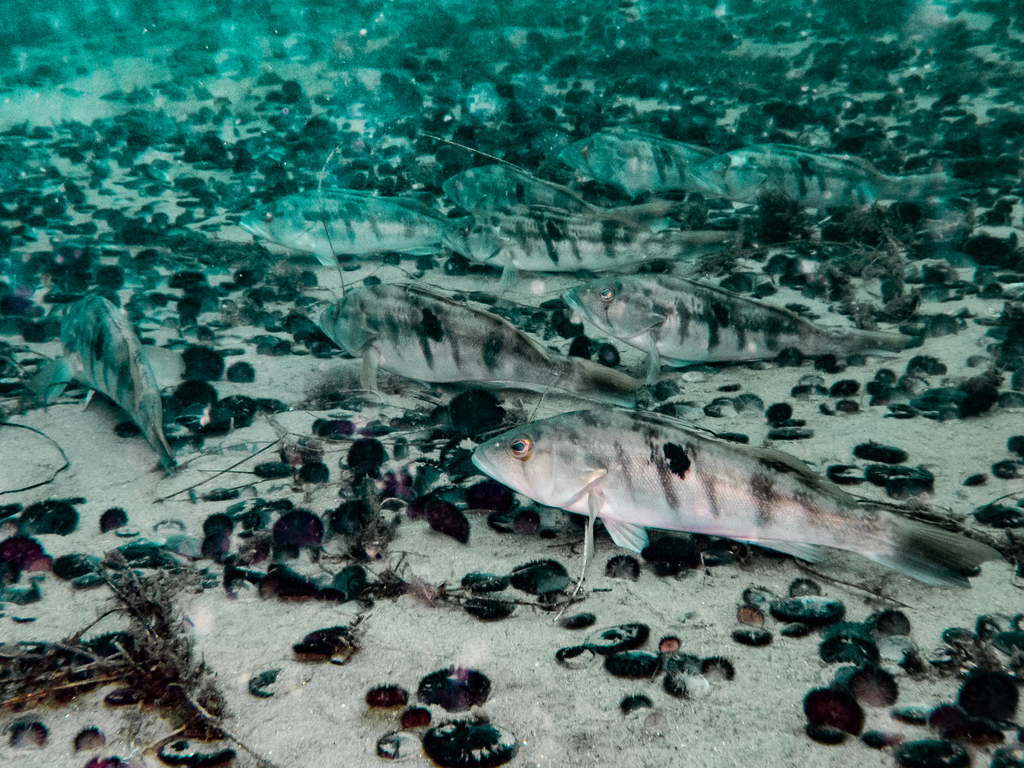
One spine separates this bass from the other two: the third dorsal spine runs about twice the length of the fourth. Add a summer gathering over sand next to rock, and it becomes the easiest of the three to overbag, which is why a separate four-fish cap took effect in 2025. In Southern California that combination is a management problem, not only an identification one.
A third dorsal spine twice the length of the fourth
Lay the fish flat and look at the front of the dorsal fin. The third spine is visibly long, about twice the length of the fourth, with the tip leaning slightly forward. The body is pale sand or grey-white, with roughly five dark vertical bars whose contrast shifts with bottom and light; some fish show them faintly, but the positions still line up. A kelp bass has pale blotches and no bars, with the third to fifth spines close to equal. A spotted sand bass is covered in small dark spots, has no bars, and stops at 60 cm. With three fish in a bucket, count spines first, then read the bars, and even a pale individual is hard to confuse.
Sand bottom among rock, shallow most of the year
FishBase runs the range from Santa Cruz in central California to Magdalena Bay in Baja California, with a record off Acapulco in Mexico. The fish sits on sand, near or between rocks, from shallow water to 183 m, mostly inside 30 m. In Southern California the working water is sandy bay, the sand-rock junction, the outside edge of a pier and shallow artificial structure; clean mud and the inside of dense kelp are not where it holds. The depth record is deep, but most of the catch comes from water shallower than 30 m.
Summer gatherings and the pressure they attract
FishBase calls the species a pelagic spawner and gives no month-by-month spawning table. The Southern California pattern is a summer gathering, with fish stacked over sand next to structure, catches concentrated and average size up; spring and autumn spread the fish out and slow the bite, and winter pushes them deeper. The gathering is exactly when fishing pressure peaks, and the four-fish single-species cap targets that window. The cap is a ceiling, not a target, and the summer fishery reaches it easily. No spawning temperature appears in the sources, so the season is read from water colour and where the fish sit rather than from a number.
Live bait over sand, plastics on the fall
Live bait over sand next to structure is the steadiest approach: a live sardine or anchovy on a 2/0 to 3/0 hook, drifted slowly so it holds a metre or two above the bottom. With lures, a 5 inch swimbait on a 3/8 to 1/2 oz head, hopped off the sand and allowed to fall free, draws most of its bites on the drop. At night under pier lights, a small swimbait or a squid strip cast at the outer edge of the shadow works. Adults feed on fish, especially the plainfin midshipman, and juveniles on crabs, clams and mysids, so match bait size to the fish in front of you.
Circle hooks and a tape measure in the boat
A 7 foot 6 inch to 8 foot medium-heavy rod with a 4000 size spinning reel, 30 lb braid, a 20 to 25 lb fluorocarbon leader and a 2/0 to 3/0 circle hook covers it. Sand is the main bottom, so the leader does not need the extra weight used for kelp bass, but the sand-rock edge still abrades line. Fish swallow deep during the gathering, and a circle hook is easier to remove than a J hook. Measure before the fish goes in the box: 14 inches total length, or the 10 inch alternate length, is a hard line. Fish from depth still need a descending release.
Four fish, one advisory, and a sunset date
FishBase calls it an important game fish and gives no eating quality. The flesh is white and firm, suited to frying or grilling. California's three Paralabrax basses share a five-fish limit, with a 14 inch total length minimum or the 10 inch alternate length, and no closed season (14 CCR § 28.30). This species also carries a single-species cap of four fish, in force from 1 June 2025 and scheduled to sunset on 1 June 2028, so check the current year's notice. OEHHA advises against eating barred sand bass taken between Santa Monica Pier and Seal Beach Pier, and fish from that stretch should not go home. Parts of the Southern California sand bay and rock lie inside marine protected areas, so check the CDFW MPA map. A licence is required from 16, plus the Ocean Enhancement Validation south of Point Arguello.
Where the numbers come from and where they stop
Length, weight, age, depth, distribution and diet come from FishBase, with the family from GBIF's Serranidae; the IUCN listing is Least Concern, assessed in 2008. The summer gathering is written from Southern California catch patterns, not from a FishBase month table, and spawning temperature and juvenile habitat are missing. The four-fish cap and the OEHHA no-eat advice come from 14 CCR § 28.30 and the OEHHA Southern California fact sheet respectively. Both can change or expire, so the current notice outranks this page.
How to catch it
Drift fishing
A live sardine on a 2/0 circle hook, with the boat drifting so the bait holds a metre or two off the bottom; wind down and set when the bait stops.
Bait fishing
A 5 inch bait on a 3/8 oz head, two short hops and slack line, so the lure falls free where most bites happen.
Pier fishing
A small swimbait or squid strip cast past the light line and retrieved slowly with pauses, working the ring where light meets shadow.
Where these facts come from
Check these pages before you rely on a size, range or protection status.
- FishBase — Paralabrax nebulifer — FishBase · T2
- GBIF — Paralabrax nebulifer occurrence records — GBIF · T2
- IUCN Red List — Paralabrax nebulifer — IUCN · T1
- Photo record — iNaturalist — iNaturalist · T3
Fish in the same water
These fish live in the same place.

Guides for this water
Technique, gear and safety guides that fit Barred sand bass.