
Broomtail grouper
The first is a brown blotched phase: a grey or grey-green body with oblong dark blotches along the upper side that form an irregular, pale, maze-like reticulum. The second is plain: uniform greyish brown with darker fins edged in white. Both phases share the same fin counts, eleven dorsal spines with fifteen or sixteen soft rays, and three anal spines with ten or eleven soft rays.
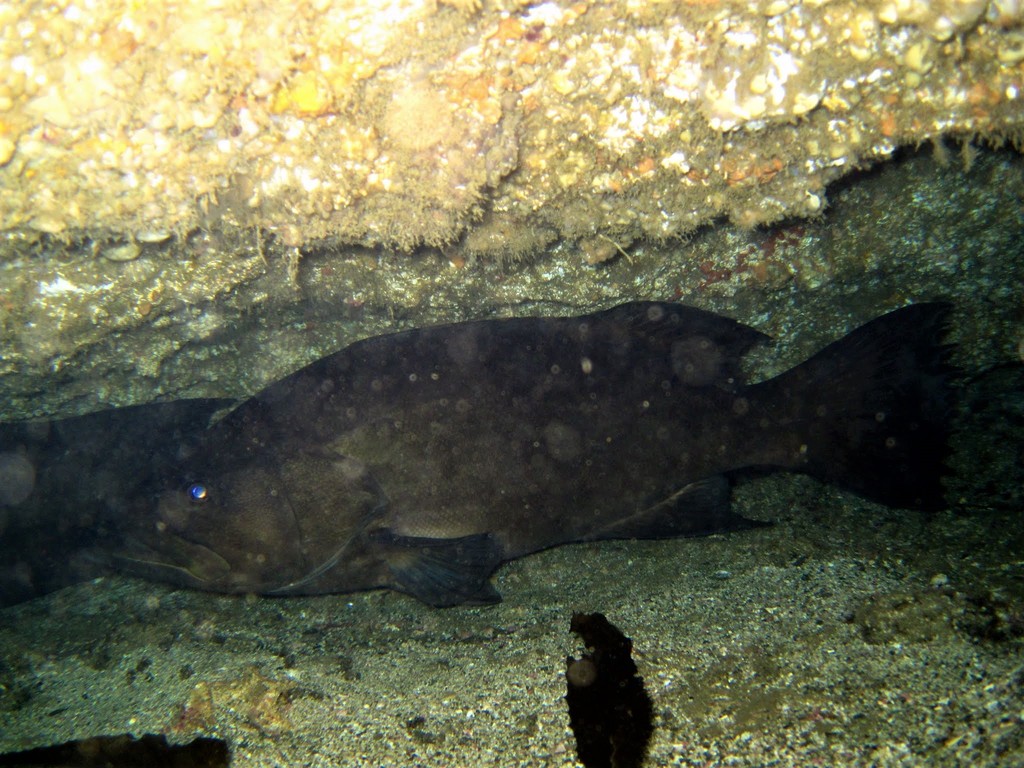
FishBase describes two patterns. The first is a brown blotched phase: a grey or grey-green body with oblong dark blotches along the upper side that form an irregular, pale, maze-like reticulum. The second is plain: uniform greyish brown with darker fins edged in white. Both phases share the same fin counts, eleven dorsal spines with fifteen or sixteen soft rays, and three anal spines with ten or eleven soft rays. Standard length is 2.9 to 3.1 times the body depth and 2.6 to 2.8 times the head length, which gives a thick, heavy-headed profile. The preopercle is angular with a distinct serrate lobe at the corner, and the posterior nostrils are notably larger than the anterior pair. A 150 cm fish is an old fish, and the plain phase in particular can look like several other groupers at a glance; count the fins and look at the preopercle rather than trusting colour alone.
From San Francisco Bay to the Galapagos
FishBase gives the range as San Francisco Bay in California south to Peru and the Galapagos Islands. The country list covers the United States, Mexico, Guatemala, El Salvador, Honduras, Nicaragua, Costa Rica, Panama, Colombia, Ecuador, Peru and the Galapagos. GBIF holds 37,428 occurrences, but the split is lopsided: 37,240 from the United States, 112 from Mexico, then Peru 19, Panama 16, Colombia 15, Costa Rica 7, Ecuador 7 and Nicaragua 1. A count that heavy on one country reflects survey effort and record density as much as fish abundance, so it should not be read as a population map. The coordinate box, 34°N to 9°S and 118°W to 79°W, follows the American Pacific coast. Depth is 0 to 60 m, and the habitat description runs from mangrove areas to hard bottom on the continental shelf and slope. Thomson and colleagues noted a preference for mangrove estuaries, and juveniles and adults both use shallow water, with adults recorded down to 60 m.
Subtropical coast, no fixed spawn
The record never assigns spawning to a month, so the season field stays blank. The climate is subtropical and the latitudinal range runs from 34°N to 9°S, which means the northern and southern ends do not share a season. Mexico can apply local grouper spawning closures, so the operative calendar is a regulatory one: check CONAPESCA and state notices before booking. In practical terms, the fish is present year-round, and the trip is limited by wind and access rather than by a spawning migration. On the Pacific side of Baja, afternoon wind is a more reliable planning constraint than water temperature, and a leeward bay is the fallback when the outside is unfishable.
Big bait, close to cover
The species is a predator of rocky and mangrove edges, and the standard presentation is a live or freshly killed whole fish held close to cover with a heavy leader. Broomtail grouper have thick lips and a large mouth, so the hook needs a wide gap and enough wire to survive the initial run. On the hookset, turn the head away from the hole immediately; a big grouper that reaches its cave is usually lost. Slow-pitch jigging with a large jig along the rock edge and over isolated high spots is a second approach, and it covers water faster when the fish are not concentrated. Live bait drifted into a current seam beside a reef or mangrove edge is the third, and it suits the estuary end of the habitat where the bottom is softer. Keep the bait a metre or two off the rock rather than dragging it; a bait that is constantly snagging is also a bait that is not fishing.
Tackle for a 91 kg fish
A recorded maximum of 150 cm and 91 kg sets the upper end, and there is no common length to plan around. That means heavy tackle: a stout boat rod, a reel with serious line capacity and a drag that can be raised in steps, and a leader heavy enough to rub across rock without fraying through. Braid as the main line keeps diameter down and capacity up, with a heavy fluorocarbon or nylon leader at the business end. Hooks should be large, strong and sharp, matched to a whole fish bait rather than a strip. Carry a large net or a gaff, and expect to use it on a fish that is still green; a 150 cm grouper at the surface is not spent. A fighting belt or harness helps when the depth and the current combine to make the lift long, and a second person on the leader is useful at the boat.
Mexico's rules and the permit chain
Recreational fishing in Mexico is governed by NOM-017-PESC-1994 as revised in 2013: ten fish per person per day, with no more than five of any one species, so five broomtail is the ceiling. Each angler over 12 on a boat needs a personal licence, the licence is not transferable and must be carried, and recreational catch may not be sold. Shore fishing does not require the licence under the NOM, but the limits still apply. Baja California sells state permits online, with 2024 reference prices of 188 MXN for one day, 470 for a week, 706 for a month and 941 for a year; Baja California Sur permits are handled through FONMAR. Any boat carrying tackle in Mexican waters needs a permit for each person aboard, and national parks or reserves add a park pass. Grouper spawning closures can be declared locally, so confirm with CONAPESCA and the state before keeping fish.
Reading the dataset carefully
The account relies on FishBase for taxonomy, range, size, depth, habitat and use, on GBIF for occurrences, and on Mexican federal and state sources for permits and limits. iNaturalist holds 55 observations, a small sample that says more about where photographers dive than about the stock. Maximum age and length at maturity are not recorded, and the IUCN status is Not Evaluated. The GBIF total is dominated by United States records, which is a sampling pattern rather than proof of abundance, and it is presented as such here. No spawning months are available, so the season and seasonality fields remain empty and zero. Permit prices and closure dates are the most volatile facts in the entry; treat the 2024 figures as reference only and confirm at purchase.
How to catch it
Bottom fishing
Fished with the listed approach, matched to the recorded depth and size.
Jigging
Fished with the listed approach, matched to the recorded depth and size.
Boat fishing
Fished with the listed approach, matched to the recorded depth and size.
Where these facts come from
Check these pages before you rely on a size, range or protection status.
- FishBase — Mycteroperca xenarcha — FishBase · T2
- GBIF — Mycteroperca xenarcha occurrence records — GBIF · T2
- IUCN Red List — Mycteroperca xenarcha — IUCN · T1
- Photo record — iNaturalist — iNaturalist · T3
Fish in the same water
These fish live in the same place.

Guides for this water
Technique, gear and safety guides that fit Broomtail grouper.