
Coral hind
Coral hind is described from clear-water coral reefs, and the record adds a detail worth more than the depth range: it turns up more often on exposed reef than on sheltered reef. Exposed means the side the swell hits, the face with the undercut, the corner where the current accelerates. Fish the calm side of the island and you are fishing the wrong half of it.
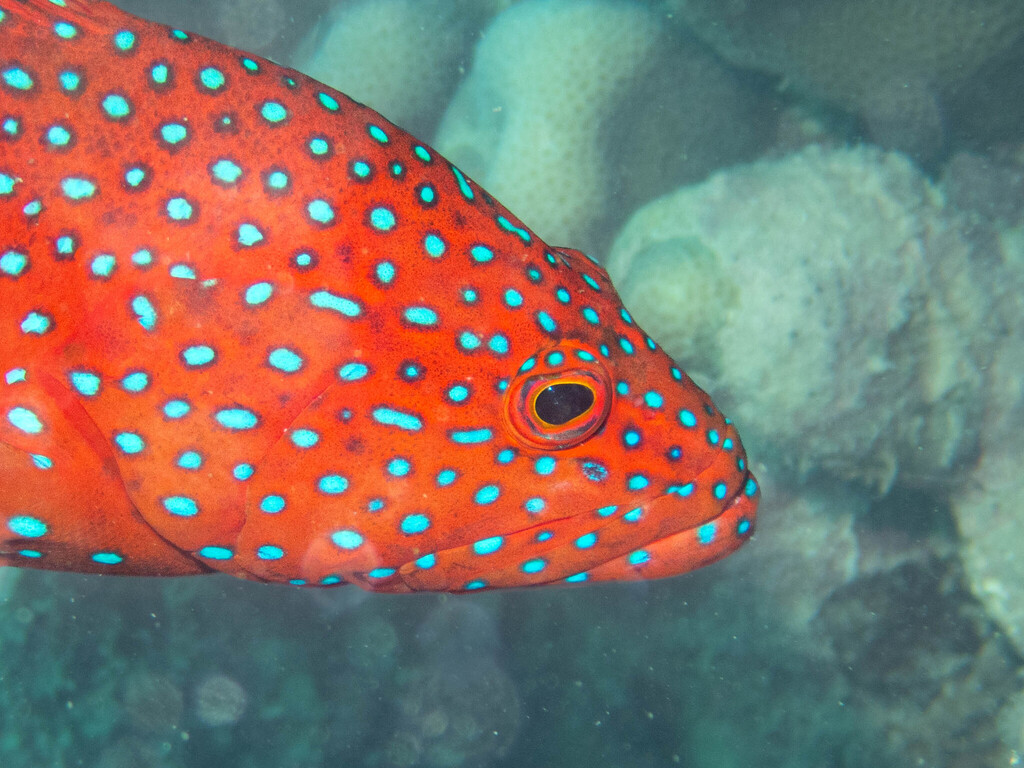
Coral hind is described from clear-water coral reefs, and the record adds a detail worth more than the depth range: it turns up more often on exposed reef than on sheltered reef. Exposed means the side the swell hits, the face with the undercut, the corner where the current accelerates. Fish the calm side of the island and you are fishing the wrong half of it.
The wall, not the flat
That single line also explains why the same reef can feel empty on a flat day and alive after a swell. The fish is not moving to meet the weather; it already lives where the water moves, and it is the angler who has to walk around to the weather side.
Orange, with dots smaller than the pupil
The body runs orange-red to reddish brown, darker toward the rear, and is covered with bright blue spots smaller than the pupil, many of them faintly edged in black. The tail carries a narrow blue margin over a blackish submarginal line, and the pectorals are orange-yellow. Juveniles are yellow with scattered, faint blue spots, which is why small ones get logged as something else.
Fin counts: nine dorsal spines with fourteen to fifteen soft rays, anal fin of three spines and eight to nine rays, seventeen to eighteen pectoral rays, 47 to 55 lateral-line scales, body depth 2.65 to 3.05 in standard length. The blue dots do the identification at arm's length; the counts only matter if you are arguing about it.
The species can also switch to a disruptive pattern of irregular olive bars, which is the version that gets misidentified in photographs. If the fish in your picture has bars instead of an even orange field, count the dots before deciding it is something else.
Two metres to a hundred and fifty
The recorded depth range is 2 to 150 m and the record gives no usual depth. That is a wide envelope, and most of it is not fishable with a rod. What matters is the shape of the bottom in the upper part of that range: with exposed reef as the habitat keyword, the productive water is the wall face, the cave mouth and the outer edge, not the sand at the base.
A wall that drops from 3 m to 20 m puts the whole range within one drop of a bait. A reef that shelves slowly across a flat puts almost none of it within reach.
Two coastal facts are worth carrying. The species is absent from the Persian Gulf and the Gulf of Oman, so a Gulf trip is not a coral hind trip however good the reef looks. And the Reunion record once travelled under the name Cephalopholis cyanostigma, a reminder that western Indian Ocean checklists are not always clean at the species level.
Follow the anthias
Diet is 80 per cent fish, and the record names one prey above the rest: Pseudanthias squamipinnis, the orange anthias that hangs in clouds above coral. Find the cloud and you have found the fish. Coral hind sits below and behind it, close to structure, waiting for something to drift out of the school.
That gives a search pattern instead of a spot. Swim or drift until the anthias appear, note the direction the current pushes them, then drop the bait on the down-current side of the cloud, near the rock. A live fish or a shrimp on a short leader, held still at the cave mouth, is the whole technique.
The ambush line
The strike happens close to the fish's own address, so the first two seconds decide everything. Hook-set with the rod already low and to the side, then walk the fish away from the wall instead of pumping over the edge. A 50 cm grouper that reaches its cave is gone.
Because the fish holds station rather than roaming, a mark that produces once will produce again on another tide. That is the difference between fishing a wall and fishing a school: one is a location, the other is a schedule.
A thirty-year fish
The record gives no common length and no weight, only a 50 cm maximum and a first-maturity figure around 26 cm. It does give age: a 30-year lifespan, K of 0.101, and a doubling time of 4.5 to 14 years. That is a slow animal. Fishing vulnerability scores 65 of 100, climate vulnerability 57.
In practice: a 50 cm coral hind is not a young fish that got lucky, and taking several from one wall changes the wall. Maturity at 26 cm is the floor, not the target.
Three countries, three frameworks
It supports a commercial fishery, a sport fishery and the aquarium trade; the IUCN assessment of 12 November 2017 lists it as Least Concern, and the human-threat field reads harmless, with ciguatera absent from the record. A large grouper still gets local advice at the table.
Thai marine-park closures take the Similan and Surin reefs out of play during the southwest monsoon, with additional closed seasons and gear rules in the national management plan. Sri Lankan protection covers the core of Bar Reef, Hikkaduwa and Pigeon Island, and no single national minimum size applies to the reef catch, which is taken mostly by handline and rod. Maldivian rules prohibit taking reef sharks at all, protect grouper aggregations in season, license reef-fish exports and bar the sale of tourist catch.
How to catch it
Boat bottom fishing
Fished with the listed approach, matched to the recorded depth and size.
Where these facts come from
Check these pages before you rely on a size, range or protection status.
- FishBase — Cephalopholis miniata — FishBase · T2
- GBIF — Cephalopholis miniata occurrence records — GBIF · T2
- IUCN Red List — Cephalopholis miniata — IUCN · T1
- Photo record — iNaturalist — iNaturalist · T3
Fish in the same water
These fish live in the same place.

Guides for this water
Technique, gear and safety guides that fit Coral hind.