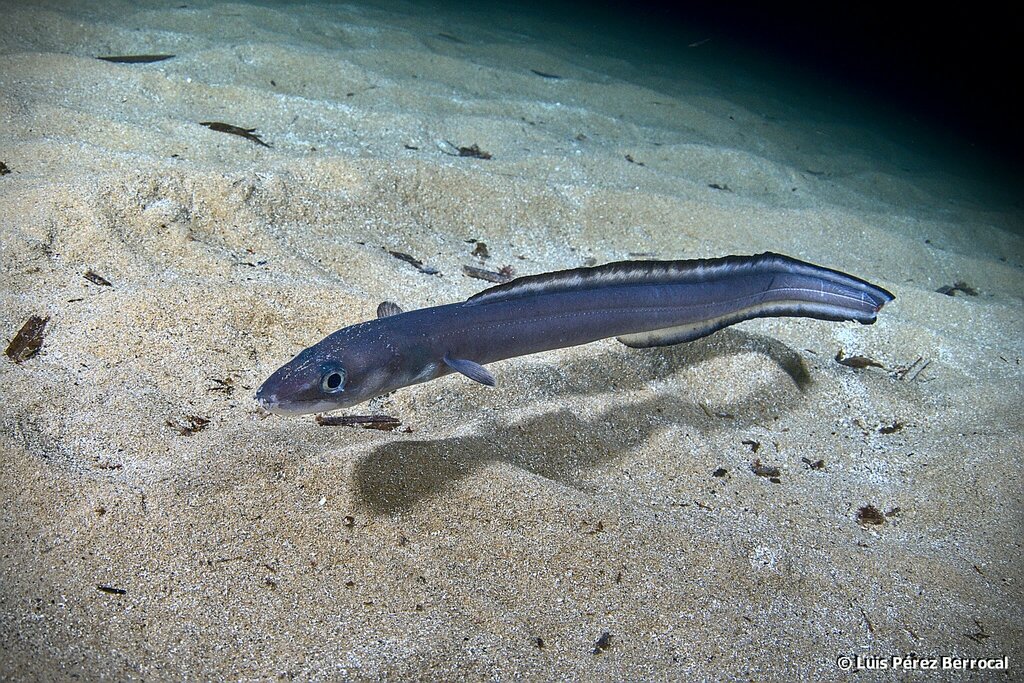
European conger (Conger conger) is a fish of the family Congridae. FishBase gives its range as: Eastern Atlantic: Norway and Iceland to Senegal. Also in the Mediterranean and Black Sea. The animal is built for a hole: a long muscular body, a large head, and a mouth that can be opened wide enough to take a fish almost as thick as the eel itself. It is recorded from 0 to 1171 m, in temperate water. The recorded maxima are 300 cm TL, 110 kg. Diet includes crustaceans, fishes and molluscs. IUCN status: Least Concern (LC). Chinese name: .
Identification
Conger conger is an eel of the family Congridae, in the order Anguilliformes. Wikipedia calls it the heaviest eel in the world, and nothing in the record contradicts that. The animal is built for a hole: a long muscular body, a large head, and a mouth that can be opened wide enough to take a fish almost as thick as the eel itself.
The record tops out at 300 cm TL and 110 kg. The usual fish is much smaller, 100 cm TL, and the usual female is larger than the usual male at 150 cm TL. No age figure is published, so there is no way to say how old a 110 kg fish is.
First maturity is placed at 200 cm. That is the number that changes how the fish is handled, and it is discussed in the next section.
The heaviest eel, and the usual one
A 300 cm, 110 kg eel is the outlier, not the target. The common length the page gives is 100 cm TL, and for females 150 cm TL. Those are the fish a boat actually meets on a reef at night.
Against a maturity length of 200 cm, every one of those usual fish is immature. That single comparison reorganises the whole trip. A conger of 100 cm is not a small adult; it is a juvenile, and a 150 cm female has still not reached the point where it breeds. The legal size, where one exists, is usually far below 200 cm, which means the law can allow a fish to be killed long before it has spawned.
The record also hides how long that takes. With no age entry, there is no growth curve, so the page cannot tell you whether a 150 cm female is ten years old or forty. Wikipedia supplies the weight record and the range, not the age structure.
Depth and ground
FishBase records the species as marine and demersal, oceanodromous, from the surface down to 1171 m, temperate between 68°N and 12°N. There is no "usually" band on the page, which is a real gap rather than a tidy summary: the fish is recorded through the whole column, but no density figure is offered.
The ground terms are rock, sand and coast, and the food list runs from crustaceans and fish to molluscs. Rock and sand together mean edges, not open flats: a conger lives in the hole where a rock meets sand, and the bait has to be presented at that hole rather than cast into the middle of either. The coast half of the entry matters because the accessible fish are the shallow ones; the deep end of the range is a trawl statistic.
Seasonal window
Spawning is listed for June, July and August. It is one row, and the locality is given as Portugal with the site not stated. Nothing else supports it: no Mediterranean row, no northern row.
A single row from an unspecified place cannot carry a European season. What it does support is a statement about the southern part of the range in high summer, and nothing more. If the trip depends on spawning behaviour, the page does not have the evidence to plan it.
Gear and approach
At 110 kg maximum, this is heavy tackle. A stiff boat rod, 50 to 80 lb braid, a short heavy leader and a large offset hook are the baseline; a light outfit will either straighten or be taken into the rocks. The leader matters more than the line, because the last metre is what touches the reef.
Landing is the other half. An eel of 100 cm is awkward to handle and an eel of 150 cm is dangerous in a small boat, so a large landing net, a wet mat and a plan for the hook come before the first cast. If the fish is to go back, cut the hook or use a barbless pattern, because a conger cannot be held while the hook is worked loose.
There is no age figure to argue for releasing the old ones. The argument is the maturity length instead: at 200 cm, almost everything a recreational boat catches is immature, and that is the reason to put the usual fish back.
Edibility and regulations
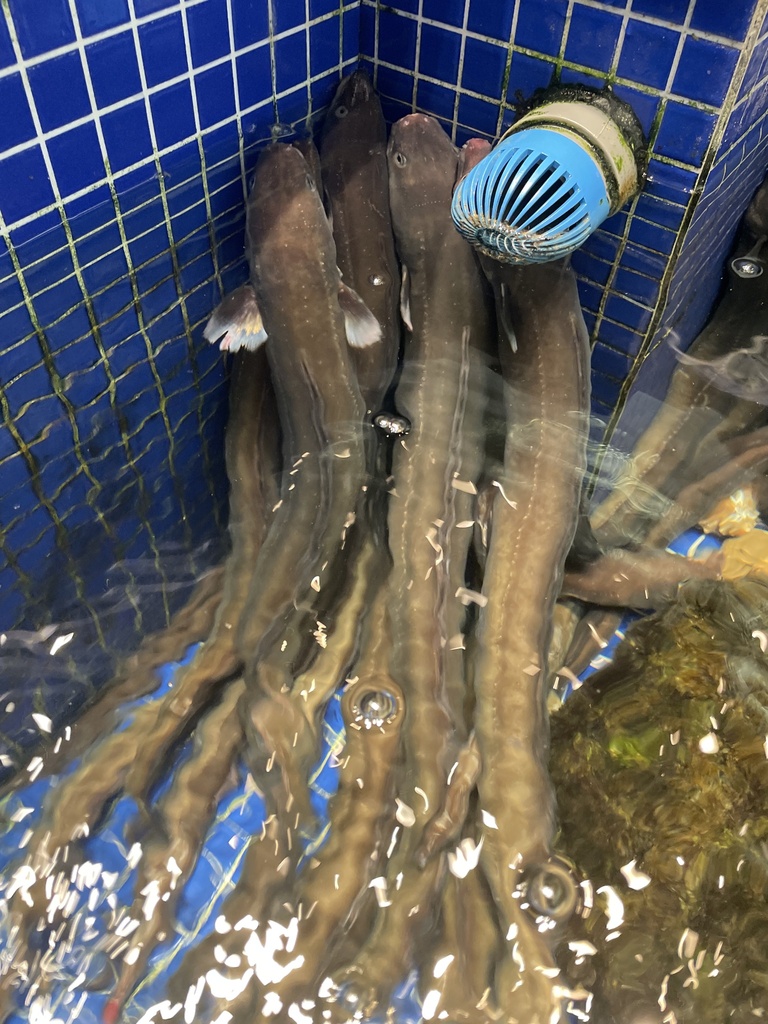
FishBase lists commercial fishing, gamefish status and public aquarium display. Wikipedia adds the weight record and the range, and the flesh is sold in southern European markets. It is eaten, it is shot at, and it is also kept alive in tanks.
No species-specific instrument covers it. Whether a conger can be kept is decided by whatever minimum size and bag limit the state along that coast has set, and in the Mediterranean the European Union framework sits on top of national rules. Whether the boat may fish at all is decided by the closure calendar, which is issued separately and rarely mentions this species by name. Neither the size limit nor the closure is reproduced here.
Where to look
The distribution text runs from Norway and Iceland south to Senegal, and includes the Mediterranean and the Black Sea. The territory list runs the same coastline: the Atlantic states from Norway to Senegal, the whole Mediterranean shore, the Black Sea states, and the island groups of the Azores, Madeira and the Canaries.
GBIF returns forty-six rows, and they are mostly regional sea areas rather than countries: the Baltic, the Black Sea, the Scheldt estuary, and two broad Atlantic sea areas on either side of the ocean. Two Ukrainian rows are marked ABSENT and INTRODUCED, the Danish and Swedish national rows carry NOT_APPLICABLE, and a set of Brazilian catalogue rows cannot belong to this species at all. Treat the table as a list of sources, not a list of fishing marks.
iNaturalist holds 2,236 observations. They sit along the north-east Atlantic and Mediterranean coast, from Norway and Ireland to Senegal, on rock and sand from the shallows to a few hundred metres.
Regulations before you keep it
These are the published regulations for this fish. Read the number first. The notice below it is the actual regulation.
Minimum size3
The minimum size for European conger in Spain is ≥58 cm.
| Congrio (Conger conger) | 58 |
The minimum size for European conger in France is ≥60 cm.
| CONGRE | Conger conger | 60 cm |
Portugal's minimum capture size for conger eel (congro/safio) is 58 cm.
DGRM applies the commercial minimum-size table to pesca lúdica: catches below these sizes are prohibited.
| Congro, Safio ( Conger conger ) | 58 cm |
Every record above names its source and the date it was retrieved. See the regulation register for the full list, or how to read these regulations.
Where these facts come from
Check these pages before you rely on a size, range or protection status.
-
FishBase — Conger conger
— FishBase · T2
-
GBIF — Conger conger occurrence records
— GBIF · T2
-
IUCN Red List — Conger conger
— IUCN · T1
-
Photo record — iNaturalist
— iNaturalist · T3