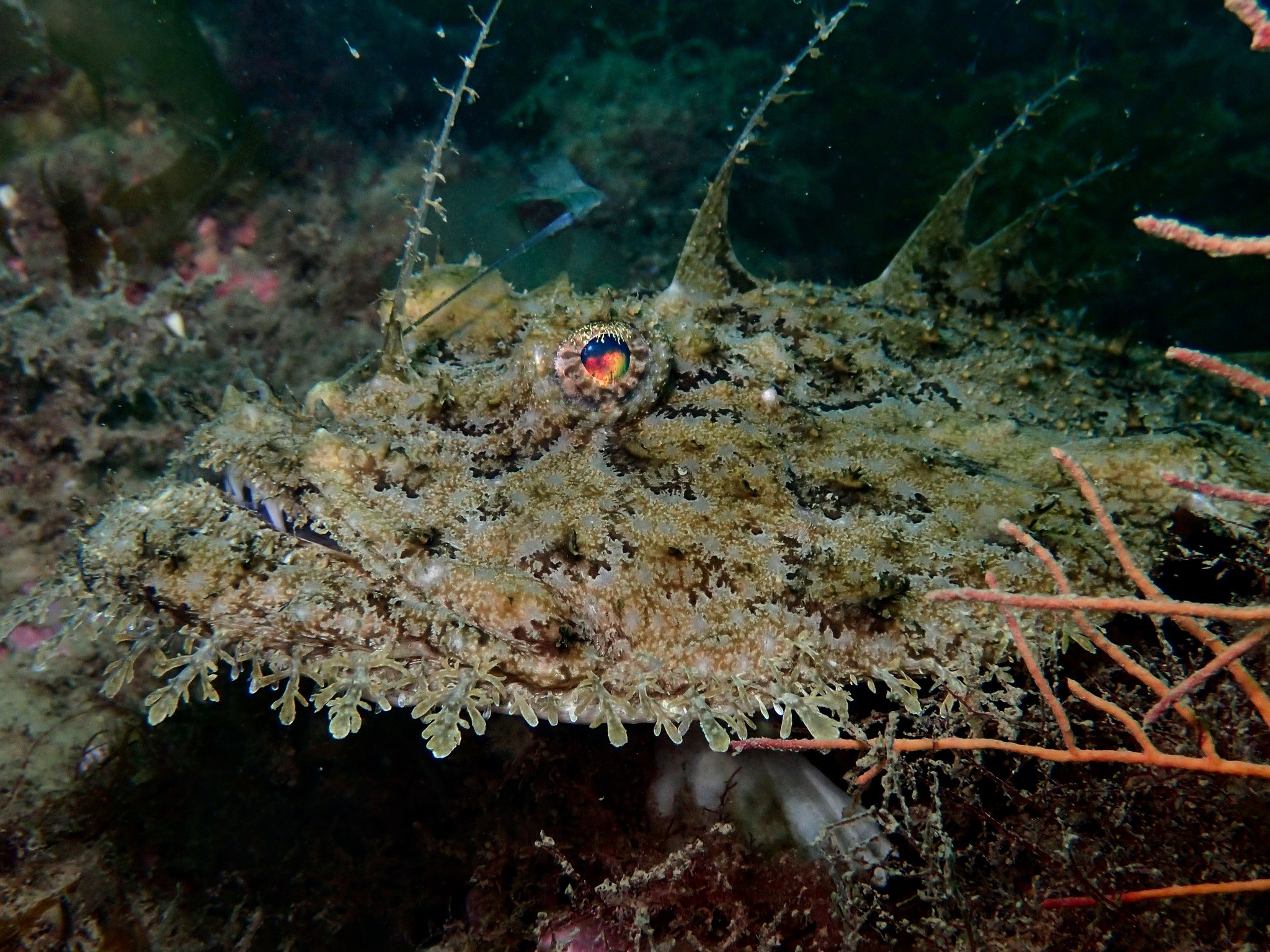
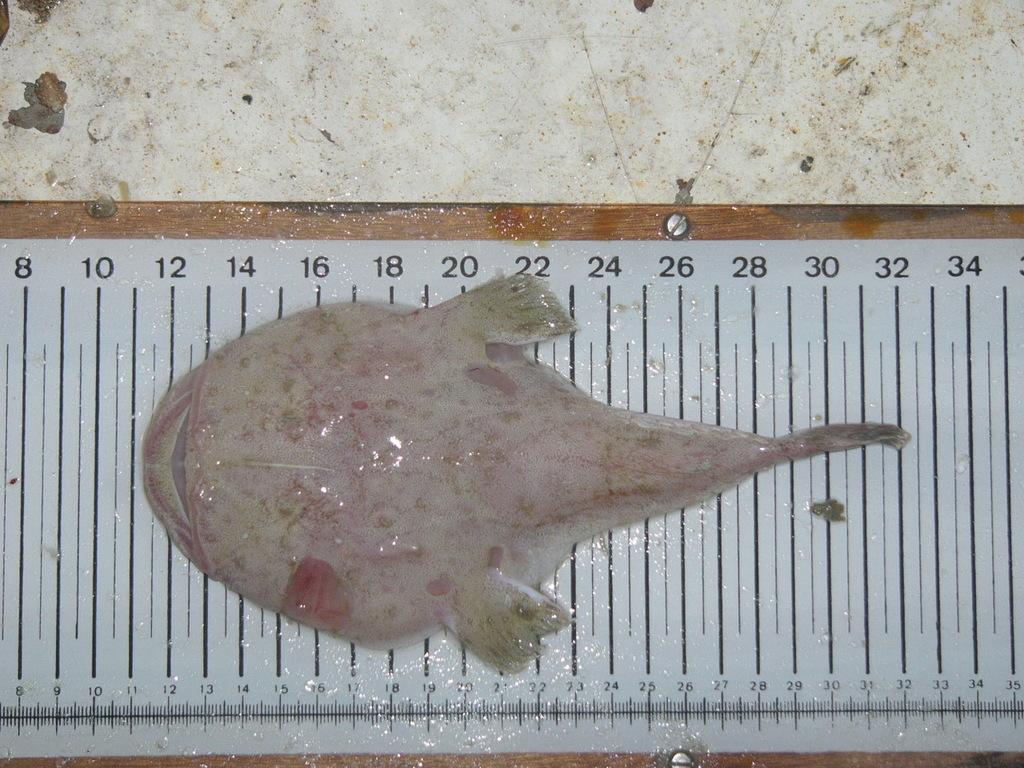
Two numbers govern this fish, and they do not describe the same animal. Measured whole, an American monkfish has to reach 17 inches. Measured as a tail, it has to reach 11. Between the two numbers sit the head, the gill covers and the belly — roughly six inches of fish that a deck hand removes before anything goes into the hold. Almost every argument about keeping one starts at that difference, and so does this page.
Six inches of difference
The federal rule for this fishery carries the pair side by side: 17 inches total length for a whole fish and 11 inches for a tail, for commercial and recreational boats alike. Converted to the units most of the world uses, that is 43 centimetres for a whole animal and 28 for the tail alone. The measurement is not a suggestion about quality; it is the line between a fish you may land and a fish you must put back.
The same rulebook sets no bag limit and no possession cap. For the person holding the rod, size is the whole of the keep-or-release decision, which makes measuring accurately the only skill that matters.
Boats that land monkfish often land tails, and the 11-inch figure exists because that is the product the market buys. Once the head is off, no inspector can rebuild the total length, so the regulation supplies a second standard for the piece. They are two points on the same body, written for two stages of handling.
This is where a careful angler gains something. A tail measured at 28 centimetres tells you very little about the fish it came from, but a whole fish measured at 43 tells you everything. If the fish is close to the line, leave the head on until the tape has been laid along the snout, and if it is short, release it before any knife work begins. A released monkfish with its head still attached has a chance; a tail in the box does not.
Forty-three is short of first maturity
FishBase puts the onset of maturity at about 46.5 centimetres. The legal minimum, at 43, sits below that figure. A monkfish that is legal to keep can therefore be one that has not yet spawned, and the largest animals are the oldest and most productive, so the gap matters.
The practical translation is simple. Below roughly 46 centimetres, a released fish is a fish that will spawn; above it, keeping one is a decision about dinner rather than about the future of the stock. The regulation answers whether you may keep an animal. The maturity figure answers whether keeping it costs the population anything. They are different questions and they do not have the same answer.
The bottom does the work
FishBase gives the vertical range as the surface down to 800 metres, with the population concentrated on the continental shelf. Shelf is not a scenery word. It means flat, soft ground extending from the coast, the kind of plain where a fish with no swim bladder can sit on the bottom without effort and wait.
That is the whole method of the animal. It buries itself in mud or sand, leaves the first dorsal spine standing as a lure, and lets small fish walk into a mouth wider than the body behind it. An angler fishing a wreck is fishing structure; an angler fishing monkfish is often fishing nothing at all, over ground so featureless that the only mark is the depth change at the shelf edge.
March to June, on a thirty-year clock
Spawning is recorded from March through June in this species. The season is broad rather than sharp, as fits a fish that spawns in deep water. For anyone planning around reproduction, the window to leave alone is the spring quarter, not a single date.
The other number worth carrying is age. FishBase records a maximum of 30 years, a maximum length of 120 centimetres and a weight of 22.6 kilograms. A fish that can live three decades does not replace itself on the schedule of a fish that lives three years. Removing the oldest animals removes the ones that have spawned most often, and the cohort behind them is not a substitute.
Trawl in the north, gillnet in the south
NOAA describes the commercial fishery as trawl gear in northern waters and gillnet in southern waters, operating from Maine to North Carolina out to the continental margin. It is managed with days at sea and trip limits rather than a single coastwide quota. Days at sea ration time; trip limits ration volume once fish are found.
In practice the fleet changes with latitude. Northern boats work the shelf and the margin with trawl gear; southern boats set gillnets on the inshore grounds. Bycatch and discards differ between those two worlds, and so does the bottom you are fishing over.
What is worth eating
The market for this fish is human consumption, and the parts that carry value are the tail, the cheeks and the liver rather than the whole carcass. The tail is the swimming muscle; the cheeks are two firm pieces beside the jaw; the liver is a separate product with its own buyers. The flesh holds together in soups and stews that would reduce a softer fish to threads.
The IUCN assessment for the species is Not Evaluated, which means the global status has not been formally assigned rather than that the fish is unstudied. Regional management, not a red-list category, is what actually limits this fishery.
Two stocks, two answers
NOAA divides the resource into a Gulf of Maine and Northern Georges Bank stock and a Southern Georges Bank and Mid-Atlantic stock. The northern one carries most of the history and most of the landings; the southern one is smaller and more exposed to inshore gear. Which of the two a given fish belongs to is not something a page like this can settle, and that is why every status report has to be read against its management unit.
The agency's own summary is unusually honest: overfishing status is unknown, and catch is at the recommended level. The stock is neither certified healthy nor declared depleted; the data are thin enough that caution is the safe reading. Separately, area closures timed to sea surface temperature protect sea turtles when warm water brings them into the path of the gear. Those closures answer whether you may fish at all, a different question from the one the tape measure answers.
Where to look
GBIF's distribution layer files the species under the North West Atlantic, the Gulf of Maine and the Gulf of St Lawrence. Those are the shelf seas where the animal is expected, and they match the two stock areas NOAA manages.
iNaturalist is a record of where people with cameras have met the fish, which for a bottom-dweller means mostly the marks boats and divers already visit. It helps choose a coast and says nothing about how many animals are there. The common-name list is equally informal: monkfish in English, lotte in French, and names such as goosefish and allmouth that describe the shape rather than the species. None of them tells you which of the two monkfishes is on a menu; only the scientific name does.
Regulations before you keep it
These are the published regulations for this fish. Read the number first. The notice below it is the actual regulation.
Minimum size3
17 in whole or 11 in tail · unlimited possession · all year
United States — federal (Atlantic) · US-FED-ATL
Federal Atlantic rules set a 17-inch (or 11-inch tail) monkfish minimum with unlimited possession.
Monkfish (Goosefish, Anglerfish)
Open season: All year
Minimum size: 17 inches
Possession limit: Unlimited
≥17 in · no bag limit
United States — Maine · US-ME
Maine sets a 17-inch monkfish minimum with no bag limit.
MONKFISH (Lophius americanus)
Size: Minimum size 17 inches
Bag limit: none
17 in or 11 in tail length · no possession limit · all year
United States — New York · US-NY
New York sets a 17-inch (or 11-inch tail) monkfish minimum with no possession limit.
Monkfish (goosefish) 17"
or 11" tail length No limit All year
Bag limit1
17 in total length or 11 in tail length · 50 lb tail weight or 166 lb whole weight per person and vessel per day
United States — Rhode Island · US-RI
Rhode Island sets a 17-inch monkfish minimum and a 50-pound tail / 166-pound whole daily limit.
3.22.1 Recreational
A.Minimum size: Seventeen inches (17”) total length or eleven inches (11”) tail length.
B.Possession limit: Fifty (50) pounds tail weight, or one hundred sixty-six (166) pounds whole weight per person and per vessel per day.
Every record above names its source and the date it was retrieved. See the regulation register for the full list, or how to read these regulations.
Where these facts come from
Check these pages before you rely on a size, range or protection status.
-
FishBase — Lophius americanus
— FishBase · T2
-
GBIF — Lophius americanus occurrence records
— GBIF · T2
-
IUCN Red List — Lophius americanus
— IUCN · T1
-
Photo record — iNaturalist
— iNaturalist · T3