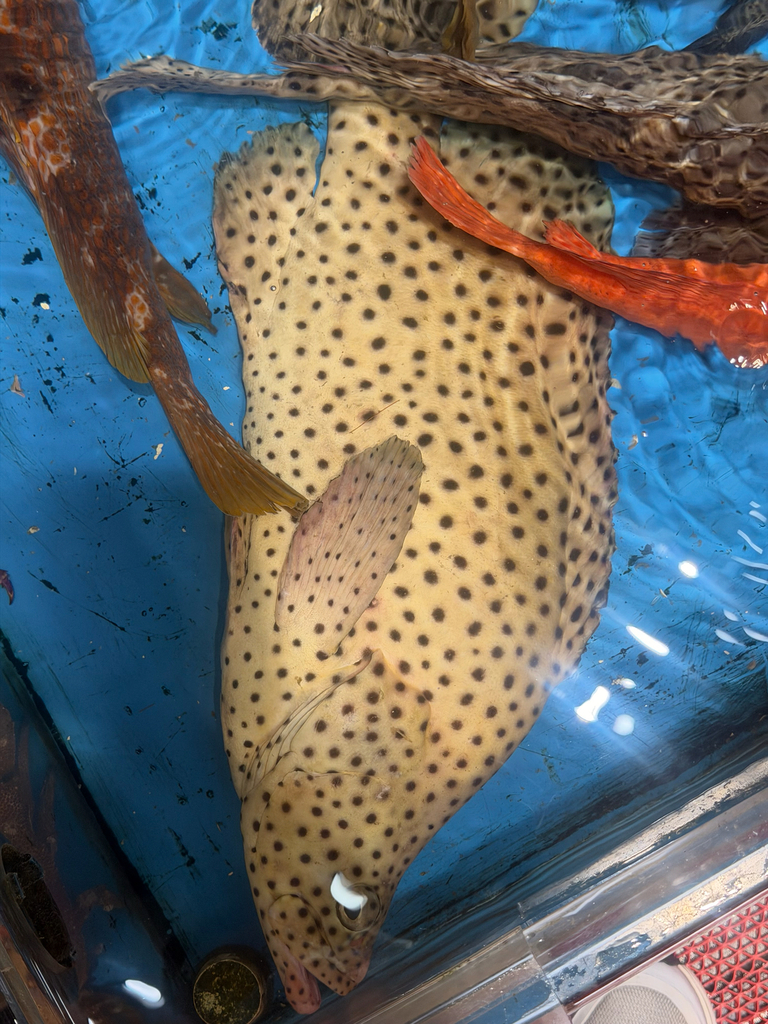
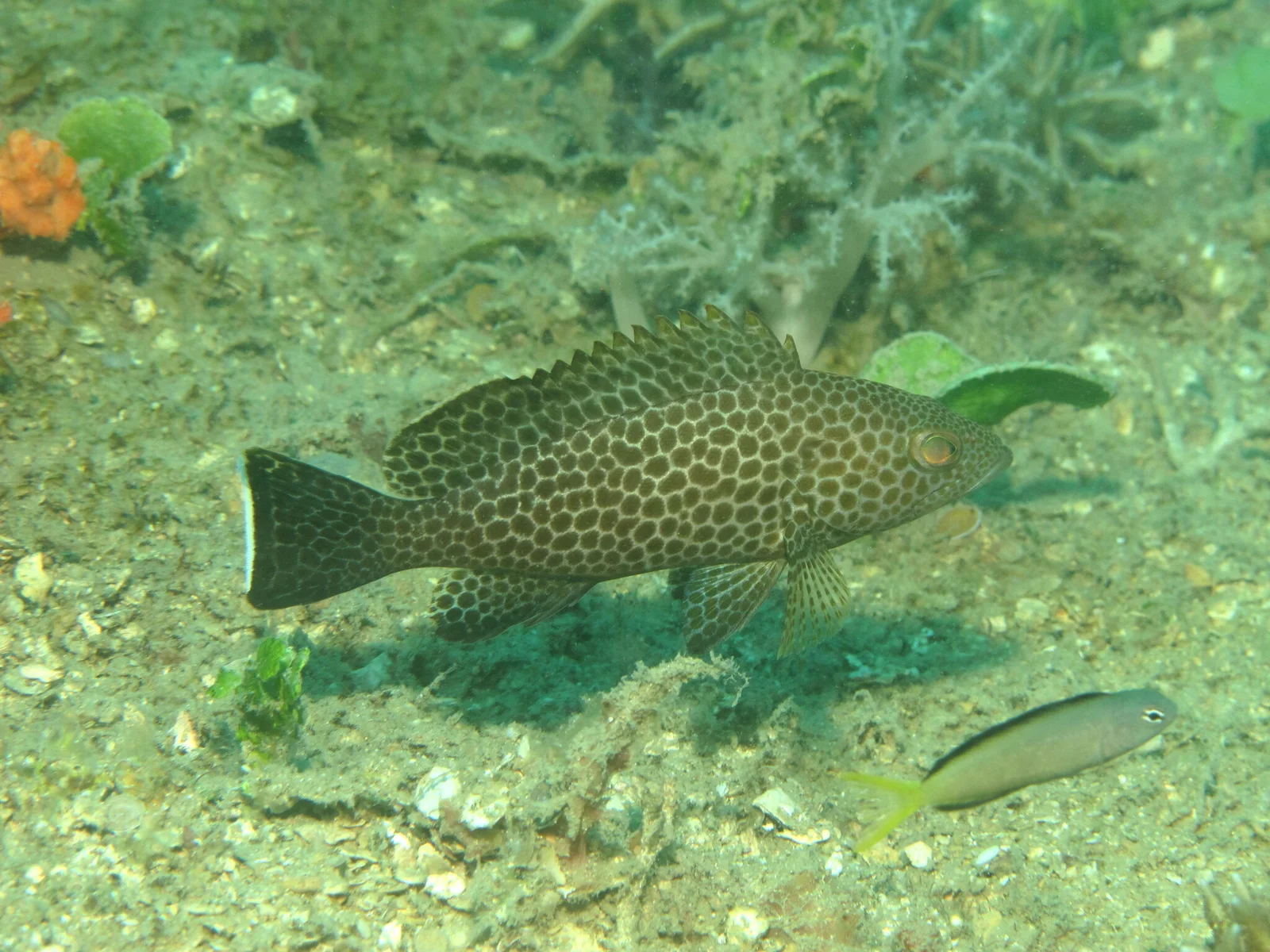
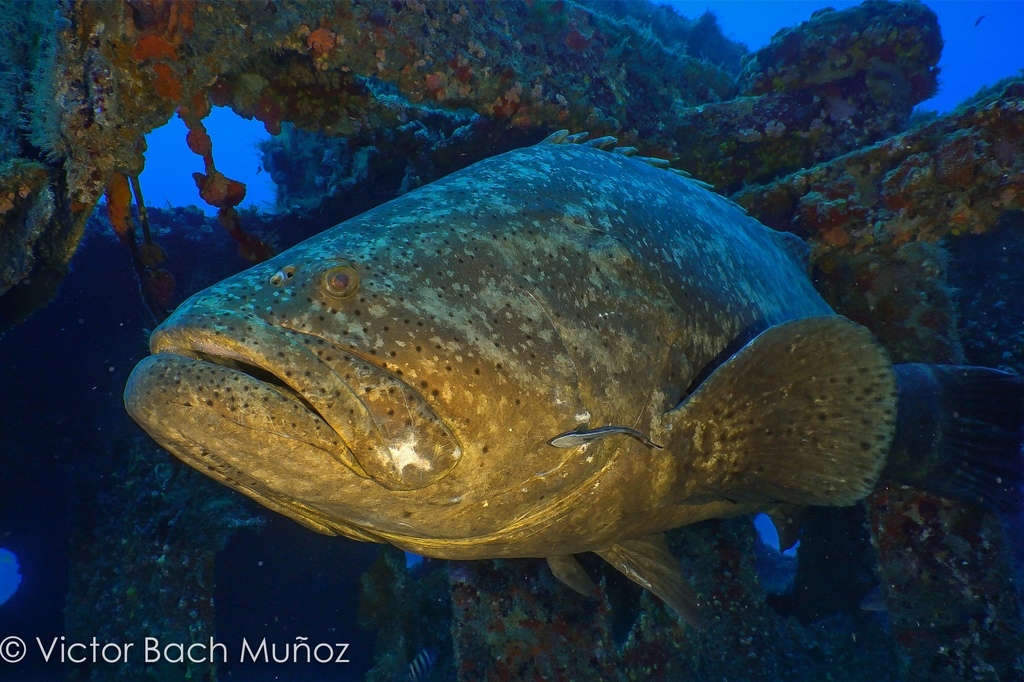
The humpback grouper is a warm-water grouper of the western Pacific, from southern Japan to Palau, Guam, New Caledonia and southern Queensland, Australia; in the eastern Indian Ocean it runs from the Nicobar Islands to Broome, Western Australia. Most western Indian Ocean reports are unsubstantiated, with one Kenyan record considered valid; Hawaiian records are probably released aquarium fish. It is recorded as marine and reef-associated, at 2–40 m, usually 5–25 m, in tropical water from 32°N to 23°S and 88°E to 170°E. FishBase gives a maximum of 70 cm total length and a maturity range starting at 39 cm. IUCN lists it as Data Deficient, assessed on 20 November 2016.
The head that gives the name
The dorsal fin has 10 spines and 17–19 soft rays; the anal fin has 3 spines and 10 soft rays (rarely 9). The head is the giveaway: the anterior part is extremely small against an elevated postorbital region; there are no canines except a very small pair at the front of the upper jaw; the posterior nostril is slit-like; body depth is 2.5–3.0 times in standard length; the eyes are small; the dorsal profile of the head is concave; the caudal fin is rounded. Colour is greenish white to light greenish brown with scattered round black spots on head, body and fins, body spots generally larger than those on the head and fins; about nine large roundish dusky blotches may be present on the body, some extending into the dorsal and anal fin bases. (“rat grouper”) comes from the pointed head, small eye and round spots; head shape reads faster than counting spots.
Western Pacific, with doubtful outliers
FishBase's range is the western Pacific: southern Japan to Palau, Guam, New Caledonia and southern Queensland; eastern Indian Ocean: the Nicobar Islands to Broome, Western Australia. Most western Indian Ocean records are unsubstantiated, with one Kenyan record possibly valid; Hawaiian records may be aquarium releases. The country table includes the Andaman and Nicobar Islands, Australia, Cambodia, China, Fiji, Guam, Hawaii (introduced), Hong Kong SAR, India, Indonesia, Japan, Malaysia, New Caledonia, the Northern Mariana Islands, the Ogasawara Islands, Palau, Papua New Guinea, the Philippines, the Ryukyu Islands, Singapore, Sri Lanka, Taiwan region, Thailand and Vietnam. It generally lives on lagoons and seaward reefs, typically in dead or silty areas, and also around coral reefs and in tide pools; growth is very slow; it feeds on small fishes and crustaceans. GBIF's 1,772 records are led by Australia (704), Indonesia (396), New Caledonia (228), the Philippines (104), Taiwan region (61), mainland China (32), Malaysia (31), Palau (28), Japan (21) and the Solomon Islands (16).
No natural spawning season
FishBase records no spawning months and no water temperature. The only firm frame is the 32°N–23°S tropical band. An artificial spawning trial recorded buoyant eggs of 0.80–0.83 mm with a single oil droplet, with larvae dying seven days after hatching; that is laboratory data, not a natural season. Plan around local temperature and tide. It lives mostly at 5–25 m, so boat and night fishing meet it more often than shore fishing, and dead coral and silty reef bottom are the places to work.
Slow fish, slow bait
Boat bottom fishing is the main method: prawn, crab, fish chunk and whole small fish all work, with a large hook and an abrasion-resistant leader. It eats small fish and crustaceans, so live prawn and small live fish have an edge on the reef. Lures are jighead soft plastics or small metal jigs crawled slowly along the bottom, placed on dead coral, crevices and the hard edge of silt; the fish moves slowly, so slow the lure rather than ripping it. Growth is very slow and large fish should not be kept; pull a hooked fish away from the hole immediately.
Heavy enough for the reef
For the 70 cm maximum, use a medium-heavy boat rod, a 5000–8000 spinning reel, 2–3 braid and a 40–60 lb fluorocarbon leader. It lives around reef and caves, so abrasion resistance matters more than raw strength. Maturity starts at 39 cm, and fish below that have not spawned and should go back. Growth is very slow, so a 39 cm fish may already be old; a 39 cm release line is safer than keeping whatever looks big enough to eat.
A high-value live-food fish
Recorded uses are commercial fisheries, commercial aquaculture and the commercial aquarium trade. It is a high-priced grouper in Hong Kong live-fish markets, and the flesh suits steaming; bleed, gut and ice promptly. Juveniles are commonly collected for the aquarium trade, adults are used as food fish. The threat field says harmless and there is no ciguatera report, but large reef groupers should still follow local advice. Taiwan region manages inshore fishing through Fisheries Agency and local-government closed areas, closed seasons, gear restrictions and minimum sizes, with separate grouper size and closed-season notices. Hong Kong SAR's Fisheries Protection Ordinance regulates methods, marine parks and reserves prohibit angling and collecting, and the live-fish trade is separately regulated. Southeast Asian states differ widely, with Malaysia, Indonesia, the Philippines and Thailand setting size, closed-season and export rules for groupers, and core protected-area zones usually no-take. Because the species is widely farmed, buying cultured fish is safer than an uncertain wild source. Check the current local notice.
What the record leaves open
The page uses FishBase taxonomy, morphology, distribution, environment, biology, reproduction, use, IUCN and threat entries, with the country table for range and GBIF for occurrence. FishBase's current accepted spelling is Chromileptes altivelis; the project keeps Cromileptes altivelis per the master plan and records the accepted spelling as a synonym. iNaturalist uses Chromileptes altivelis, and photos are taken under that taxon. No natural spawning months or water temperature are recorded and no estimates are added. and are local aliases; the formal name is .
How to catch it
Bottom fishing
Fished with the listed approach, matched to the recorded depth and size.
Lure fishing
Fished with the listed approach, matched to the recorded depth and size.
Regulations before you keep it
These are the published regulations for this fish. Read the number first. The notice below it is the actual regulation.
Bag limit1
2 per day (West Coast) · 1 (Abrolhos Islands) · 4 (other bioregions)
Australia — Western Australia · AU-WA
Western Australia allows barramundi cod within the demersal scalefish bag limit: 2 per fisher per day in the West Coast bioregion, 1 at the Abrolhos Islands and 4 in other bioregions.
"Barramundi cod Cromileptes altivelis N/A 2 1 4" (West Coast / Abrolhos Islands / other bioregions)
Protected species1
No take
Australia — Queensland · AU-QLD
Queensland prohibits taking barramundi cod.
Queensland uses the common name barramundi cod; species.json lists Cromileptes altivelis as Humpback grouper with Barramundi cod as an alias.
Barramundi cod | No take | No take
Every record above names its source and the date it was retrieved. See the regulation register for the full list, or how to read these regulations.
Where these facts come from
Check these pages before you rely on a size, range or protection status.
-
FishBase — Cromileptes altivelis
— FishBase · T2
-
GBIF — Cromileptes altivelis occurrence records
— GBIF · T2
-
IUCN Red List — Cromileptes altivelis
— IUCN · T1
-
Photo record — iNaturalist
— iNaturalist · T3