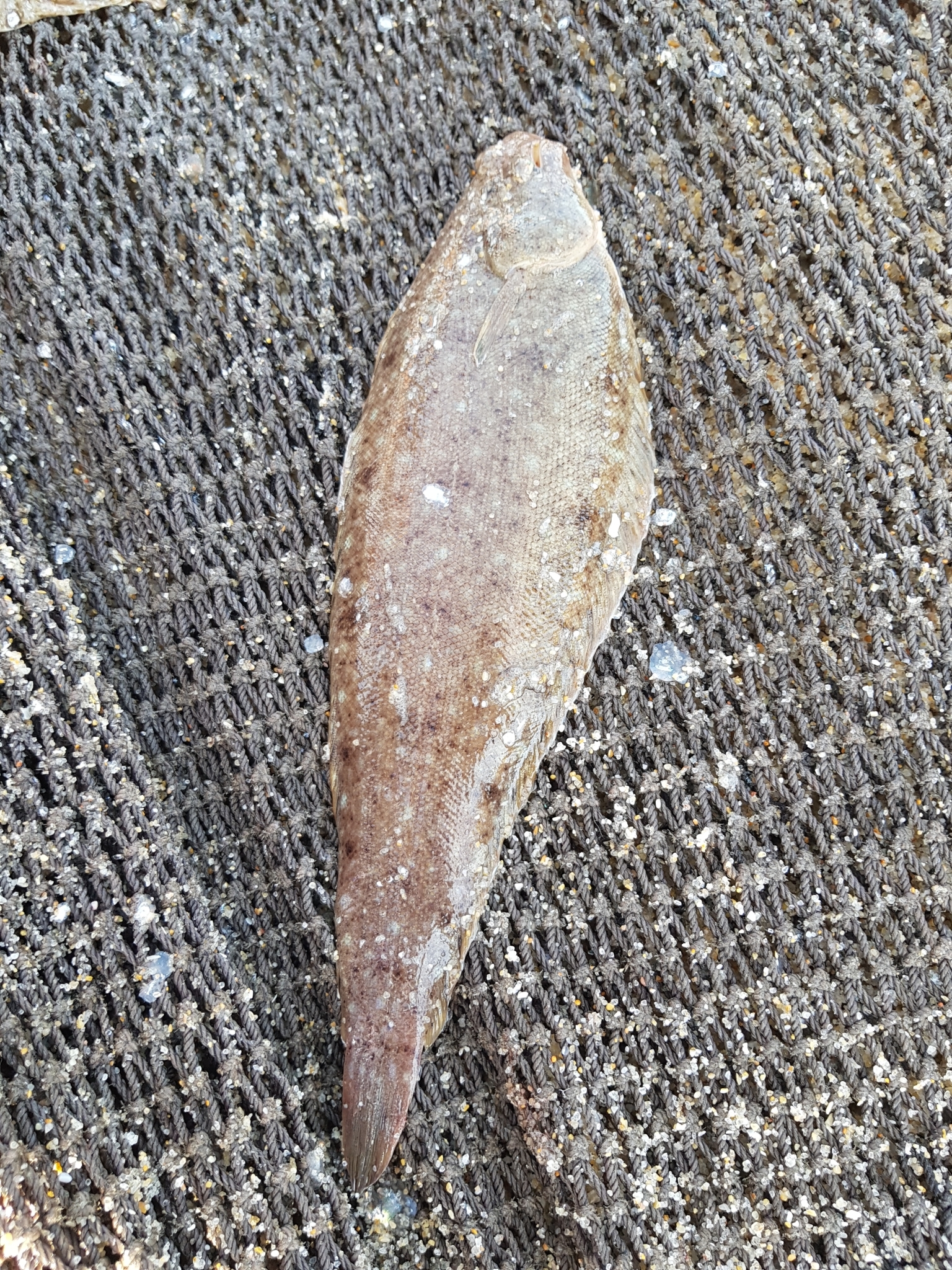
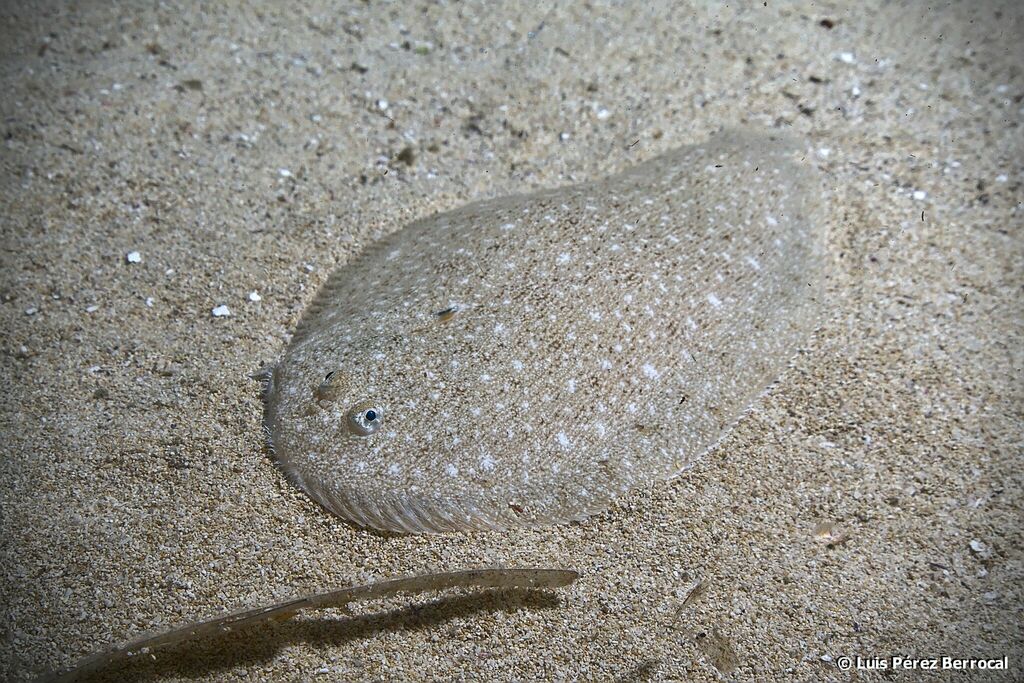
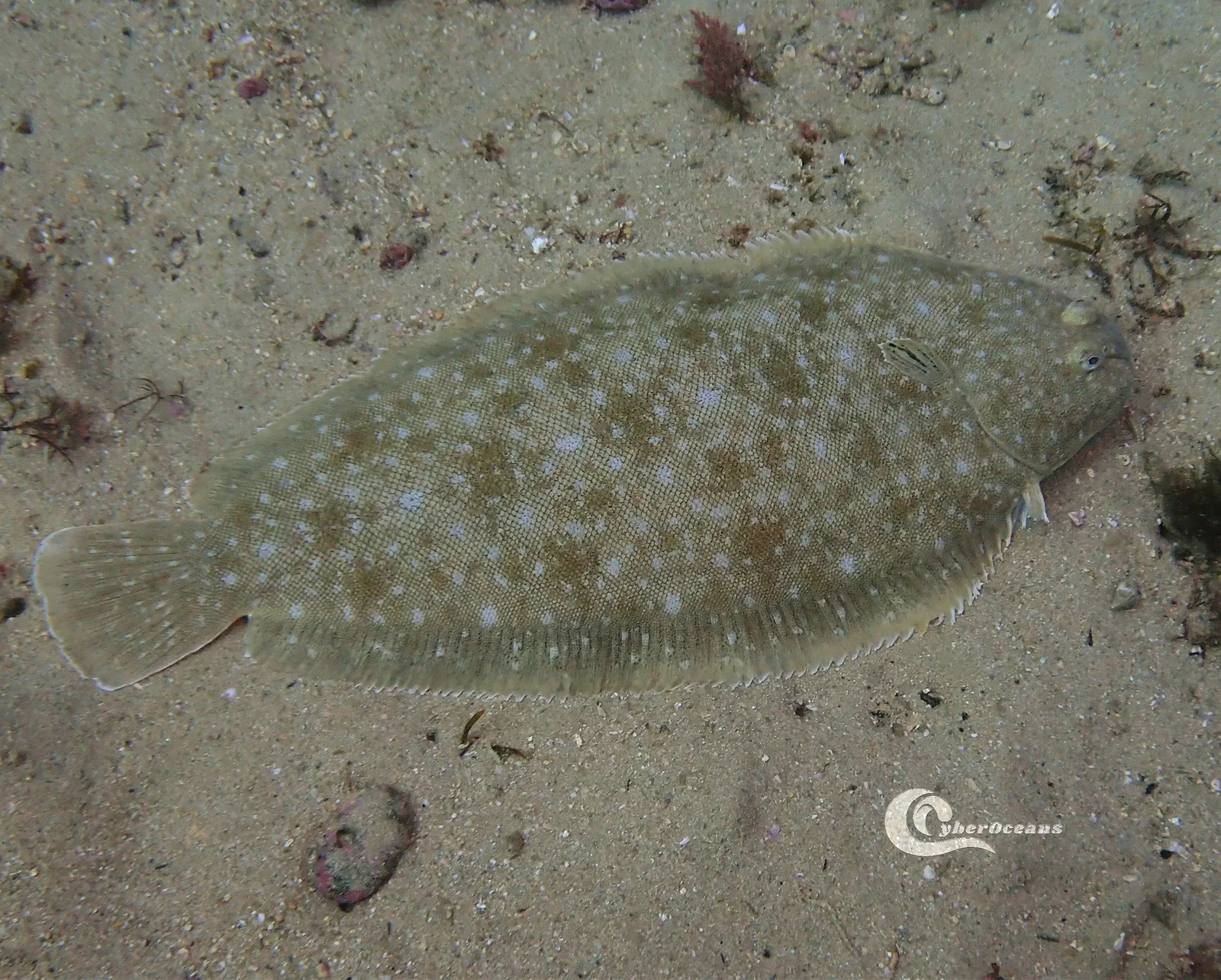
The wedge sole is a small sole of the eastern Atlantic and the western Mediterranean, recorded from the Bay of Biscay south to the Cape of Good Hope. FishBase gives a maximum length of 30 cm SL, a common length of 20 cm TL and a length at first maturity of 17.1 cm, with a listed range of 17–19.9 cm. It lives on sand and sand-mud from 10 m down to 460 m, usually 10–150 m. It is commercial, but boat and shore anglers fishing for flatfish take it regularly.
Identification
Soles are flatfish with both eyes on one side of the head and a small, asymmetric mouth. Dicologlossa cuneata has 81–90 dorsal soft rays and 65–77 anal soft rays, no anal spines, and 43–45 vertebrae. FishBase's short description calls the body short and deep, brownish grey with small dark spots, with blackish pectoral fins edged pale. The outline is wedge-like: deepest behind the head, tapering to the tail, which gives the English name.
The counts separate it from Solea solea, but counting rays on a live fish is impractical. In the hand, look for the wedge outline, the spotted brownish upper surface and the dark pectoral with a pale edge, then confirm against photographs and a regional key before keeping the fish.
Habitat and behaviour
It inhabits mainly sandy or sand-mud bottoms, and FishBase gives a range from 10 m to 460 m, usually 10–150 m; the species is recorded as marine and brackish, demersal and subtropical. It feeds on a wide range of small bottom-living animals, mainly crustaceans, polychaete worms and bivalve molluscs, so it works the surface layer of the sediment rather than hunting fish. Reproduction is oviparous, with pelagic, non-adhesive eggs.
That diet points to clean sand and soft mud holding worms and small bivalves, not rough ground, and to baits that sit still or move slowly along the bottom.
Seasonal window
The spawning records are regional rather than a single season. FishBase lists January–April and December off the Atlantic coast of Morocco, March–June off central Portugal, June–September in the Bay of Biscay, January–April off the Mediterranean coast of Algeria, and January–May plus November–December in the Gulf of Cadiz. Across all records the months run from January to September and again in November and December.
Those are spawning records, not a promise of fish. The recorded spawn falls in summer in the Bay of Biscay, spring in Portugal, and across winter and spring in the Gulf of Cadiz, so the local picture changes with latitude. What holds is that soles feed best in cool, moving water and over ground that has not been stirred flat: night tides and the first of the flood are usually better than a bright, still afternoon. Big swells and rain that colours the shallows tend to shut it down.
Gear and approach
A light to medium boat rod, a 4000–6000 size reel, 15–20 lb braid and a long, soft fluorocarbon leader of 10–15 lb make a workable sole outfit. Braid lets you feel a sole's soft take, often no more than a slight weight. Use a running ledger or one-hook paternoster with 1–3 oz, enough to hold bottom but light enough to lift and reset. Hook sizes 1 to 2/0 suit the small mouth, and long-shank hooks help with deep takes.
Bait: lugworm and ragworm, a strip of squid, small mussel or clam flesh, and a thin strip of fish belly. Soles are not aggressive feeders, so a bait that stays put and smells is better than one that is constantly moved. Lift the rod tip slowly, feel for weight, and strike with a steady sweep rather than a hard jerk. After dark from shore, with the bait beyond the first gutter, is the simplest way to catch them without a boat.
Edibility and regulations
FishBase records the species as a commercial catch; it is a valued food fish in Spain, Portugal and France, usually fried or grilled whole. Keep it cold and clean it promptly; sole deteriorates quickly.
The IUCN Red List category is LC (Least Concern), assessed on 29 June 2021. No CITES or CMS listing is recorded and the species is harmless to humans.
Regulations are jurisdiction-specific. In EU waters there is no minimum conservation reference size listed for Dicologlossa cuneata, no EU-wide closed season verified and no EU-wide recreational bag limit verified; a TAC for Pleuronectiformes exists, but commercial and recreational rules differ. Portugal's DGRM table lists a 24 cm minimum for Solea spp., but wedge sole is a different genus: do not apply that 24 cm figure to this species without confirming the current DGRM table. In Spain (autonomous-community rules) and France (DDTM/OFB) no species-specific minimum was verified; check national and regional rules before keeping fish.
Where to look
GBIF holds 7,377 occurrence records, with France (4,377), Spain (1,803) and Portugal (315) leading, followed by Nigeria (118), Gabon (80) and Ghana (75). FishBase's distribution runs from the Bay of Biscay and the Mediterranean to the Cape of Good Hope, and the habitat keywords are sandy, muddy and open-water.
Those records track survey and fleet effort along the shelf as much as the fish. Fish sand and sand-mud in the 10–150 m band, along depth contours and off estuary mouths, and treat the deeper end of the range as a boat-only proposition.
How to catch it
Boat bottom fishing
Fished with the listed approach, matched to the recorded depth and size.
Shore casting
Fished with the listed approach, matched to the recorded depth and size.
Regulations before you keep it
These are the published regulations for this fish. Read the number first. The notice below it is the actual regulation.
Minimum size2
The minimum size for Wedge sole in Spain is ≥15 cm.
| Acedia (Dicologoglossa cuneata) | 15 |
The minimum size for Wedge sole in Portugal is ≥15 cm.
Língua (Dicologlossa cuneata) | 15 cm
Every record above names its source and the date it was retrieved. See the regulation register for the full list, or how to read these regulations.
Where these facts come from
Check these pages before you rely on a size, range or protection status.
-
FishBase — Dicologlossa cuneata
— FishBase · T2
-
GBIF — Dicologlossa cuneata occurrence records
— GBIF · T2
-
IUCN Red List — Dicologlossa cuneata
— IUCN · T1
-
Photo record — iNaturalist
— iNaturalist · T3