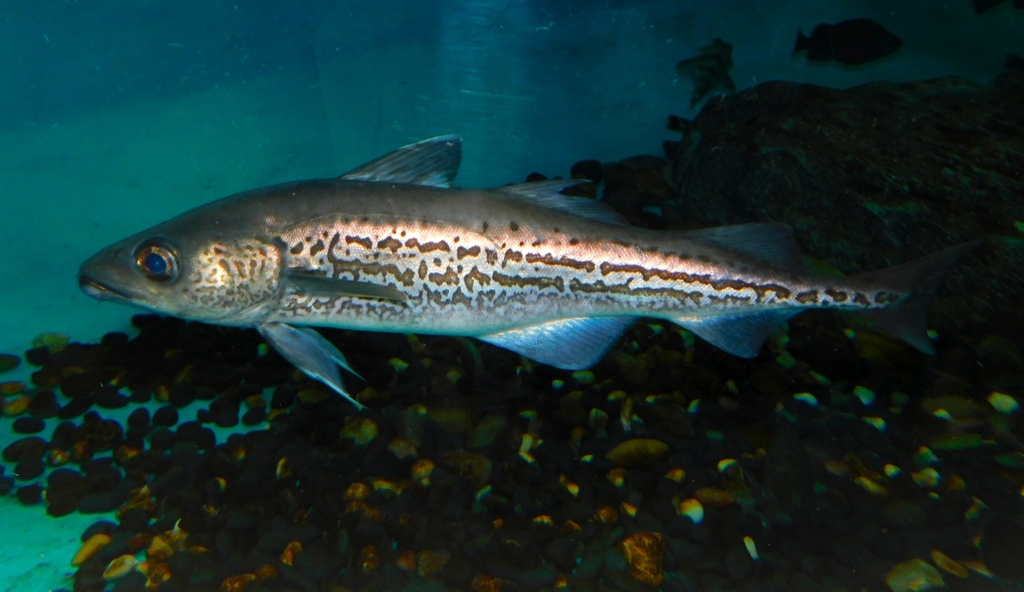
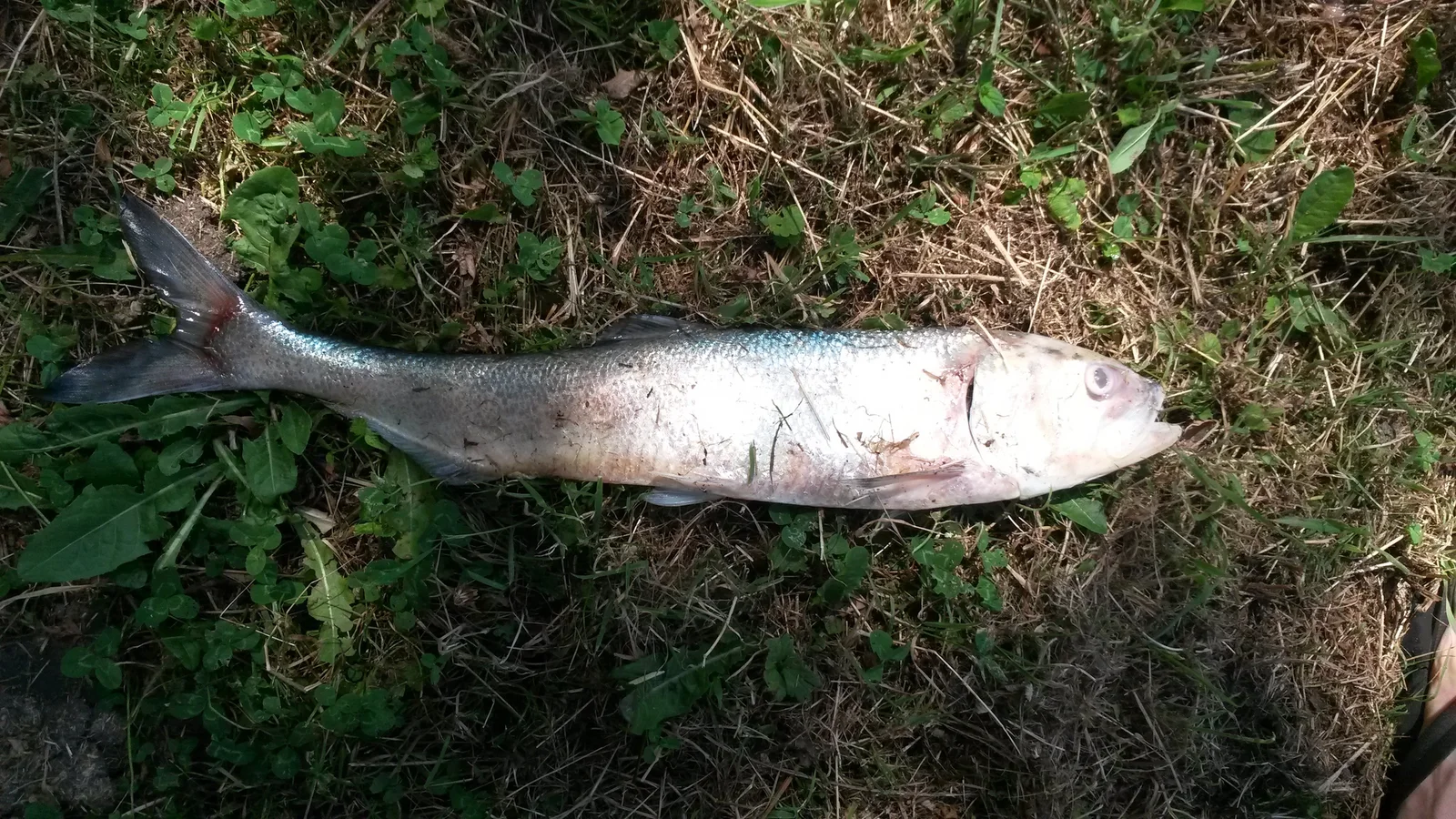
European anchovy (Engraulis encrasicolus) is a fish of the family Engraulidae. FishBase gives its range as: Eastern Atlantic: Bergen, Norway to East London, South Africa. Also all of Mediterranean, Black and Azov seas, with stray individuals in Suez Canal and Gulf of Suez; also recorded from St. Helena. Reported from Estonia. It is recorded from 0 to 400 m, in subtropical water. The recorded maxima are 20 cm SL, 5 years. Diet includes fishes and zooplankton. IUCN status: Least Concern (LC). Chinese name: .
Identification
The ruler in this record is standard length: 20 cm SL maximum, 13.5 cm SL common. Standard length stops at the base of the tail, so a 20 cm SL anchovy is a larger animal than a 20 cm total-length measurement would suggest. Maturity is reached somewhere between 9 and 14 cm SL, which means a 10 cm fish is not automatically a juvenile; judge the school by its size grade, not by an assumption that small equals young. Maximum reported age is five years.
The 13.5 cm figure is the one to carry to the tackle box. It is the ordinary adult in the school, and it sets the hook size that will hold a fish without tearing a 9 cm one apart.
Habitat and distribution
The tag set is marine and brackish, pelagic-neritic, oceanodromous, 0 to 400 m, subtropical from 62°N to 37°S. The 400 m is a recorded depth, not a fishing depth: this is a surface-school fish, and the water that matters is the top few metres. The written range runs from Bergen in Norway to East London in South Africa, through the whole Mediterranean, Black and Azov seas, with strays in the Suez Canal and a population at St. Helena.
GBIF's 39 distribution rows include national checklists from Norway and Denmark south to Israel, Mozambique, Mauritius and the Seychelles. iNaturalist holds 244 observations. OBIS returns 23,138 records, making this one of the most heavily recorded small pelagics in the eastern Atlantic.
Season and fishing approach
Spawning records are grouped by area. The Adriatic runs May to October, the Bay of Biscay March to August, the Gulf of Cadiz March to November, the northwestern Black Sea May to August, the North Sea June to August, and the Moroccan coast nearly all year. The southern stocks start earlier and run longer; use the row for your own coast.
Fish the surface school, not the bottom. A sabiki or feather rig with hooks matched to the 13.5 cm common length, a light rod and a small sinker are enough; the fish come to chum and to the tide line. Because the species is oceanodromous, the school that is here this week may be somewhere else the next. When you are collecting bait rather than food, take the 13.5 cm grade and leave the 9 cm fish to grow.
Edibility and regulations
FishBase records highly commercial fishing and usual use as bait. The assessment dates from 23 May 2013 and carries LC. Both facts point the same way: this is a stock managed as a fishery, and the rule that applies is the one set by the coastal state or regional body for the water you are in.
Read the definition of length in that rule before you measure. A limit written in total length and a limit written in standard length are not the same number, and a fish measured the wrong way can be legal on one side of a border and short on the other.
Regulations before you keep it
These are the published regulations for this fish. Read the number first. The notice below it is the actual regulation.
Minimum size6
≥12 cm (≥10 cm in ICES division IXa)
Spain · ES
The minimum size for European anchovy in Spain is ≥12 cm (≥10 cm in ICES division IXa).
| Boquerón (Engraulis encrasicholus) | 12 (**) |
The minimum size for European anchovy in Spain is ≥9 cm.
| Boquerón (Engraulis encrasicholus) | 9 |
The minimum size for European anchovy in France is ≥12 cm.
| ANCHOIS | Engraulis encrasicolus | 12 cm |
The minimum size for European anchovy in France is ≥9 cm.
| ANCHOIS | Engraulis encrasicolus | 9 cm |
The minimum size for European anchovy in Portugal is ≥12 cm.
Biqueirão (Engraulis encrasicolus) | 12 cm
≥12 cm (or 90 individuals/kg) · ≥10 cm in ICES division IXa east of 7°23′48″W
United Kingdom · UK
The minimum size for European anchovy in UK waters is ≥12 cm (or 90 individuals/kg) · ≥10 cm in ICES division IXa east of 7°23′48″W.
| Anchovy | Engraulis encrasicolus | Whole area, except ICES division IXa east of longitude 7° 23′ 48″ W: 12 cm or 90 individuals/kg. ICES division IXa east of longitude 7° 23′ 48″ W:10cm |
Every record above names its source and the date it was retrieved. See the regulation register for the full list, or how to read these regulations.
Where these facts come from
Check these pages before you rely on a size, range or protection status.
-
FishBase — Engraulis encrasicolus
— FishBase · T2
-
GBIF — Engraulis encrasicolus occurrence records
— GBIF · T2
-
IUCN Red List — Engraulis encrasicolus
— IUCN · T1
-
Photo record — iNaturalist
— iNaturalist · T3