
Rooster hind
Rooster hind is an epinephelid of the eastern Pacific, from southern California in the United States south to Peru. It lives from 46 to 90 m in subtropical water and reaches 100 cm TL, a large size for a hind.

Rooster hind (Epinephelus acanthistius) is a fish of the family Epinephelidae. FishBase gives its range as: Eastern Pacific: southern California in the USA, south to Peru. Dorsal soft rays number 16–18, with three anal spines plus eight soft rays, on a fusiform, compressed body. It is recorded from 46 to 90 m, in subtropical water. The recorded maximum is 100 cm TL. IUCN status: Vulnerable (VU). Chinese name: .
Identification
The page name and the registry name do not agree. FishBase serves this species under Hyporthodus acanthistius, while the batch list and this article's registry carry Epinephelus acanthistius; WoRMS accepts Hyporthodus acanthistius at AphiaID 475097. One fish, two genus placements: the binomial in the text and the binomial in the FishBase URL differ by design.
What the sources do give is a fin formula and a ceiling. Dorsal soft rays number 16–18, with three anal spines plus eight soft rays, on a fusiform, compressed body. Maximum length is 100 cm TL; weight, common length, maturity length and maximum age are all missing. WoRMS repeats the 100 figure as a "body size" attribute taken from Heemstra and Randall's 1993 FAO catalogue — the same ceiling restated, not an independent measurement.
The English names split on the same fault line. "Gulf coney" is the AFS entry for the United States; "Rooster hind" is the FAO global entry. iNaturalist's preferred name is "Rooster Hind" and its taxon 103154 holds 36 observations. The Chinese list gives as the FAO name and as a vernacular.
Habitat and distribution
The range runs from southern California to Peru, and the country table carries eleven territories, from Colombia and Costa Rica through Mexico and Panama to Peru, with the contiguous United States also listed. Its environment line is marine and demersal in subtropical water, 33°N to 10°S and 116°W to 78°W, at 46–90 m. The habitat keywords are "sandy" and "coastal". Spawning months and diet keywords are both absent from the record, so the only positional material is the depth band and those two substrate words.
OBIS returns 113 records in 16 datasets, dated 1889 to 2026. Those years point to museum lots and survey trawls, not angling logs: the set shows where specimens were taken, not where a line finds fish.
Season and fishing approach
The list of blanks is the method. Weight, common length, maturity length, maximum age, spawning month, diet keyword and gamefish entry are all absent — seven gaps that remove the usual advice about season, size and bait. What remains is 46–90 m and sand.
That band is deep for a grouper: the fish sits below the zone where most reef work is done, so the approach is a boat with a sounder, a bottom rig and a sand patch, not a shallow cast onto coral. Because the species is demersal, the bait should rest on or just above the sand rather than drift through midwater.
WoRMS records sound production as "likely to produce sound under natural conditions but unconfirmed". Listening is worth a try, but not worth building a trip around. The 36 iNaturalist observations are photographic records, and no source here splits them by depth.
Edibility and regulations
The only use entry is minor commercial landings — no gamefish line, and neither aquaculture nor the aquarium trade. Its Red List status, assessed 18 November 2016, is Vulnerable. That is a conservation judgement; on a page whose only other number is 100 cm, it is easily mistaken for a taking rule.
Eleven territories appear in the country table, from Colombia and Costa Rica to Peru and the United States. The table records presence and stops there: it carries no daily bag, no closed season and no minimum length, and it names no fisheries authority for any of the eleven. With a Vulnerable listing and nothing but minor commercial landings on the record, the honest reading is that this is not a recreational target, and any legal take would have to be confirmed in the country where the boat is registered.
Where these facts come from
Check these pages before you rely on a size, range or protection status.
- FishBase — Epinephelus acanthistius — FishBase · T2
- GBIF — Epinephelus acanthistius occurrence records — GBIF · T2
- IUCN Red List — Epinephelus acanthistius — IUCN · T1
- Photo record — iNaturalist — iNaturalist · T3
Fish in the same water
These fish live in the same place.
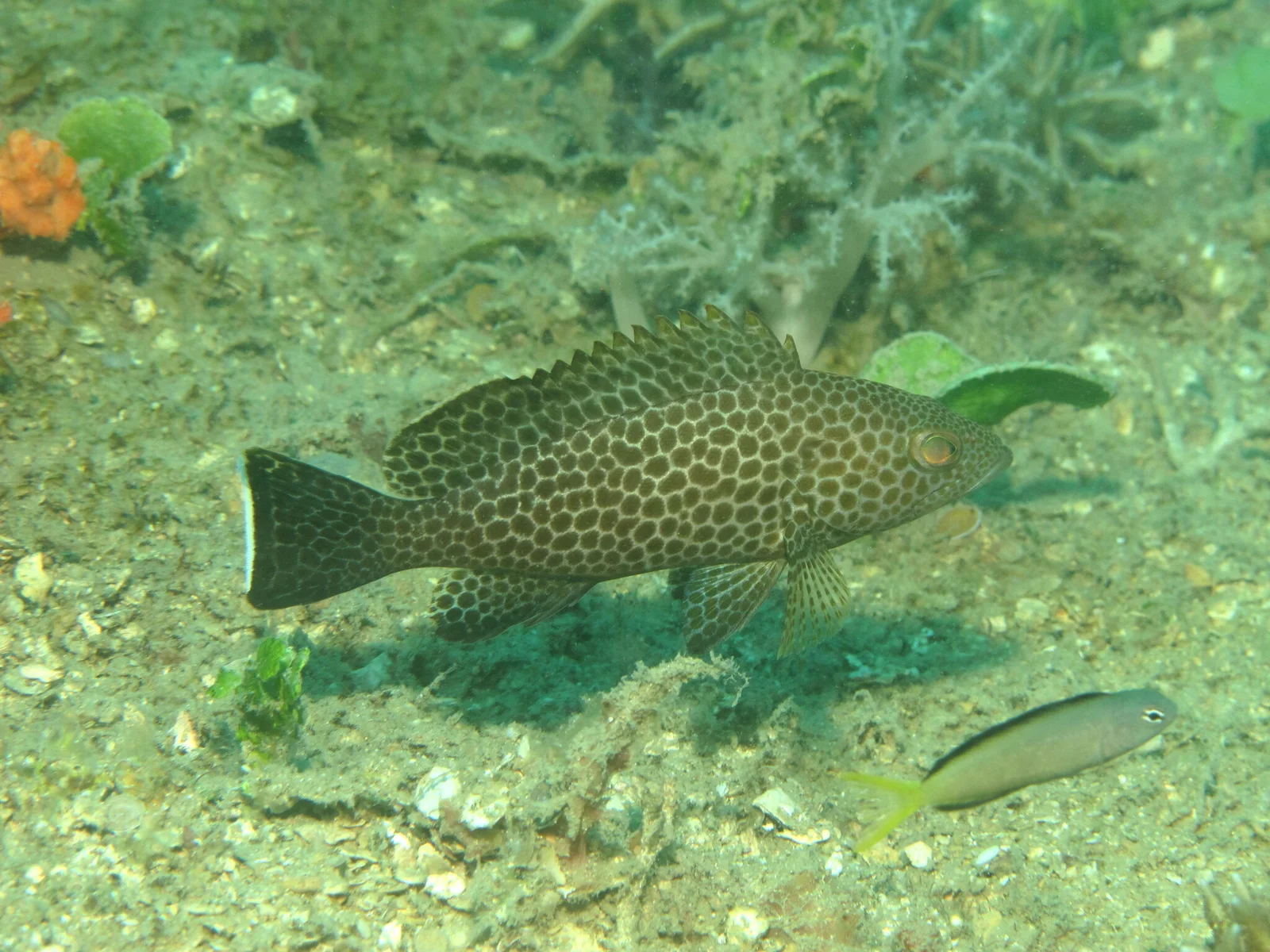
Areolate grouper
- Family
- Epinephelidae
- Depth
- 6–200 m
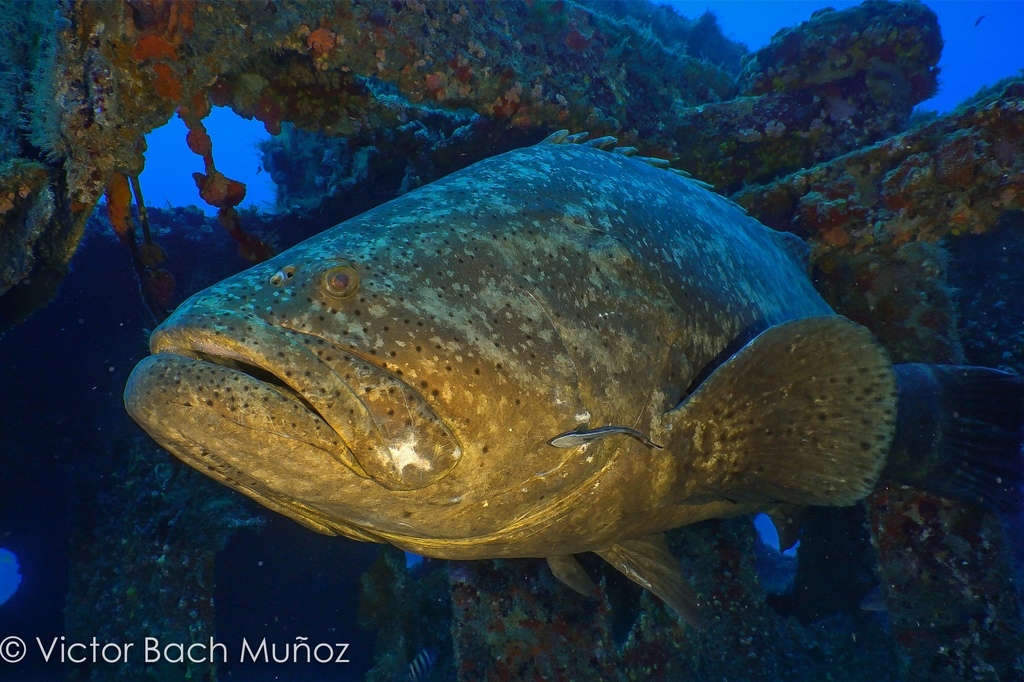
Atlantic goliath grouper
- Family
- Epinephelidae
- Depth
- 0–100 m
- Season
- Jan, Feb, Jun, Jul, Aug, Sep

Black grouper
- Family
- Epinephelidae
- Depth
- 60–250 m
- Season
- Jan, Feb, Mar, Apr, May, Jun, Jul, Aug, Sep, Oct, Nov, Dec
Guides for this water
Technique, gear and safety guides that fit Rooster hind.