
White grouper
White grouper is a fish of moving salinity before it is a fish of any one rock. The record runs from estuary mud to the 200 m shelf edge and calls the species oceanodromous, so the first decision is where on that gradient the boat is working — find the water, then find the structure.
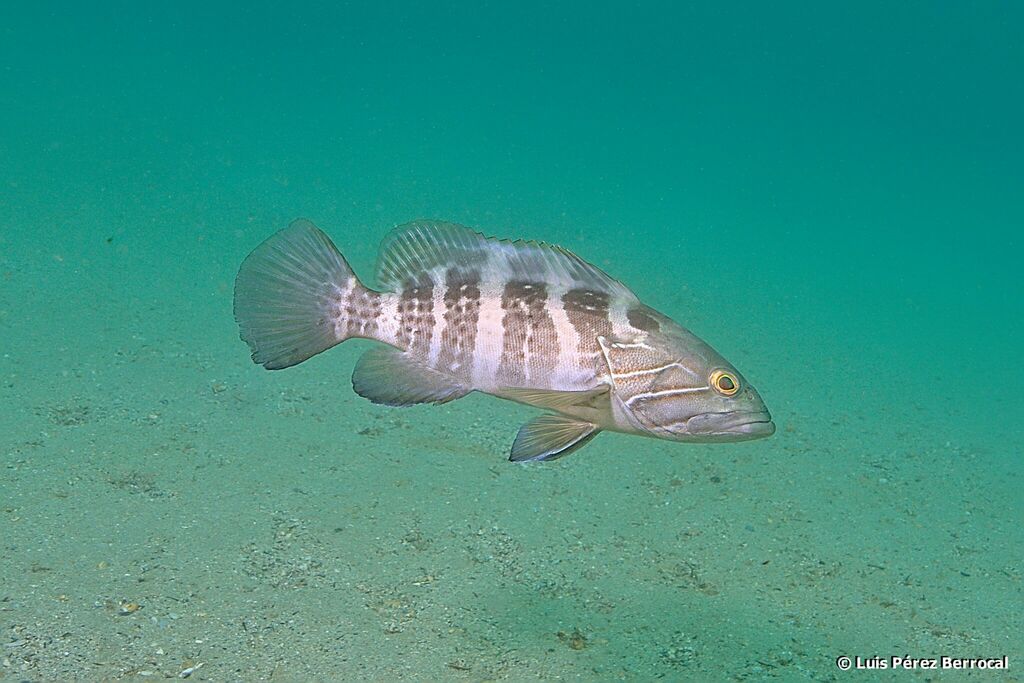
White grouper is a fish of moving salinity before it is a fish of any one rock. The record runs from estuary mud to the 200 m shelf edge and calls the species oceanodromous, so the first decision is where on that gradient the boat is working — find the water, then find the structure. A 60 cm common length is the plan and the 120 cm ceiling is the exception, which puts circle hooks and a release tool in the standard kit.
Identification
The environment line for this fish says brackish and oceanodromous in the same breath. Those words are not decoration. They place the species on a salinity gradient that runs from estuary and coastal water at one end to the 200 m shelf edge at the other, and they make the usual grouper question — which rock? — the wrong first question. Here you read the water before you read the bottom.
The recorded ceiling is 120 cm and 25 kg, and the common length is 60 cm. First maturity sits between 50 and 60 cm. That gives a release line with a clear lower edge: under 50 cm the fish has not yet reproduced, so it goes back without an argument; by 60 cm it is mature and the question becomes legal rather than biological.
The spiny dorsal section has 10 or 11 spines, followed by 14 to 16 soft rays; the anal fin combines three spines with seven to nine soft rays. The English name is white grouper, with common white grouper and seaperch as alternatives. "White" is not a field mark on its own; the fin counts and the head profile are what separate it from the other pale groupers on the same coast.
Habitat and behaviour
The habitat list is rocky, sandy and muddy bottom, estuary and coastal. Read as a gradient rather than a list, it describes a shelf that changes with distance from land: mud and estuarine influence inshore, sand and rock farther out, and a fish that moves across the whole sequence. The environment line's "oceanodromous" is the part that confirms movement rather than a stationary life on one patch.
Its prey list runs to fishes and molluscs. That is a bottom-oriented offer, and it fits a demersal fish that feeds where the substrate changes. The 20 m shallow end is already boat water in most places; the 200 m end is beyond recreational range. The usable band is the upper half, and it is wider than a reef mark because the bottom itself changes.
Seasonal window
The one dated spawning record is the southeastern Mediterranean, March to May. That is a real window, but it belongs to the eastern Mediterranean, not to the whole range. The Atlantic coast from West Africa to Angola is a different water mass with a different calendar, and transplanting a Mediterranean month onto it is guesswork. Where the March-to-May record applies, it is the period to avoid removing spawners; where it does not, the local authority is the only source of a season.
The rest of the year is set by water and access. Because the fish crosses a salinity gradient, rain matters: a flooded estuary pushes turbid, low-salinity water offshore, and the gradient moves with it.
Gear and approach
A 60 cm common length sets the default: medium-heavy rod, 40 lb leader, and enough sinker to hold bottom in 40–60 m of water. The 120 cm ceiling is the exception, not the plan. Circle hooks and a dehooker are standard because a large share of the catch will be below the release line.
That release line should be set above the legal one. The record puts first maturity at 50 to 60 cm, while the Mediterranean minimum is 45 cm. A fish at 46 cm is legal to keep and has probably not spawned. The rule allows it; the biology argues against it. When the two disagree, the higher line is the one that keeps the spawning stock intact.
Edibility and regulations
The European Commission's species page records a minimum conservation reference size of 45 cm total length for white grouper in the Mediterranean, under Regulation (EU) 2015/812. That is the keep instrument: it decides whether a fish may go in the box, not whether the trip is allowed. A closed season, where one exists, is a separate rule.
Near Threatened is the Red List category, from an 18 November 2016 assessment. On the use side the page names commercial fishing, experimental aquaculture and gamefishing. The distribution table lists 41 countries and territories, and that is a range rather than a rulebook: the Mediterranean minimum above is one jurisdiction's answer, and each Atlantic state sets its own.
Where to look
GBIF's distribution list holds nine entries for the taxon: Eastern Atlantic, Afrotropical, Palaearctic, a global outline, European Marine Waters, country records for Benin, Greece and Israel, and a freshwater assessment. That last record does not fit a marine grouper and is a useful warning about how loosely these declarations are drawn. The written range is the West African coast to southern Angola, including the southern Mediterranean, with a first Corsican record in 2012 and unsubstantiated Canary Islands and Cape Verde reports. iNaturalist holds 272 observations under taxon 68118.
Look on the 20–60 m shelf, at the boundary between muddy inshore water and sand or rock farther out, and look after rain has moved the gradient. In the Mediterranean, the March-to-May window is the one to leave alone.
Where the gradient ends
The white grouper is a single species with two ends that behave differently. At the inshore end, brackish water and mud; at the offshore end, sand, rock and 200 m. The law draws its line at 45 cm, the biology draws its line at 50 cm, and the two do not coincide. An angler who follows the legal number alone keeps fish that have not spawned; an angler who follows the biological number alone may be below the legal floor in some jurisdictions. The honest position is to release at the higher of the two, and to check which end of the gradient — and which country — the trip is in.
Where these facts come from
Check these pages before you rely on a size, range or protection status.
- FishBase — Epinephelus aeneus — FishBase · T2
- GBIF — Epinephelus aeneus occurrence records — GBIF · T2
- IUCN Red List — Epinephelus aeneus — IUCN · T1
- Photo record — iNaturalist — iNaturalist · T3
Fish in the same water
These fish live in the same place.
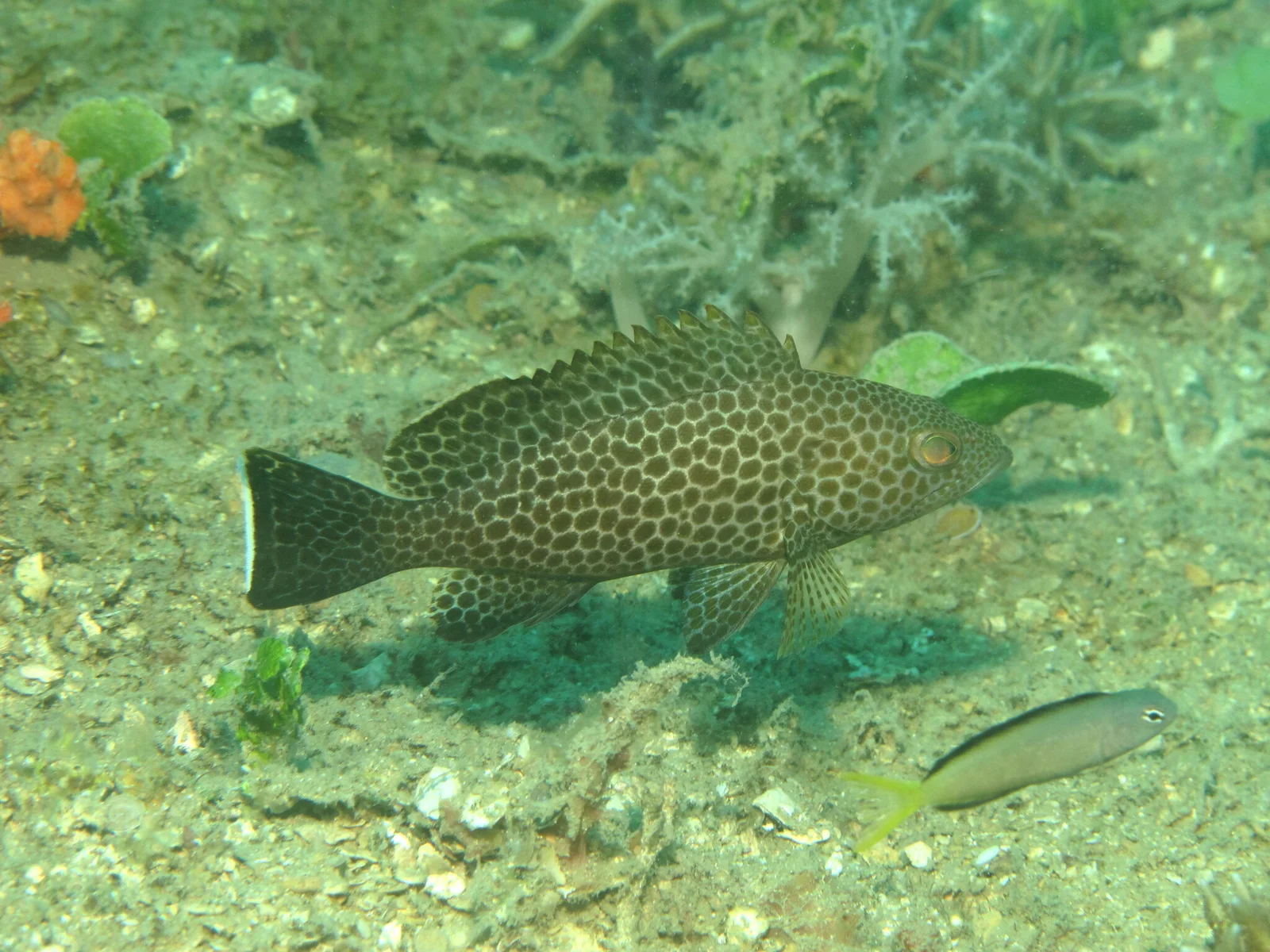
Areolate grouper
- Family
- Epinephelidae
- Depth
- 6–200 m
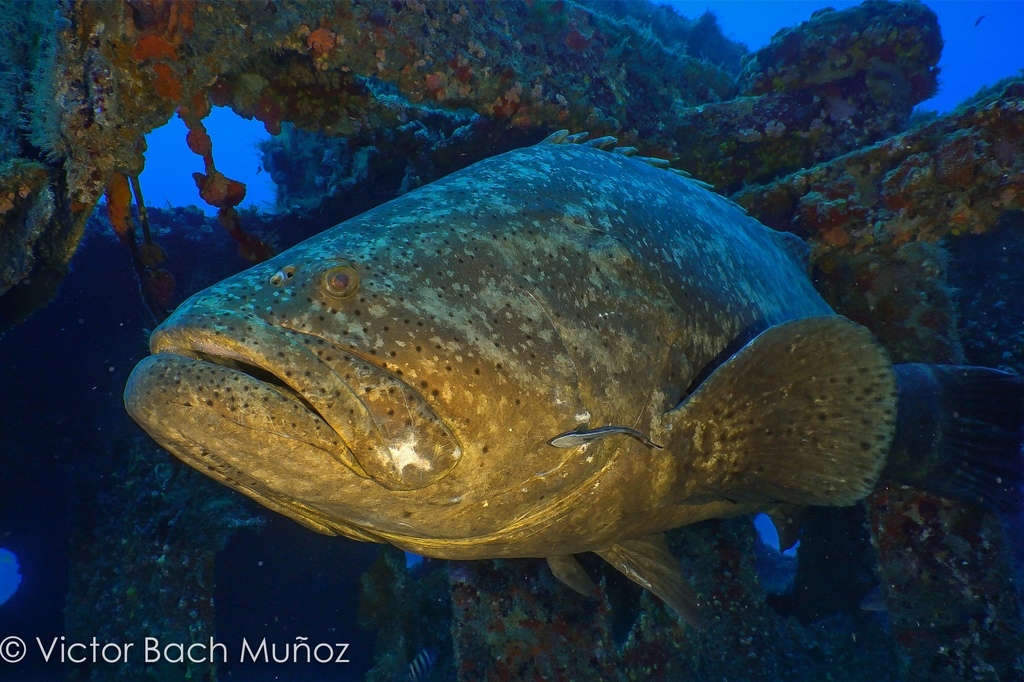
Atlantic goliath grouper
- Family
- Epinephelidae
- Depth
- 0–100 m
- Season
- Jan, Feb, Jun, Jul, Aug, Sep

Black grouper
- Family
- Epinephelidae
- Depth
- 60–250 m
- Season
- Jan, Feb, Mar, Apr, May, Jun, Jul, Aug, Sep, Oct, Nov, Dec
Guides for this water
Technique, gear and safety guides that fit White grouper.