
Longtooth grouper
Longtooth grouper is a large epinephelid of the northwest Pacific, from Korea and Japan to China, Hong Kong, Hainan and Taiwan. It lives from 20 to 200 m in tropical water and reaches 136 cm TL and 33 kg. It is a deep reef species.
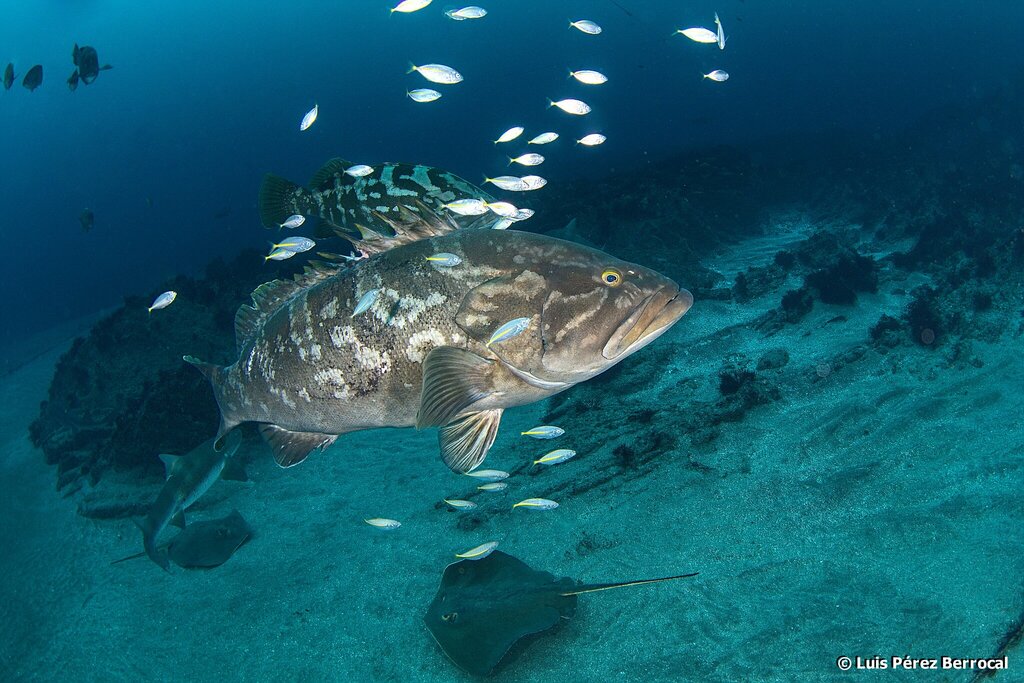
Longtooth grouper (Epinephelus bruneus) is a fish of the family Epinephelidae. FishBase gives its range as: Northwest Pacific: Korea, Japan (north to Hegura-jima Island), China (south to Hong Kong and Hainan Island), and Taiwan. It is recorded from 20 to 200 m, in tropical water. The recorded maxima are 136 cm TL, 33 kg. IUCN status: Vulnerable (VU). Chinese name: .
Two bottoms in one sentence
"Inhabits rocky reefs; also found on muddy grounds". The order matters: rock is the primary description, mud is the addition. A reef is a fixed, visible structure; a muddy ground is a soft, featureless one. An ambush fish on rock can be located by reading relief; an ambush fish on mud has to be located by depth, current and the edges where mud meets something harder. The page never states which bottom the larger fish prefer, so both are kept.
Twenty metres to two hundred
The depth field gives 20–200 m. The entry gives no usual-depth qualifier, so the whole band stands. The only size-related depth statement is that juveniles occur in shallow water, which places the young fish near the top of the range and says nothing about where the 60 cm common fish sits. The 20 m lower bound also excludes the shallowest rock, so a juvenile described as "shallow" could sit above the recorded adult band, and the source does not reconcile the two. The 200 m end is a recorded limit, not a described habitat; the page gives no behaviour to fill it.
The long teeth and the wait
The name Longtooth grouper is the FAO entry, shared with Malaysia, Vietnam and Hawaii. The description gives a rounded caudal fin, ctenoid scales on the lateral body, and six irregular broad oblique bars, with the second bar running forward and becoming nearly horizontal below the lateral line. The fin counts are soft dorsal rays 14–16, three anal spines, 8–9 anal soft rays, with 23–24 vertebrae. A rounded tail and a heavy, compressed body are the shape of a short-burst ambusher rather than a chaser, and the bars break the outline against both rock and mud.
The sixty-centimetre class
At 60 cm TL, the usual fish runs against a 136 cm maximum, and 33 kg is the top published weight. Maturity is written as Lm "?" with a range of 54 to "?" cm, which is a minimum without a maximum. There is no reported maximum age. So the only release anchor the page provides is 54 cm, and the common fish is already above it. The 136 cm fish is more than twice the common length and belongs to the rare end, not to the fish a charter will promise.
Records that sit outside the range
The written range is the Northwest Pacific: Korea, Japan north to Hegura-jima, China south to Hong Kong SAR and Hainan, and Taiwan region. The territory table lists six entries. GBIF, however, holds 29,447 records, of which 29,095 are from Australia, followed by Japan with 190, Korea with 34 and China with 25. Australia is not in the six-territory list and not in the written range. The occurrence set and the range sentence therefore describe different areas, and both are reported here without choosing one. Nor does the Australian total prove the fish is there; it proves that the occurrence set is attached to a different area than the text. iNaturalist holds only 46 observations, which is closer to the scale of a deep, locally fished grouper than the GBIF total.
Seen through declarations instead of counts, GBIF moves the species west: one WoRMS-sourced Kenyan EEZ presence, an ITIS statement naming the Indo-West Pacific and Southern Asia, and a Taiwan region IUCN presence marked NATIVE. WoRMS's accepted entry is AphiaID 273840 under Bloch, 1793; the brackish box is empty, and the record offers no estuary reading to weigh against the reef one.
Names across markets
The common-name table has 11 English entries. Longtooth grouper is the FAO and multi-country name; Kelp grouper is the US entry; Mud grouper is recorded for Hong Kong SAR, China; Coral cod, Reef cod and Seabass appear under Malaysia; Yellow grouper under Japan. The Chinese names include and . Kelp and mud are habitat words, coral and reef are habitat words, and yellow is a colour — four different naming logics for one fish, which is why the binomial belongs in the logbook beside whichever local name was used. The two habitat names in that list, kelp and mud, are not the two substrates the biology gives, rock and mud; the page does not explain the difference.
The vulnerability question
The species is assessed Vulnerable (A2bd), dated 20 November 2016. The same page lists commercial capture, farm production and gamefish use, and notes that it is commercially cultured in Japan. A Vulnerable rating beside a commercial culture industry does not contradict itself; it describes pressure on wild stocks coexisting with farm supply. For the angler, the rating is the reason a large fish should be released rather than weighed.
Fishing the edge without guessing
The practical mark is the transition the source implies but does not map: rock rising out of mud, or a reef edge with soft ground at its foot, within the 20–200 m band. Because juveniles are shallow and the common fish is 60 cm, the top of the range is the first place to try, and the 54 cm maturity minimum is the release anchor. Fish a bait or jig that sits still on the bottom rather than one that travels, and expect the take at the moment of the lift, when an ambusher has judged the bait. The cost of guessing the bottom is a snag; the cost of guessing the range is a blank day.
Where these facts come from
Check these pages before you rely on a size, range or protection status.
- FishBase — Epinephelus bruneus — FishBase · T2
- GBIF — Epinephelus bruneus occurrence records — GBIF · T2
- IUCN Red List — Epinephelus bruneus — IUCN · T1
- Photo record — iNaturalist — iNaturalist · T3
Fish in the same water
These fish live in the same place.
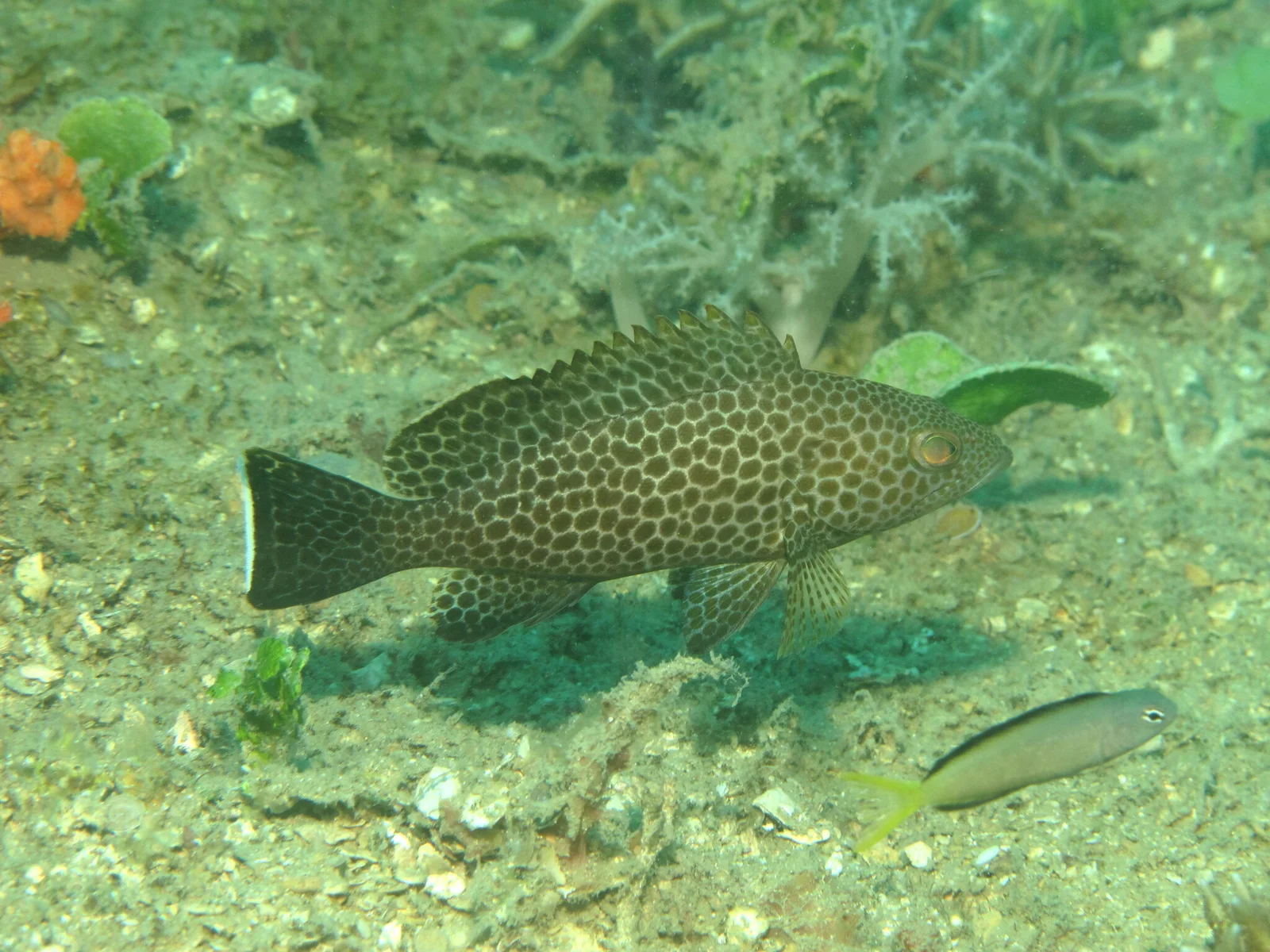
Areolate grouper
- Family
- Epinephelidae
- Depth
- 6–200 m
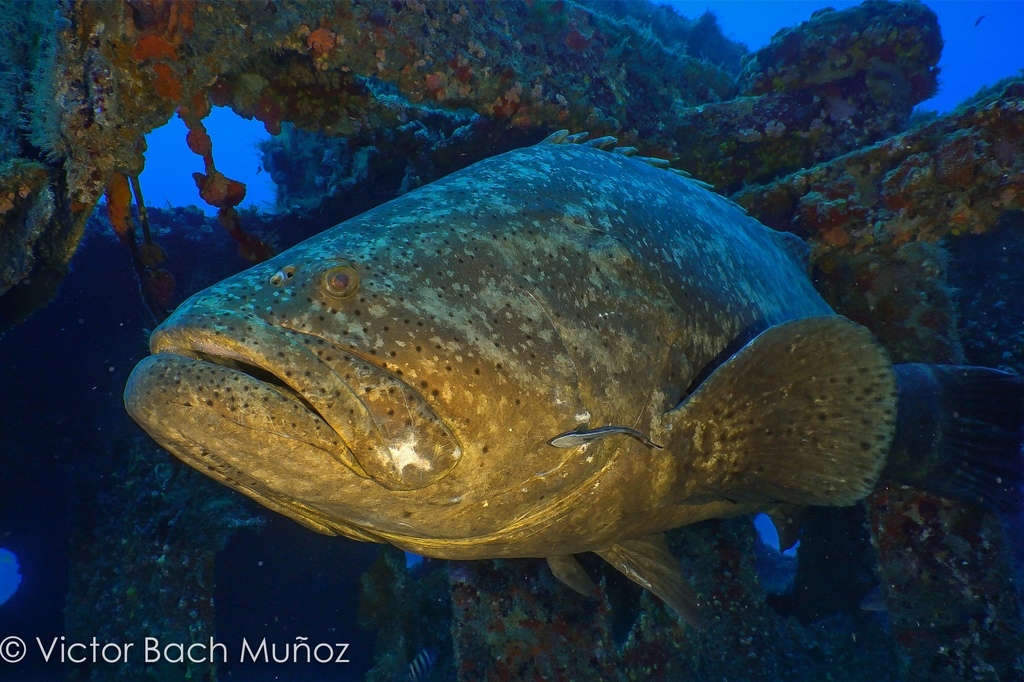
Atlantic goliath grouper
- Family
- Epinephelidae
- Depth
- 0–100 m
- Season
- Jan, Feb, Jun, Jul, Aug, Sep

Black grouper
- Family
- Epinephelidae
- Depth
- 60–250 m
- Season
- Jan, Feb, Mar, Apr, May, Jun, Jul, Aug, Sep, Oct, Nov, Dec
Guides for this water
Technique, gear and safety guides that fit Longtooth grouper.