
Orange-spotted grouper
Orange-spotted grouper is a large reef grouper of the Indo-Pacific, from East Africa and the Red Sea to southern Japan and northern Australia. FishBase notes it is often confused with Epinephelus tauvina or E. malabaricus. It reaches 120 cm and 15 kg, lives up to 22 years, and is fished by boat bottom fishing, slow-pitch jigging or hole fishing, with a season from March to May.

In much of the Indo-Pacific, this grouper has been landed and recorded under two other names. FishBase notes that it is often confused with Epinephelus tauvina or E. malabaricus, and calls the Red Sea record a misidentification. The same account tops out at 120 cm TL and 15 kg, gives 22 years as the oldest age, then contradicts itself on maturity. Name trouble and number trouble sit side by side, and neither is a reason to avoid the fish.
A name with two lookalikes
The accepted English name is orange-spotted grouper, but the alias list includes brown-spotted rockcod, estuary cod, estuary rockcod, goldspotted rockcod, greasy cod and blue-and-yellow grouper. Those names have been applied to fish later separated. The tauvina and malabaricus confusion matters because market data and catch records filed under those names may contain this species, and records filed under this name may contain the others.
The distribution text adds a second identity question: a recent report from the Mediterranean coast of Israel. That is a new sea, far from the Indo-West Pacific core, and the source does not classify it as established. This article will not accept or reject it; it will only note that a single recent record is not the same as a range. For a trip, the Indo-West Pacific is the usable geography, and the Mediterranean dot is a question for a taxonomist.
The maturity line that disagrees with itself
The size record contains two maturity statements on one line: Lm 41.3 cm, and a range of 25 to 30 cm. A species cannot hold an Lm of 41.3 cm and a maturity range of 25 to 30 cm at once. Both trace to separate references and neither is reconciled; this page keeps the pair side by side and averages nothing.
For a release decision, the conservative number is 41.3 cm. If that is the true Lm, a 30 cm fish is immature, and the smaller range is a sample-specific or regional figure. If the 25 to 30 cm range is right, then 41.3 cm is late maturity for some population and early for another. Either way, a fish below 41 cm should go back if the goal is to protect spawning stock.
From one metre to a hundred
The depth range is 1 to 100 m, unusually wide for a reef grouper. The environment line is marine and brackish, and the habitat keywords are sandy, muddy, estuary, coastal, brackish and open-water. Those words cover two different lives: a shallow, turbid estuary edge and a clear reef at 100 m. The source does not say that every fish moves between them, only that the species has been recorded in both.
Wikipedia's lead keeps the species in marine and brackish water and numbers estuary cod among its common names. That salinity tolerance is part of the depth story: at the shallow 1 m limit the fish is often on an estuary edge, not the reef.
The practical split is by size and structure. A one-metre fish is a shore or small-boat cast away; the 100 m end wants a boat, a jig and a sounder. In between, the reef and its holes are the target. The approved methods reflect that: boat bottom fishing, slow-pitch jigging and, regionally, hole fishing. None of them requires a 1 m cast.
Spring spawning, one Gulf record
The spawning table gives March, April and May, with a single record from the coast of the Emirate of Abu Dhabi surveyed between September 2000 and March 2003. The months and the survey span do not line up neatly: a survey that began in September found spawning in spring. That is a data conflict, not a discovery, and this article will not resolve it.
One Gulf record is not a species-wide season. In the tropics and subtropics, grouper spawning is often tied to water temperature and lunar phase, neither of which is in the record. Use the March-to-May window as a regional signal, not as a rule for the Philippines or the Great Barrier Reef. The source gives no closure information, and the local season is the only one that can be checked.
Fin counts, spot pattern
Counts on the checked page: 13–16 soft dorsal rays, 8 soft anal rays behind 3 spines, a fusiform outline and a laterally compressed section. No dorsal spine count or vertebrae appear, so the tally is partial. Live photographs carry the colour pattern: orange spots on a brown body, which is where the name came from.
Those characters are not enough to separate this species from every other brown grouper on a reef. The source itself warns about tauvina and malabaricus, and that warning should travel with any identification made from a photograph. For a kept fish, match counts against spot pattern; two disagreeing features leave the identification unfinished.
A hundred and twenty centimetres
At the top end: 120 cm long, 15 kg heavy, 22 years old. No common length is offered. A 120 cm grouper is a large, old fish, and a 15 kg fish in a reef hole is not one to stop with light line. The maturity figure of 41.3 cm sits far below the maximum, which is why the big fish are the spawning stock rather than the average catch.
Gear follows from the habitat. A slow-pitch jig or a bottom bait needs a rod that can lift a heavy fish away from coral, and a leader that survives abrasion. Hole fishing is close-range work: short pitches, precise drops, and a drag locked briefly to turn a fish. No exact ratings are given here.
Least Concern, commercial, farmed
Uses span commercial capture, commercial farming and gamefishing; the Red List puts it at Least Concern on 21 November 2016. That 2016 listing is a snapshot, with no rule text on the page. The species is also farmed commercially, which means the market fish and the reef fish are separate supply chains.
A Least Concern label does not set a size limit. Groupers are vulnerable to fishing pressure because many are slow-growing and long-lived, and this one reaches 22 years. The source gives the age and the maturity line but no local rules. If you keep one, the 41.3 cm threshold is the number the biology supports; the legal number may be different.
Where the specimens come from
Of 2,579 preserved GBIF records, Australia supplies 1,146, Indonesia 176, Taiwan region 160, India 146, Thailand 97, China 80 and Japan 73. Then come the Mediterranean and out-of-range signals: Turkey 23, Spain two, Italy one, Mexico one and the United States two. The distribution text already calls the Red Sea record a misidentification, so the Mediterranean dots are not a second range.
iNaturalist has 1,235 observations, a much richer photographic record than the specimen count suggests. Start from the Indo-West Pacific core, then pick habitat: an estuary edge for the shallows, a reef or a hole for depth. The two identity warnings, tauvina and malabaricus, are the part of the page to carry into the boat.
How to catch it
Boat bottom fishing
Anchored or drifting boat, bait or lure worked near the recorded bottom.
Slow pitch jigging
Slow-pitch jigging with a controlled fall and short lifts.
Hole fishing
Fish crevices and holes in reef or rock structure.
Where these facts come from
Check these pages before you rely on a size, range or protection status.
- FishBase — Epinephelus coioides — FishBase · T2
- GBIF — Epinephelus coioides occurrence records — GBIF · T2
- IUCN Red List — Epinephelus coioides — IUCN · T1
- Photo record — iNaturalist — iNaturalist · T3
Fish in the same water
These fish live in the same place.
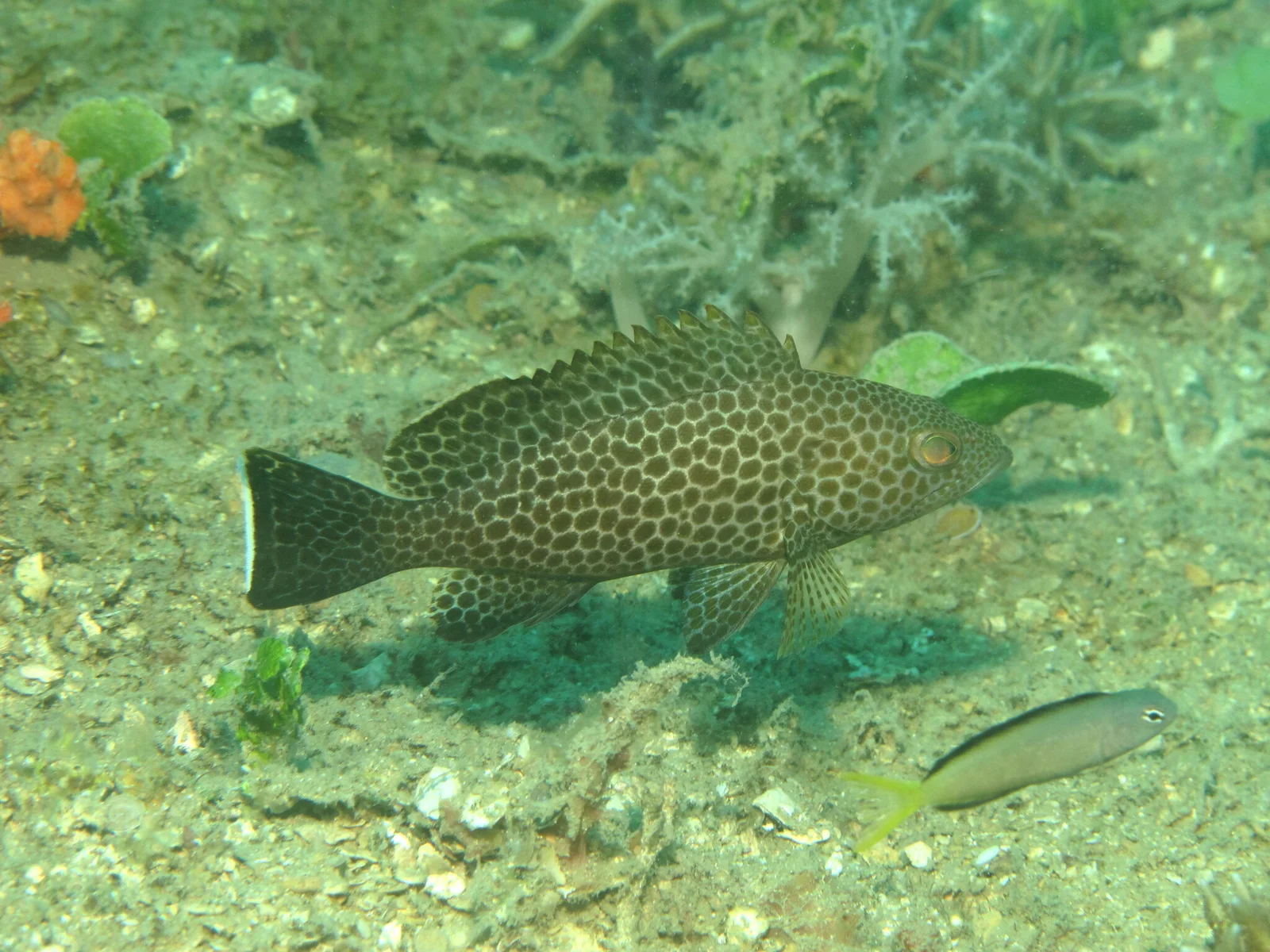
Areolate grouper
- Family
- Epinephelidae
- Depth
- 6–200 m
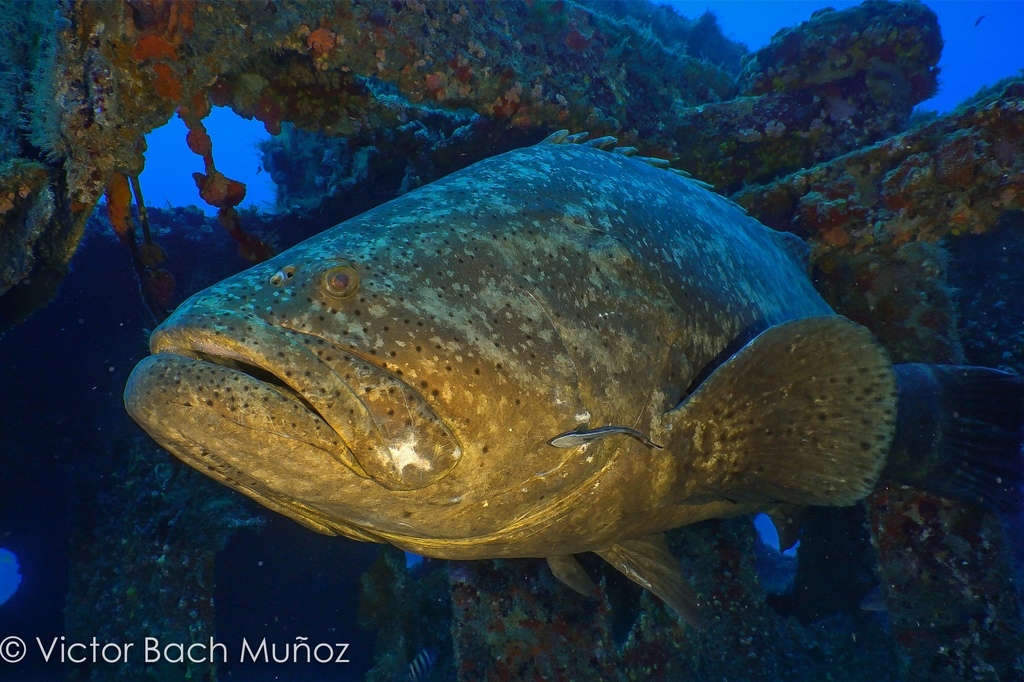
Atlantic goliath grouper
- Family
- Epinephelidae
- Depth
- 0–100 m
- Season
- Jan, Feb, Jun, Jul, Aug, Sep

Black grouper
- Family
- Epinephelidae
- Depth
- 60–250 m
- Season
- Jan, Feb, Mar, Apr, May, Jun, Jul, Aug, Sep, Oct, Nov, Dec
Guides for this water
Technique, gear and safety guides that fit Orange-spotted grouper.