
Brown-marbled grouper
Brown-marbled grouper is an ambush fish of the seam where hard reef meets seagrass, not of either habitat alone: rock gives it cover, grass gives it the fish and molluscs it eats. That seam is the mark to fish, not the middle of a reef. The species can live forty years and rebuilds slowly, so the release line at roughly 48 cm is the rule that applies everywhere, whatever the local keep window says.
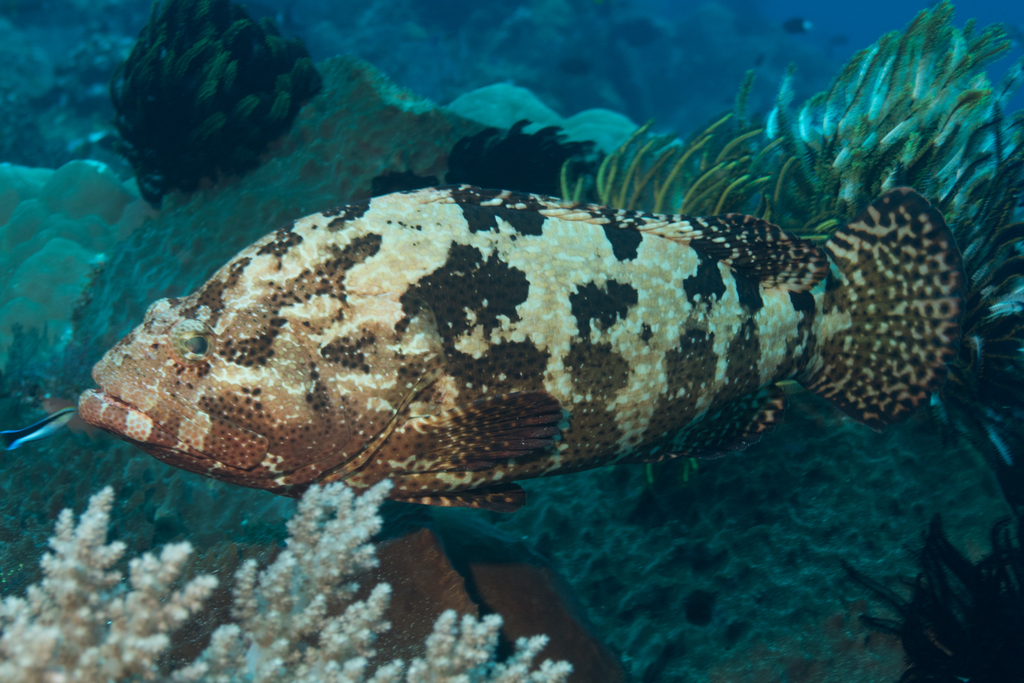
Brown-marbled grouper is an ambush fish of the seam where hard reef meets seagrass, not of either habitat alone: rock gives it cover, grass gives it the fish and molluscs it eats. That seam is the mark to fish, not the middle of a reef. The species can live forty years and rebuilds slowly, so the release line at roughly 48 cm is the rule that applies everywhere, whatever the local keep window says.
Identification
Fourteen or fifteen soft rays support the dorsal fin, and the anal fin is built from three spines plus eight soft rays. The body is fusiform and laterally compressed. At the top, the record gives 120 cm total length and 11 kg, with a maximum reported age of 40 years. Those figures describe the outer edge of the species; the common length on the same record is 50 cm, which is closer to the size most trips produce. The English name is brown-marbled grouper, but the alias that decides how you are treated on an Australian jetty is flowery rockcod: that is the name the Queensland rulebook uses for this animal. Below roughly 48 cm it is immature, so where no legal floor exists that is the release line. The identification problem is not the body but the name. FishBase warns that the species is regularly confused with Epinephelus polyphekadion, and a check that stops at "brown blotchy grouper" merges two species into one. On the water the practical test is pattern plus locality; on paper it is which alias the local rule uses.
Habitat and behaviour
It is a reef fish of tropical water, recorded between 1 and 60 m. The habitat words on the record are reef and seagrass, and the useful reading is the seam between them rather than either word alone: hard structure gives an ambush point, soft seagrass holds the fish and molluscs named in the diet. A fish that lives forty years on that seam accumulates slowly and disappears slowly, which is why a single large fish is a long withdrawal rather than one meal. Spawning is not one calendar. The record carries a Saudi Arabian window in the Arabian Gulf from March to May, and an Australian window inside the Great Barrier Reef Marine Park in January, November and December. Two places, two calendars; neither is a measurement of the other.
Seasonal window
Read the records as a set of local windows, not as a global season. The Arabian Gulf window is a spring event, the Great Barrier Reef window straddles late spring and summer, and neither tells you what happens on the coast between them. That matters because spawning is when the fish gather and when they are easiest to find. The range sentence on the same record says the species is unknown from the Persian Gulf, yet the spawning table carries an Arabian Gulf record. The two statements have not been reconciled. Treat the Gulf edge as a place to verify with a local source, not as a place to assume either way. Where the window is known, use it to plan release rather than harvest: an aggregation is when the stock is easiest to hurt, and a fish taken from it is removed from the breeding stock, not just from the reef.
Gear and approach
A medium-heavy outfit covers the common 50 cm fish without turning a 120 cm ceiling into the default. The leader has to survive contact with reef, and the drag should be set by hand so it can be raised if the fish turns out to be large. Carry circle hooks and a release tool: the release line is the first rule that applies everywhere, and below roughly 48 cm the fish goes back. On the sounder, look for the change from hard reef to soft seagrass and fish that seam; anchor up-current and let the bait fall down the edge rather than into the middle of the bed. If a large fish is hooked, measure it before anything else, because the 70 cm ceiling in Queensland is a put-back rule, not a trophy rule.
Edibility and regulations
Queensland's table is the concrete keep rule in this record: flowery rockcod may be taken from 50 cm to 70 cm, inside a combined possession limit of five cods and groupers. The maximum is the part that changes behaviour. A 75 cm fish goes back, not into the icebox, and the combined limit means five fish across the whole grouper group rather than five of this species. A closed season is a different instrument: the size table governs what you may keep, while the schedule governs when you may fish, and the two should be checked separately. Ciguatera is reported for this species; a large old fish is the higher-risk meal. The Red List assessment from November 2016 places it as Vulnerable. Minor commercial fishing, commercial aquaculture, gamefishing and the aquarium trade all appear under uses, so the same name will appear on market lists and in tank catalogues.
Where to look
GBIF returns 33 distribution records for the taxon. The localities are coarse: a global IUCN declaration, Madagascar, the Somali exclusive economic zone, the Réunion zone, and the Red Sea through WoRMS. They say which jurisdictions have declared a presence, not where a fish is this afternoon. iNaturalist holds 1011 observations under taxon 56559, which measures where photographers went rather than how many fish exist. For planning, the written range runs from the Red Sea and East Africa to Samoa and the Phoenix Islands, north to Japan and south to Australia, and it explicitly excludes Hawaii and French Polynesia. Start at the reef-seagrass seam near the shallow end of the depth band, where a shore cast can reach and a small boat can hold position.
One of those records is not a range edge. China appears in the GBIF set as INTRODUCED, sourced from the Global Register of Introduced and Invasive Species – China and from WRiMS/WoRMS, and both entries carry the remark that the begin date is not specified. Chinese Taipei, by contrast, is listed as native in the Taiwan region's IUCN species list. So a fish taken in mainland Chinese water is a record of an introduced population, not part of the native Indo-Pacific range, and the source supplies neither an introduction date nor a pathway — this article does not invent either. For an angler the practical reading is that the same species can appear under two different statuses, and which one applies to the water in front of you is a question for the local authority.
What the record supports
Put the pieces together and the fish stops being a single Indo-Pacific species and becomes two local problems. In Queensland the keep rule is a window: 50 cm is the floor, 70 cm is the ceiling, and five cods and groupers share the bag. Everywhere else the only universal line is the release line at roughly 48 cm, because the legal floor changes with the jurisdiction. The range map is wide, but the record itself flags two gaps — the Persian Gulf is called unknown in one section and carries a spawning record in another — so the edges are places to verify, not places to plan around. That is the honest use of a long record: it tells you which question belongs to which authority.
Where these facts come from
Check these pages before you rely on a size, range or protection status.
- FishBase — Epinephelus fuscoguttatus — FishBase · T2
- GBIF — Epinephelus fuscoguttatus occurrence records — GBIF · T2
- IUCN Red List — Epinephelus fuscoguttatus — IUCN · T1
- Photo record — iNaturalist — iNaturalist · T3
Fish in the same water
These fish live in the same place.
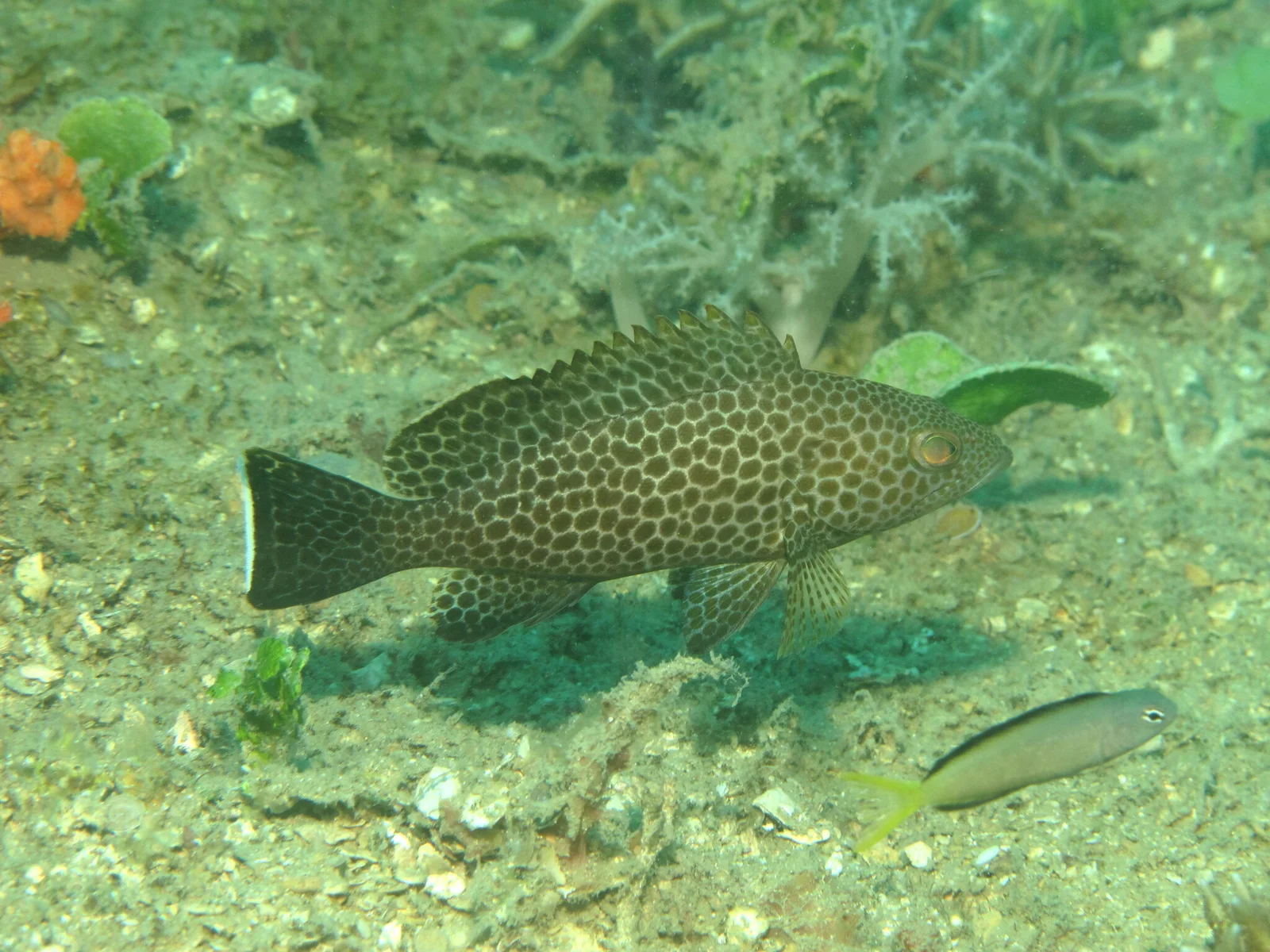
Areolate grouper
- Family
- Epinephelidae
- Depth
- 6–200 m
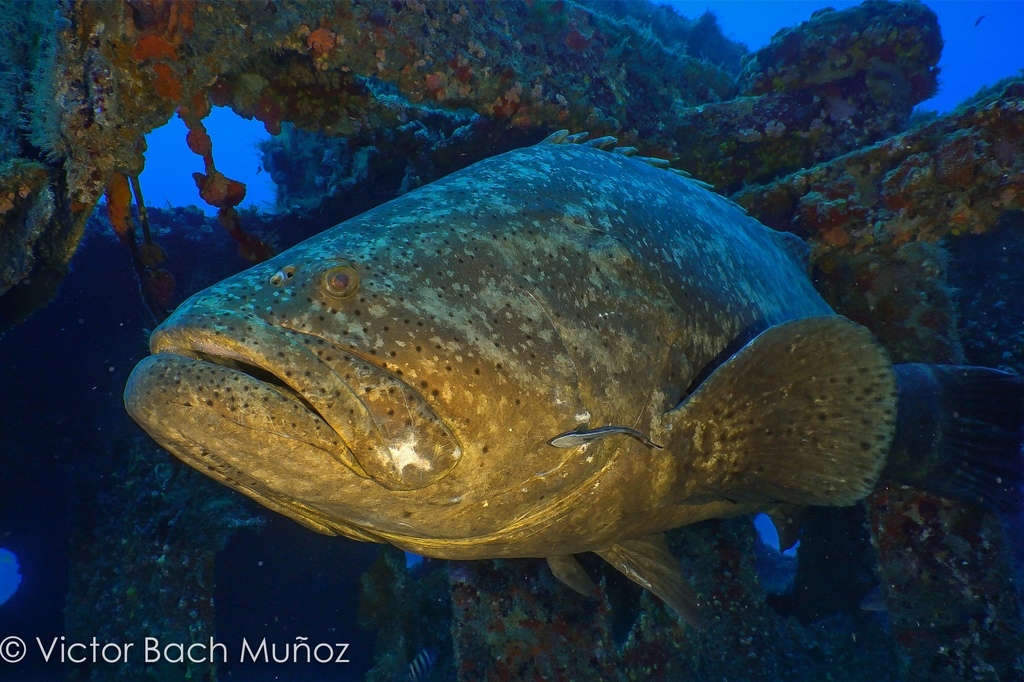
Atlantic goliath grouper
- Family
- Epinephelidae
- Depth
- 0–100 m
- Season
- Jan, Feb, Jun, Jul, Aug, Sep

Black grouper
- Family
- Epinephelidae
- Depth
- 60–250 m
- Season
- Jan, Feb, Mar, Apr, May, Jun, Jul, Aug, Sep, Oct, Nov, Dec
Guides for this water
Technique, gear and safety guides that fit Brown-marbled grouper.