
Starry grouper
Starry grouper is a small tropical grouper of the eastern Pacific, ranging from Baja California and Mexico down to Peru, with Cocos, Revillagigedo and the Galapagos Islands inside its range. It is an inshore fish recorded from 1 to 50 m, feeding on crustaceans and small fish. Even full grown it stays modest, with 60 cm TL the largest recorded. Anglers working shallow warm water are the ones most likely to meet it.
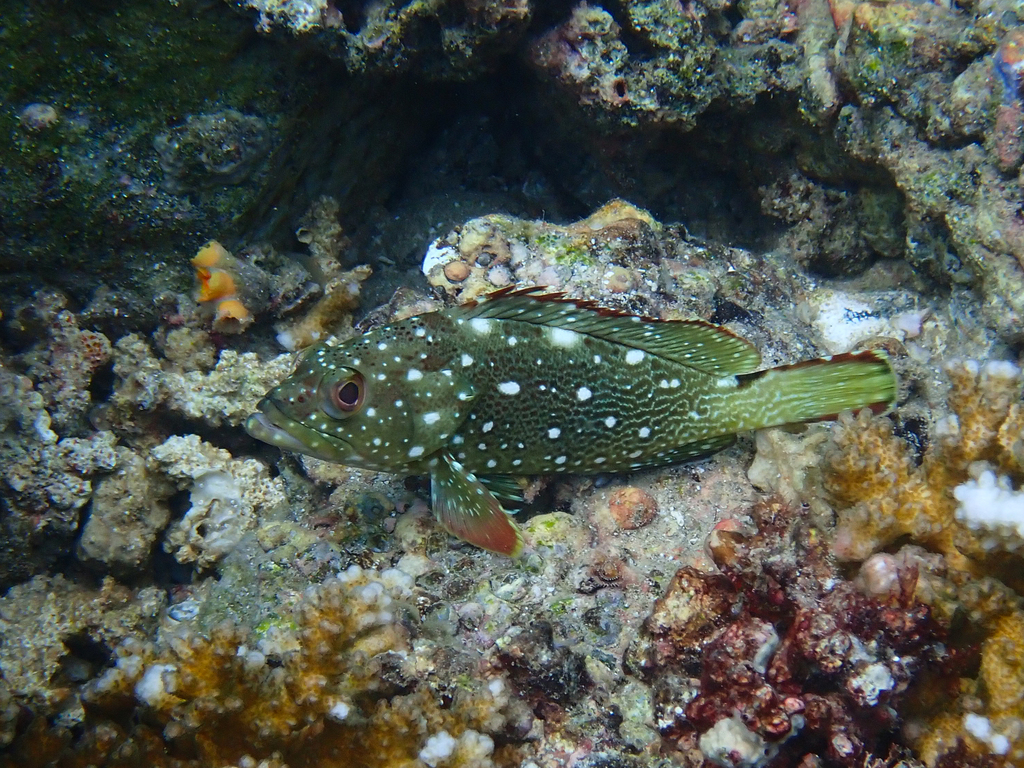
Starry grouper (Epinephelus labriformis) is a fish of the family Epinephelidae. FishBase gives its range as: Eastern Pacific: Baja California, Mexico to Peru, including the offshore islands of Cocos, Revillagigedo, and the Galapagos Islands. The body is fusiform and compressed; 16–18 dorsal soft rays, three anal spines and eight soft rays. It is recorded from 1 to 50 m, in tropical water. The recorded maximum is 60 cm TL. Diet includes crustaceans and fishes. IUCN status: Least Concern (LC). Chinese name: .
Identification
FishBase's AFS name for Mexico is "Flag cabrilla", and the same table carries a run of UK vernaculars — grouper, red-tipped, rock bass, sea bass — none of which is a name a fishmonger would recognise. iNaturalist's preferred name is "Starry Grouper", and Wikipedia's lead gives "starry grouper or flag cabrilla" in one sentence. The body is fusiform and compressed; 16–18 dorsal soft rays, three anal spines and eight soft rays.
The family label is the other split: Wikipedia puts the species in Serranidae, FishBase uses Epinephelidae. Both describe the same fish, and the difference is a family-level convention rather than a species-level doubt. Maximum length is 60 cm TL, and no common length, weight, maturity length or maximum age is recorded.
Habitat and distribution
The range runs from Baja California to Peru and includes Cocos, Revillagigedo and the Galapagos. The country table has 12 entries, among them Colombia, Costa Rica, Peru and the contiguous United States; Ecuador and the Galápagos Islands appear as separate rows. The environment is marine, demersal, tropical, 31°N to 10°S and 115°W to 77°W, at 1–50 m. The habitat keywords are "rocky", "coastal" and "continental-shelf", and the diet is crustaceans and fishes. No spawning month is recorded.
The band starts at 1 m, which is wading depth on a rocky shore, and stops at 50 m, so the whole vertical range is reachable from a small boat or from land. OBIS returns 4,939 records in 39 datasets, dated 1889 to 2026. That volume of records over that span comes from surveys and museum lots; it maps the range well but says nothing about catch rates.
Season and fishing approach
The size question has only one number. With a 60 cm maximum and no common length and no maturity length, the page cannot say what a typical fish measures, and a rule built on 60 cm would be built on the extreme rather than on the stock. That is the correction this section has to make: 60 cm is a record, not a target, and every fish below it is unclassified by the database.
What can be used is the shallow end and the diet. The 1–50 m band means the shallow half is fishable from rocks without a boat; "rocky" and "continental-shelf" point to structure over hard ground rather than sand. Crustaceans and fishes support crab, prawn or small-fish baits fished close to the rock, and the absence of a spawning month means the calendar is a field note rather than a plan.
iNaturalist holds 1,569 observations, and those photographs show the live colour and pattern that the sparse morphology fields do not record.
Edibility and regulations
Uses are minor commercial landings and gamefish "yes", with neither an aquaculture nor an aquarium entry. IUCN's 9 December 2016 assessment is Least Concern, a statement about extinction risk rather than about whether a fish may be taken.
Across the 12 rows there is no minimum length, no daily bag and no closed season, and no national fisheries authority is named for any of them. The table's own structure is worth a second look: Ecuador and the Galápagos Islands are listed separately, which is a reminder that a single country can hold two jurisdictions with different rules, and a presence row does not tell you which one applies.
Where these facts come from
Check these pages before you rely on a size, range or protection status.
- FishBase — Epinephelus labriformis — FishBase · T2
- GBIF — Epinephelus labriformis occurrence records — GBIF · T2
- IUCN Red List — Epinephelus labriformis — IUCN · T1
- Photo record — iNaturalist — iNaturalist · T3
Fish in the same water
These fish live in the same place.
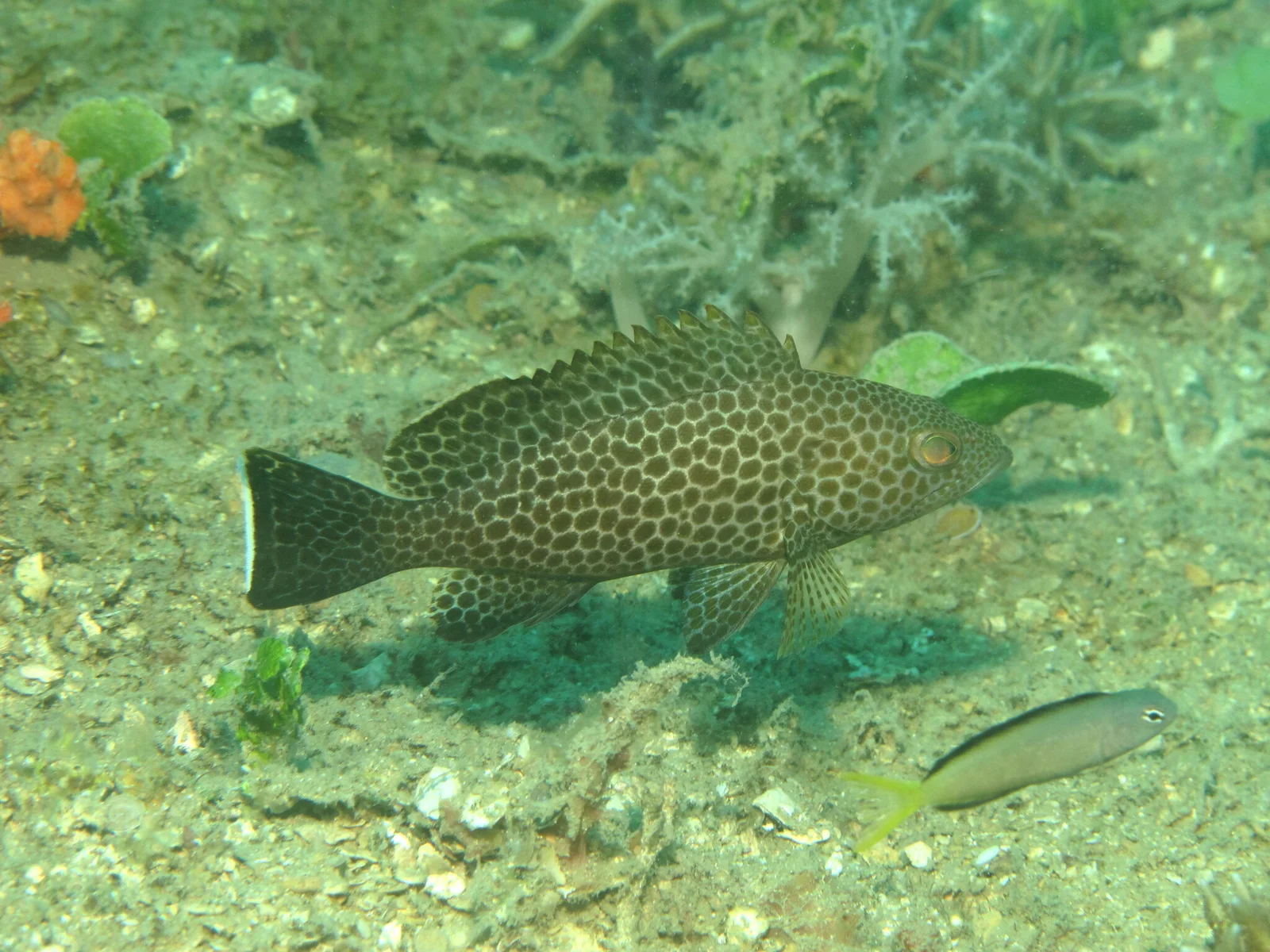
Areolate grouper
- Family
- Epinephelidae
- Depth
- 6–200 m
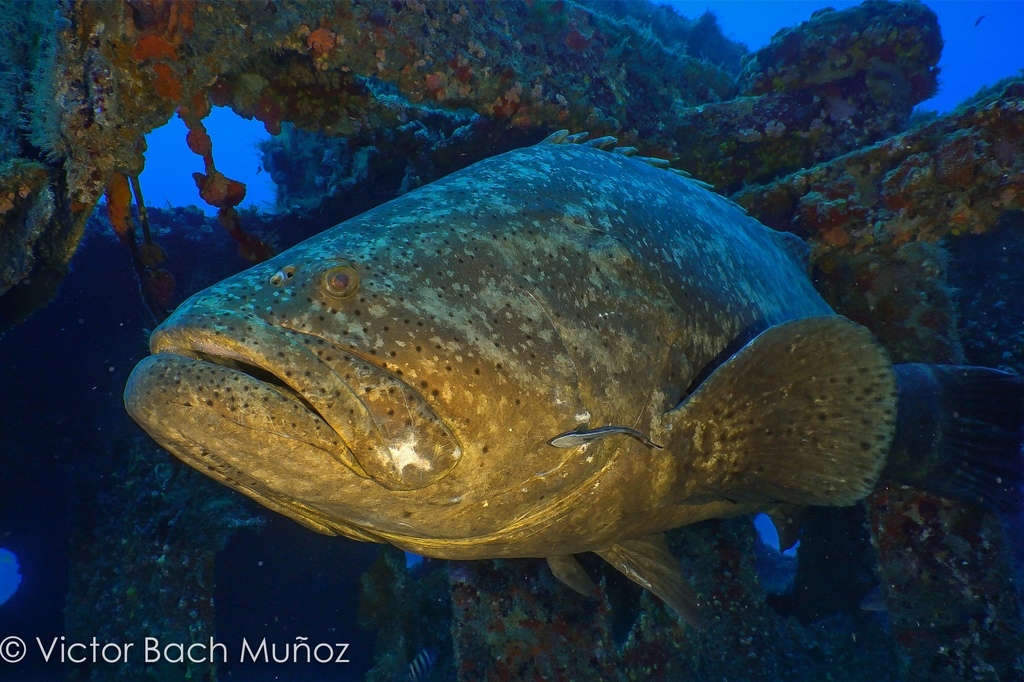
Atlantic goliath grouper
- Family
- Epinephelidae
- Depth
- 0–100 m
- Season
- Jan, Feb, Jun, Jul, Aug, Sep

Black grouper
- Family
- Epinephelidae
- Depth
- 60–250 m
- Season
- Jan, Feb, Mar, Apr, May, Jun, Jul, Aug, Sep, Oct, Nov, Dec
Guides for this water
Technique, gear and safety guides that fit Starry grouper.