
Red grouper
Red grouper is a large epinephelid of the western Atlantic, from North Carolina through the Gulf of Mexico, Caribbean and Bermuda to southern Brazil. It lives from 5 to 330 m in subtropical water, reaches 125 cm TL and 23 kg, can live 25 years, and feeds on fish. Its season runs January to June.
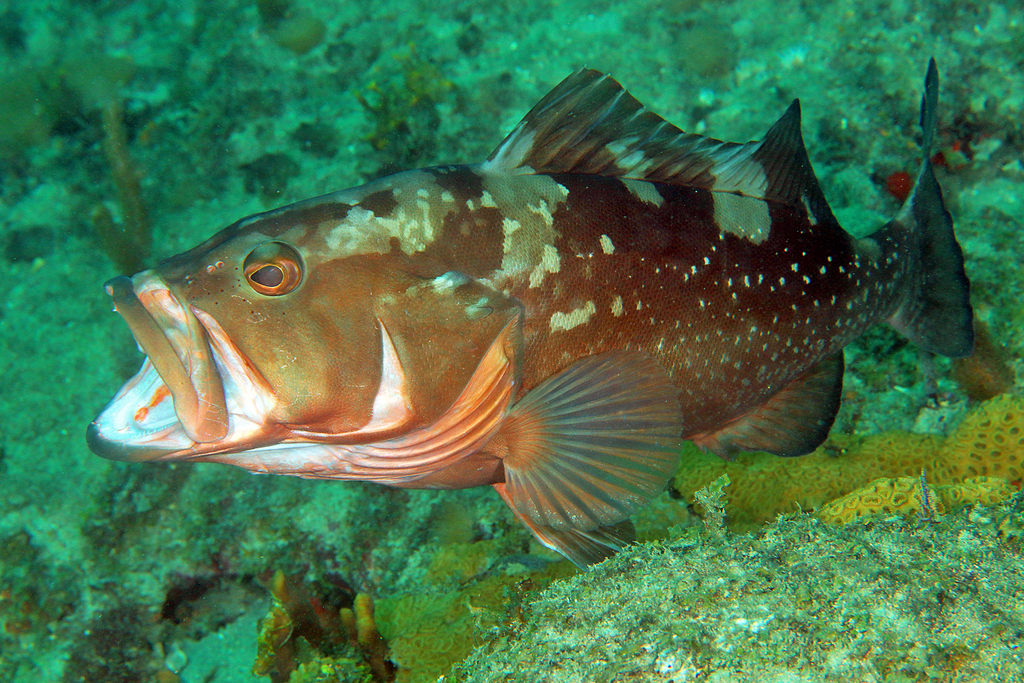
Red grouper (Epinephelus morio) is a fish of the family Epinephelidae. FishBase gives its range as: Western Atlantic: North Carolina, USA to southern Brazil, including the Gulf of Mexico, Caribbean, and Bermuda; strays occur north to Massachusetts. It is recorded from 5 to 330 m, in subtropical water. The recorded maxima are 125 cm TL, 23 kg, 25 years. Diet includes fishes. IUCN status: Vulnerable (VU). Chinese name: .
Total length is not what you measure
FishBase labels the 125 cm figure as TL, total length, which runs to the farthest tip of the tail, while a tape laid on a deck usually stops at the fork because that is where the fish lies flat and where most rules are written. The two figures for one fish differ by the length of the tail lobe, and on a grouper that lobe is not trivial. The page publishes no fork-length equivalent, so the 125 cm figure should not be moved onto a board that stops at the fork.
The name registry makes the same point from another angle. The same fish appears under brown grouper, deer grouper, hamlet and red grouper, so a label on a fish box is not an identification and a length quoted for one name may have been measured on another.
A common size below the maturity midpoint
Fifty centimetres is the common length: the size a typical landed fish reaches, not the size a mature one reaches. The maturity figure is 54.4 cm as an average, so the common fish sits below it. Read with the range, maturity spans 35 to 98 cm, which means some fish are mature at 35 cm and others are not mature at 90.
Both statements can be true because maturity is not a single size. It varies with sex, region and age, and the average compresses that variation into one number. A 50 cm fish from one part of the range may be a spawning adult while a 50 cm fish from another part may not, and the record does not break the range down by region. The only honest use of 54.4 cm is as a midpoint, never as a threshold.
Why a size limit cannot be one number
If maturity starts at 35 cm and only ends at 98 cm, any single minimum length protects some of the population and misses the rest. A limit at the midpoint lets mature fish of 35–54 cm be taken; a limit at the top protects almost everything but is not a rule anyone would write. That is why the maturity number belongs in an article rather than on a sticker.
The record also gives 25 years as the maximum age, against a 23 kg maximum weight. A slow-growing fish that matures across a 63 cm spread and lives a quarter of a century has size classes that are not interchangeable, at either end.
Five to three hundred and thirty, usually seventy-plus
The depth field reads 5 to 330 m, usually 70 to 330 m. The "usually" says the shallow band is recorded but not typical, which separates a shore rock from a deep ledge only a sounder will find.
The habitat keywords are reef, rocky and muddy. Rock and reef are hard, mud is soft; a fish associated with all three is a fish of the transition, and the transition at 70 m is where the usual range begins. If the sounder shows hard relief dropping into soft bottom at that depth, the record and the ground agree.
Spawning spread across four regions
The spawning table gives January to June at species level, then four regional records: Brazil's Ceará in April and May, Cuba in February to April, the eastern Gulf from February to June, and the southern Gulf from January to March. Those are not four versions of one season; they are four places with their own calendars.
For an angler, a closed season written in one jurisdiction and a spawning aggregation reported in another may both be correct and may not apply to the same water. The species is also recorded as non-migratory, so a fish that spawns off one coast is not the same fish that appears off another. Plan the month by region, not by the species-level table.
A fish that stays put
Non-migratory is one of the few behavioural words on the page, and it changes how a mark should be treated. A resident grouper can be located, learned and over-collected in one small area; a mark that produced last season is also more likely to hold fish again than one chosen from a map. The cost is that a quiet mark stays quiet for a reason.
Reef, rock and mud also say something about release. A fish hooked on hard relief and brought up through 70 m of water arrives in poor condition, and a non-migratory species has nowhere to redistribute the loss. That does not dictate a rule, but it should shape how deep you fish when the intention is to release.
iNaturalist carries 485 observations for the species, a record of where people with cameras have met it rather than a measure of abundance. For a resident fish, repeat observations cluster at accessible marks, which is useful for choosing a coast and useless for estimating a stock.
Vulnerable, assessed in 2016
The Red List entry is Vulnerable, assessed on 20 November 2016. A 2016 assessment describes the stock at that point, and a decade of fishing since then is not represented in the letter. The use record adds commercial fishing, gamefishing and public aquariums, so the same species is a market fish, a sport target and a display animal.
Vulnerable is not a prohibition and not a bag limit. It says the species faces a higher extinction risk than Least Concern, so the practical translation is caution rather than a rule you can quote; the page consulted here carries no regulation text.
What to carry on the deck
Two tools resolve most of the ambiguity here: a tape marked for both total and fork length, and a habit of noting which one you used. A 50 cm fish is common and possibly immature; at 54.4 cm it is at the midpoint and still possibly immature.
The 23 kg maximum is real and rare, and the 25-year maximum age is a reminder that a large fish is old. Set the drag for the fish you can see and treat the maturity range as a reason to leave the biggest fish in the water.
GBIF's distribution file holds 59 records for the Caribbean, with Brazil contributing 14 from its national fauna catalogue and Mexico two, one marked Vulnerable; the IUCN entry is Vulnerable and Venezuela's Data Deficient. NOAA Fisheries counts five red grouper stocks and reports the Gulf of America stock as not overfished and the South Atlantic stock as overfished under a rebuilding plan. Identity is settled; abundance was never there.
Where these facts come from
Check these pages before you rely on a size, range or protection status.
- FishBase — Epinephelus morio — FishBase · T2
- GBIF — Epinephelus morio occurrence records — GBIF · T2
- IUCN Red List — Epinephelus morio — IUCN · T1
- Photo record — iNaturalist — iNaturalist · T3
Fish in the same water
These fish live in the same place.
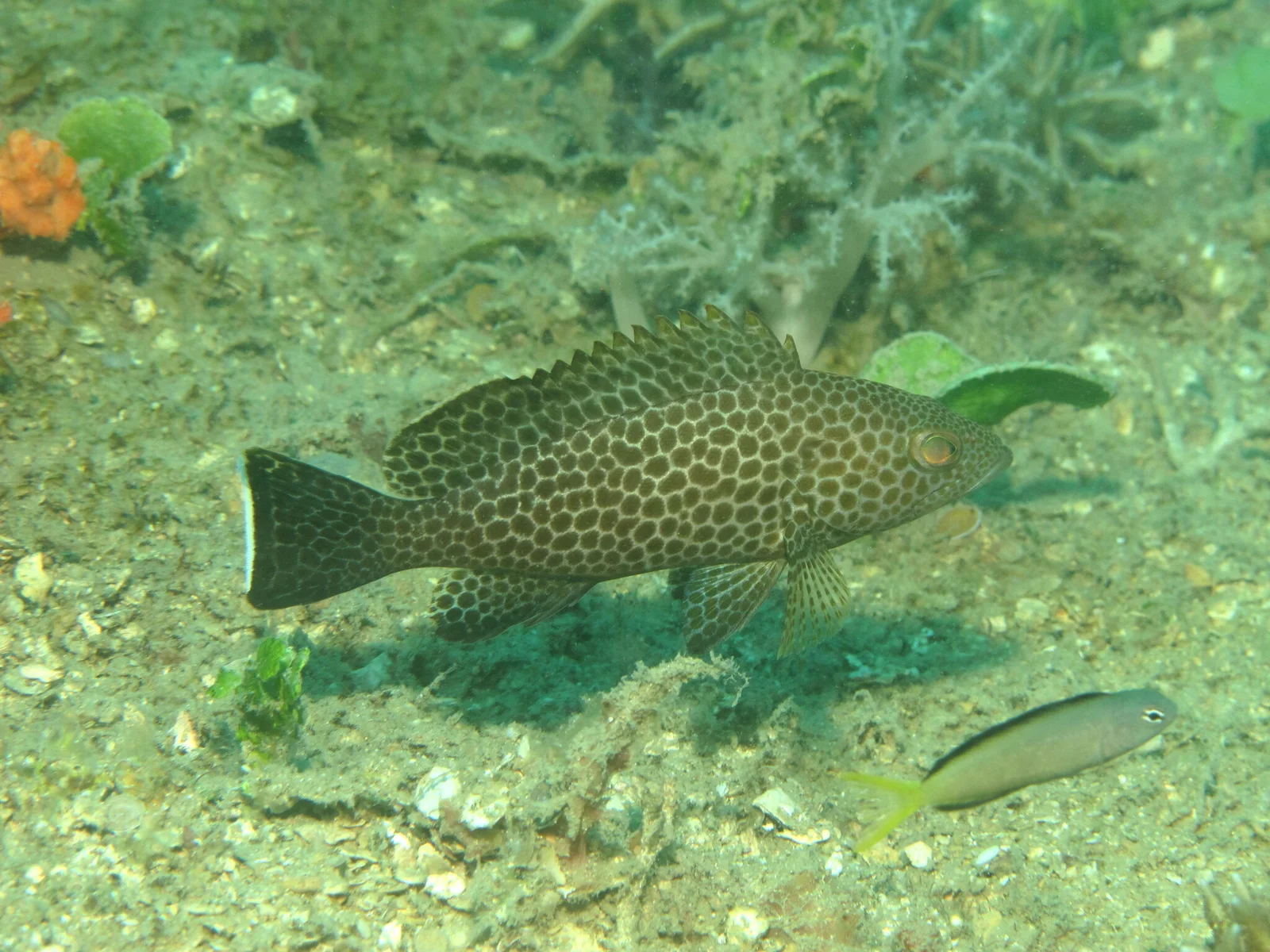
Areolate grouper
- Family
- Epinephelidae
- Depth
- 6–200 m
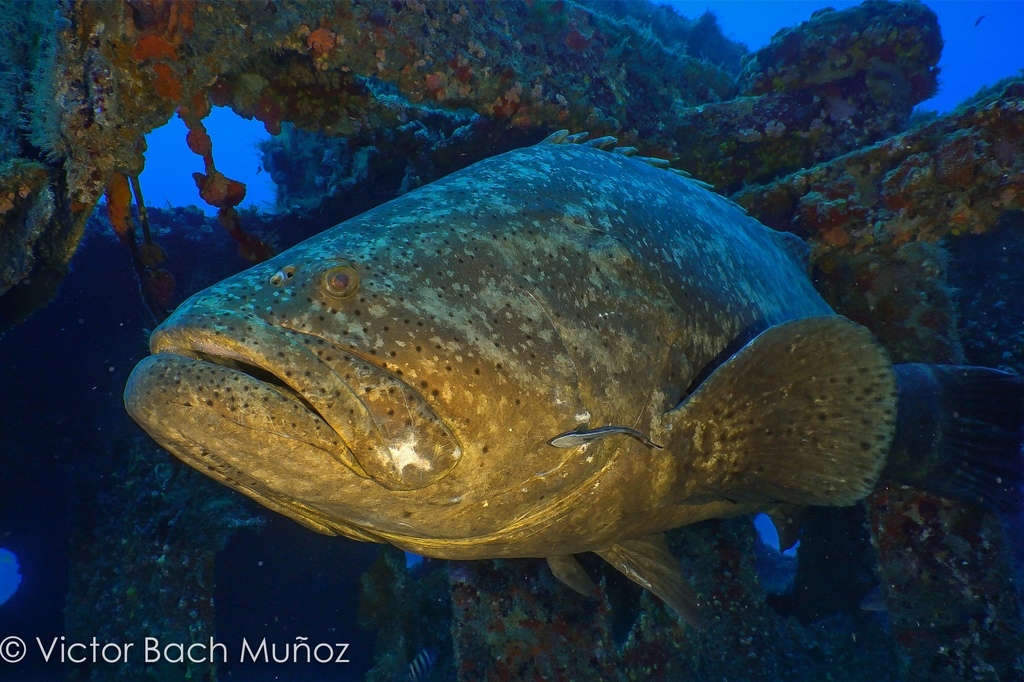
Atlantic goliath grouper
- Family
- Epinephelidae
- Depth
- 0–100 m
- Season
- Jan, Feb, Jun, Jul, Aug, Sep

Black grouper
- Family
- Epinephelidae
- Depth
- 60–250 m
- Season
- Jan, Feb, Mar, Apr, May, Jun, Jul, Aug, Sep, Oct, Nov, Dec
Guides for this water
Technique, gear and safety guides that fit Red grouper.