
Camouflage grouper
In a fish market, a camouflage grouper is a grouper, and the name on the ice may say nothing more. At sea it is one of two species that are routinely confused, the other being Epinephelus fuscoguttatus. FishBase says so directly in the distribution note, which is unusual and useful: the confusion is part of the species description, not a buyer's mistake.
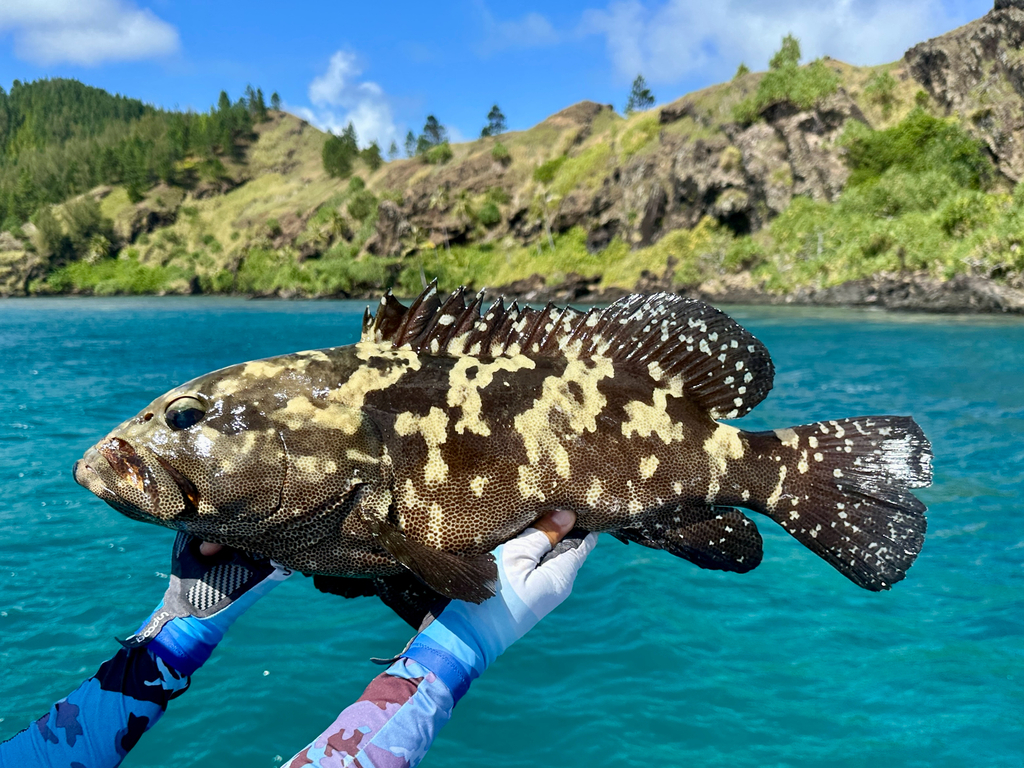
In a fish market, a camouflage grouper is a grouper, and the name on the ice may say nothing more. At sea it is one of two species that are routinely confused, the other being Epinephelus fuscoguttatus. FishBase says so directly in the distribution note, which is unusual and useful: the confusion is part of the species description, not a buyer's mistake. The field marks that separate them are on the rear half and inside the mouth. This one has a prominent black saddle blotch on the caudal peduncle, and dark spots that extend over the head, lower jaw, lips, branchiostegal membranes, gular area and the inside of the mouth. If the mouth is closed and the tail is in shadow, you are guessing.
A 90 that is not the same 90
The file gives a maximum length of 90 cm standard length and a common length of 90 cm total length. Those are two different measurements, and the source does not reconcile them; total length includes the tail, standard length does not. Read them as two size statements, not as one confirmation. Maturity is recorded from 58 cm. The body is deep, 2.7–3.1 times into standard length, the preopercle is rounded and finely serrate, the upper opercular edge is distinctly convex, and the rear nostril is about twice the diameter of the front one. Counts are 11 dorsal spines, 14–15 soft rays, three anal spines, eight soft rays and 24–27 gill rakers. The colour is pale brown under dense small dark spots, with irregular darker blotches on the upper half and small white spots on the fins.
Shallow reef, deep trouble
The range runs from the Red Sea and East Africa to French Polynesia, with the western Pacific population from southern Japan to southern Queensland and Lord Howe Island. The depth band is 0–50 m, and the species is marked oceanodromous. A 0 m lower limit means a snorkeller can see one; it does not mean the big ones are shallow. The 50 m upper limit is where the slope drops away from the reef flat, and that is where a cautious large grouper is more likely to sit. The same distribution text that notes the confusion with E. fuscoguttatus also tells you the two overlap, which is why a market can mix them without anyone lying.
The market side of the ledger
FishBase records commercial fishing and experimental aquaculture, and the Red List status is Vulnerable under criterion A2bd, assessed 20 November 2016. That combination is the whole argument of this page: a fish that is commercially caught, has been tried in aquaculture, and is assessed as declining. The vulnerability score is moderate to high and the climate vulnerability score is very high. None of that is a legal prohibition. It is a reason to know what you are holding before you decide to keep it, and a reason not to treat a market label as an identification.
Bait on the slope, not on the flat
The recorded fishing methods are bottom gear and handlines, and the reef slope is where both work. The bait has to hang just off the bottom; a bait lying on coral is a snag, not a presentation. Whole small fish, squid and shrimp fit a predatory reef fish with a trophic level of 4.0. The bite is often a series of taps before the fish commits, so leave slack and strike on the second or third pull. The critical moment is the first two seconds after the hook sets: a grouper of this size turns for the nearest hole, and the angler who waits loses the fish to the reef. Turn the head first, then pump.
Ciguatera, and the rules of seven coasts
FishBase records ciguatera poisoning for this species. The toxin comes from benthic dinoflagellates and accumulates through the food chain; larger, older fish carry more. Do not eat the liver, head or viscera. There is no reliable field test, and numbness of the lips or tongue, or gastrointestinal symptoms, need medical attention. Fish from the same reef vary widely, so another boat's good experience is not evidence. The Maldives bans reef shark fishing nationwide, closes reef-fish spawning aggregation sites seasonally, requires export permits and bars sale of tourist catches. Thailand closes Similan and Surin national parks during the monsoon, roughly May to October. Malaysia protects the core zones of the Tioman, Redang and Perhentian marine parks, with state-level size and gear rules under the 1985 Fisheries Act framework. Indonesia zones marine protected areas and manages grouper exports and sizes by ministerial regulation. Mozambique, Kenya and Tanzania each apply their own fisheries law, with different export and reef protection rules. Check the current notice for the site.
Names, counts and what is missing
The English name is camouflage grouper; the Maldivian Faana is a general word for groupers and reef fish, not a species name. iNaturalist holds 798 observations. The counts and colour marks above come from the same FishBase entry. What the entry does not give is a spawning month or a weight, and this page does not invent either. The absent spawning data matter more than usual for a VU species, because a seasonal aggregation fishery would be the first thing a manager needed to know about.
How to catch it
Boat bottom fishing
Fished with the listed approach, matched to the recorded depth and size.
Handline
Fished with the listed approach, matched to the recorded depth and size.
Where these facts come from
Check these pages before you rely on a size, range or protection status.
- FishBase — Epinephelus polyphekadion — FishBase · T2
- GBIF — Epinephelus polyphekadion occurrence records — GBIF · T2
- IUCN Red List — Epinephelus polyphekadion — IUCN · T1
- Photo record — iNaturalist — iNaturalist · T3
Fish in the same water
These fish live in the same place.

Guides for this water
Technique, gear and safety guides that fit Camouflage grouper.