
Longfin grouper
Longfin grouper is a small western Pacific grouper, from Japan to Australia, with a single Indian Ocean record from the Andaman Islands. It lives on inshore silty reef no deeper than 50 m and is often mistaken for Epinephelus macrospilos. It reaches 40 cm TL and matures at about 18 cm. Bottom fishing and lures are the methods listed, and it occurs in Taiwan, Hong Kong, southern China and Southeast Asia.
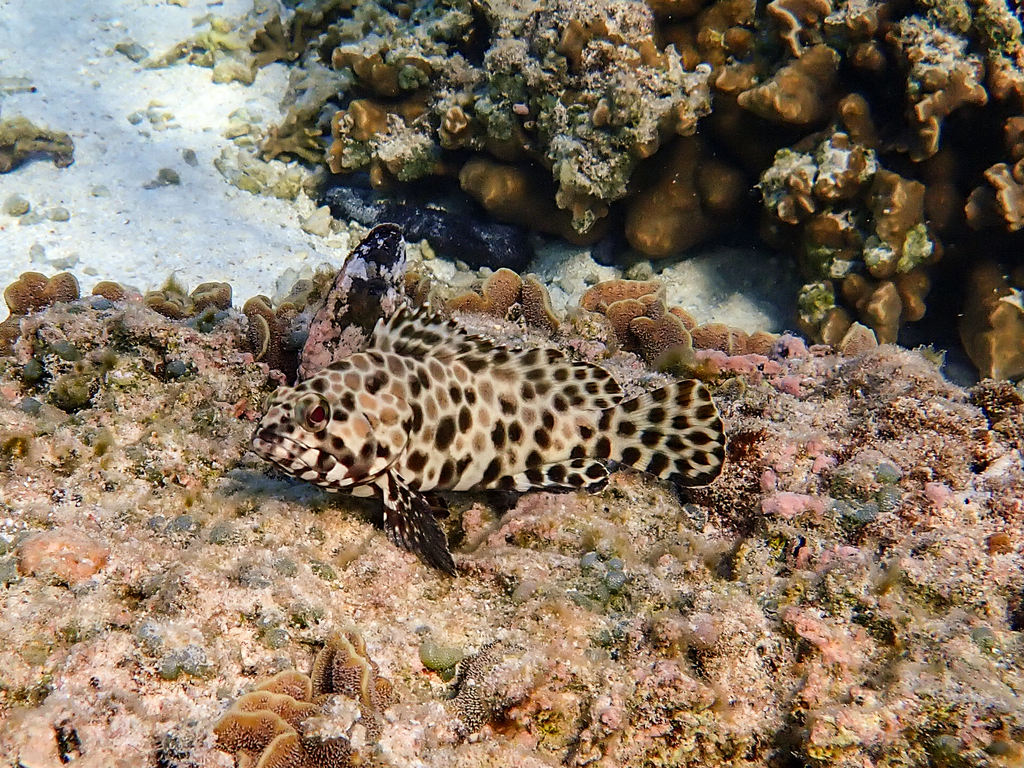
Longfin grouper is a small western Pacific grouper, from Japan to Australia, with only an Andaman Islands record in the Indian Ocean; it occurs in Taiwan region, Hong Kong SAR, southern China and Southeast Asia. It lives on inshore silty reefs at depths no greater than 50 m and is often misidentified as Epinephelus macrospilos or E. hexagonatus. FishBase gives a maximum of 40 cm total length and maturity at about 18 cm. IUCN lists it as Least Concern, assessed in 2016.
Reading the spines
The dorsal fin has 11 spines and 16–18 soft rays; the anal fin has 3 spines and 8 soft rays. The body is whitish, with numerous large, close-set hexagonal to roundish dark brown to blackish spots on the head, body and fins. Body scales are ctenoid except cycloid dorsoanteriorly above the lateral line, on the thorax and abdomen; auxiliary scales are present. Body depth is 2.7–3.2 times in standard length; the caudal fin is rounded; the pelvic fins are 1.7–2.1 times in head length; head length is 2.3–2.6 times in standard length; the dorsal head profile is evenly curved; the snout is subequal to eye diameter and 4.6–5.3 times in head length; the preopercle is rounded or subangular; the upper opercular edge is almost straight; the posterior nostril is about twice the diameter of the anterior; the maxilla reaches to or past the vertical at the rear edge of the eye. The hexagonal spots, round tail and white ground are the field marks, but check the scales and spots against E. macrospilos and E. hexagonatus.
A small grouper of silty reefs
FishBase's range is the western Pacific from Japan to Australia, with an Andaman Islands record in the Indian Ocean; it is unreported from Micronesia, Melanesia and the central Pacific and is often confused with E. macrospilos or E. hexagonatus. The country table includes the Andaman and Nicobar Islands, Australia, Cambodia, China, Hong Kong SAR, India, Indonesia, Japan, Korea, Malaysia, the Ogasawara Islands, Papua New Guinea, the Philippines, Taiwan region, Thailand, Timor-Leste and Vietnam. GBIF's 2,508 records are led by Australia (1,471), Thailand (213), Taiwan region (169), the Philippines (137), Indonesia (132), Japan (60), Hong Kong SAR (56), Malaysia (45), mainland China (42), Singapore (24) and Vietnam (24). It inhabits inshore silty reefs, with no records below 50 m; it feeds on shrimps, small fishes, worms and crabs; the enlarged fleshy pectoral fins appear to suit its habit of sitting on the substrate; it is solitary.
The blanks are information
FishBase gives a Hong Kong SAR spawning window of April to September. The species is tropical and catchable all year; in Taiwan region, Hong Kong SAR and southern China, late spring to autumn is the main window, with winter fish deeper or on lee reefs. No temperature number is published, so follow local reef temperature. Tide and slack water concentrate small fish and crustaceans; dawn, dusk and night also work. As a grouper it grows slowly and lives long, so keep fish conservatively.
Where to start looking
The GBIF pattern is Australian-first, with Thailand, Taiwan region, the Philippines and Indonesia secondary. Fish the crevices, dead-coral rubble and low reef in sheltered, silty water; this is not a blue-water species. The source gives no coordinates. A mark that holds small reef fish and crustaceans is more useful than a clean coral head.
Tackle and baits
Reef bottom fishing and light rock fishing are the standards: small hooks, short leaders, prawn, fish chunk, crab meat and sandworm. The mouth is small and the fish swallows deep, so large hooks and heavy leaders cost bites; after the hookset it dives for crevices, so an abrasion-resistant leader and a fast lift matter. Small soft plastics, micro-minnows and jigheads slow-rolled along rubble work. Night fishing with scented bait is effective. Avoid big baits that produce pulls without hookups.
Eating, handling and the rules
The species is a commercial fishery target; the flesh is fine, good steamed, braised or in soup. Bleed, gut and ice it promptly. FishBase reports ciguatera poisoning, and as a mid-level reef predator, large individuals, heads and organs should not be eaten often. Rules vary: Taiwan region sets minimum sizes, closed seasons and area closures for groupers, and recreational fishing must follow Fisheries Agency and local government notices; Hong Kong SAR's Fisheries Protection Ordinance regulates methods, marine parks and reserves prohibit angling and collecting; Southeast Asian states differ widely, with Malaysia, Indonesia, the Philippines and Thailand each issuing size and closed-season rules and usually prohibiting take in marine protected areas. Check the current local notice.
What the record leaves open
The page is built from FishBase taxonomy, morphology, distribution, environment, biology, reproduction, use, IUCN and ciguatera entries, with the country table for range and GBIF/iNaturalist for occurrence. Water temperature, local size limits and ciguatera monitoring are not standardised, so the text stays conservative. Separation from E. macrospilos and E. hexagonatus follows FishBase's scale and spot descriptions.
How to catch it
Bottom fishing
Fished with the listed approach, matched to the recorded depth and size.
Lure fishing
Fished with the listed approach, matched to the recorded depth and size.
Where these facts come from
Check these pages before you rely on a size, range or protection status.
- FishBase — Epinephelus quoyanus — FishBase · T2
- GBIF — Epinephelus quoyanus occurrence records — GBIF · T2
- IUCN Red List — Epinephelus quoyanus — IUCN · T1
- Photo record — iNaturalist — iNaturalist · T3
Fish in the same water
These fish live in the same place.
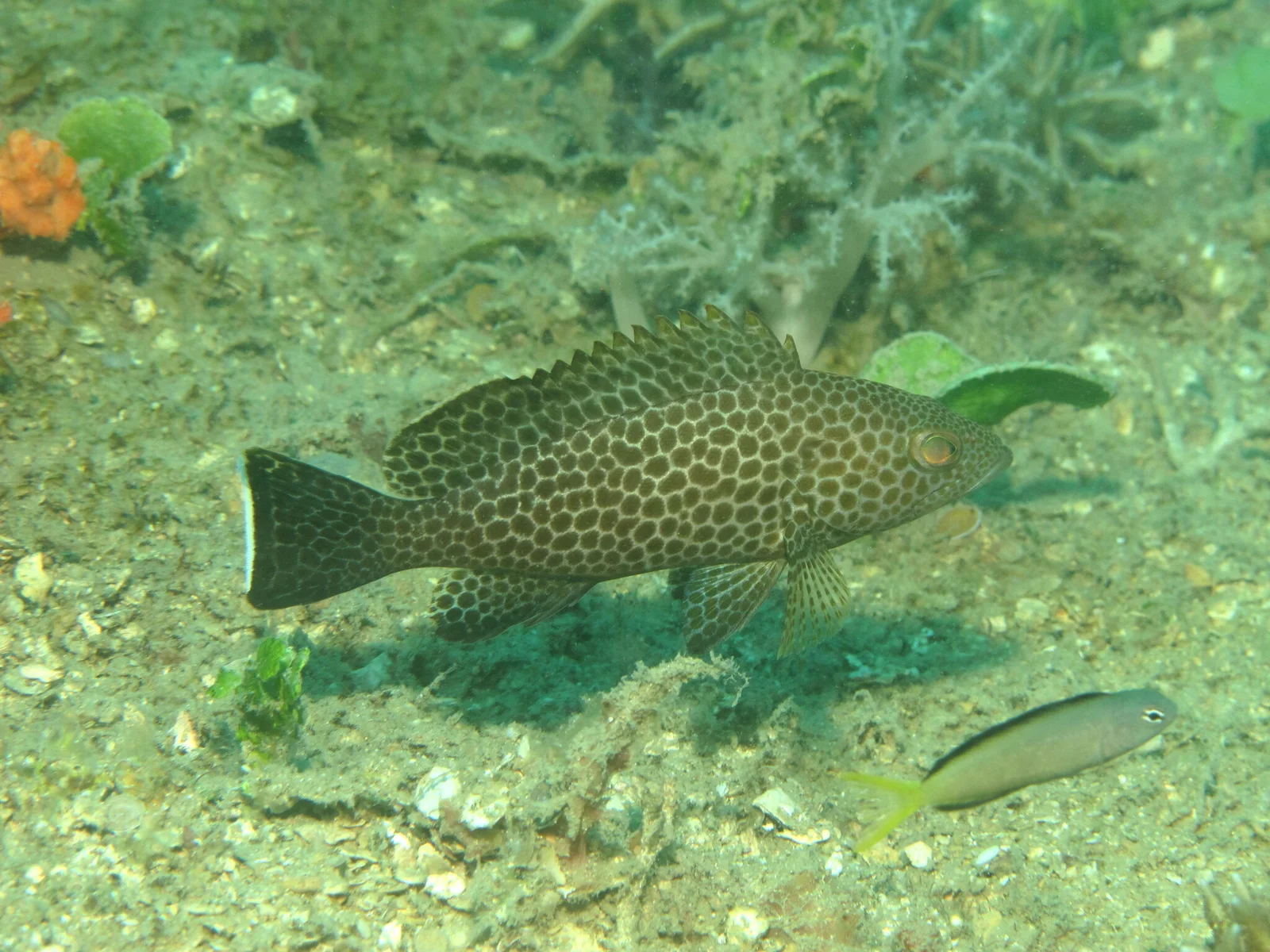
Areolate grouper
- Family
- Epinephelidae
- Depth
- 6–200 m
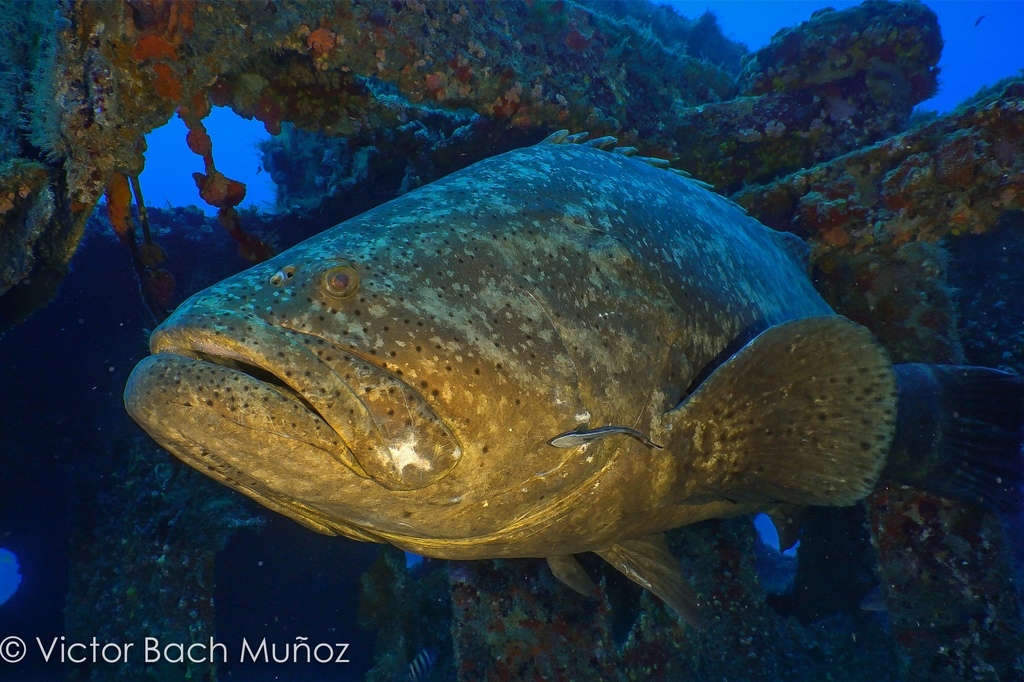
Atlantic goliath grouper
- Family
- Epinephelidae
- Depth
- 0–100 m
- Season
- Jan, Feb, Jun, Jul, Aug, Sep

Black grouper
- Family
- Epinephelidae
- Depth
- 60–250 m
- Season
- Jan, Feb, Mar, Apr, May, Jun, Jul, Aug, Sep, Oct, Nov, Dec
Guides for this water
Technique, gear and safety guides that fit Longfin grouper.