
Convict grouper
Sevenband grouper is a non-migratory resident of shallow rock, recorded only between 5 and 30 m, so the mark that holds fish in summer is likely to hold them next month — and the hole you empty stays empty. There is no common length and no spawning month on the record: build for a 50–80 cm fish, and read the season from water temperature at the northern edge of the range rather than from a borrowed breeding calendar.
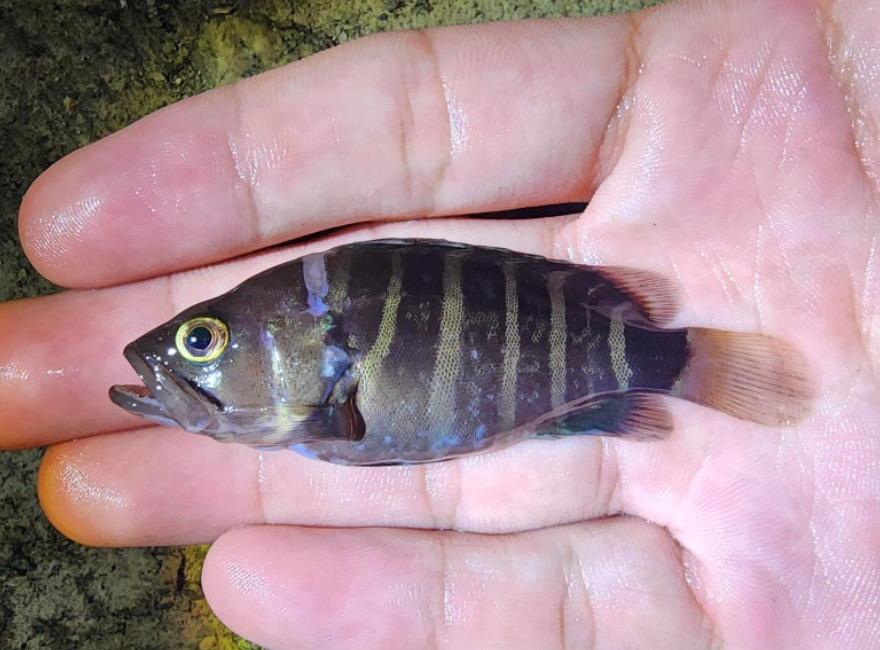
Sevenband grouper is a non-migratory resident of shallow rock, recorded only between 5 and 30 m, so the mark that holds fish in summer is likely to hold them next month — and the hole you empty stays empty. There is no common length and no spawning month on the record: build for a 50–80 cm fish, and read the season from water temperature at the northern edge of the range rather than from a borrowed breeding calendar.
Identification
FishBase's record for this fish is headed Hyporthodus septemfasciatus, while the registry line behind the page still reads Epinephelus septemfasciatus. iNaturalist follows the first name and lists the taxon as Convict Grouper. GBIF keeps the second name and marks its status as a synonym. None of these is a misspelling; they are three institutions holding different snapshots of a genus that was split. The consequence for a reader is search: current literature and the photo record sit under one name, older regulations and landings statistics under the other.
Fin counts are the cleanest field mark: 14 or 15 soft dorsal rays, and a three-spine anal fin carrying nine soft rays. The outline is spindle-shaped and flattened side to side. Its maximum is 155 cm and 62.8 kg. The page gives that ceiling and nothing in the middle — no common length, no length at maturity, no reported age. So the release line cannot be derived from biology here; it comes from the rule of the jurisdiction you are fishing in.
The alias set is where confusion begins. Convict grouper is the FAO English name, sevenband grouper is the Japanese vernacular, and seven-banded grouper is a Palau usage. A juvenile sold as "convict" in the aquarium trade may be this fish or another one; the name does not settle it. More important, the range sentence warns that reports from outside Japan, Korea and China appear to be misidentifications of Epinephelus octofasciatus. A photograph from Western Australia labelled sevenband is therefore more likely the eightbar grouper. Before applying a foreign size rule to a Japanese fish, check which species that rule was written for.
Habitat and behaviour
The species is reef-associated, non-migratory, and recorded between 5 and 30 m in tropical water from 40°N to 24°N. The single substrate word is rocky, and that word does the work: it means vertical faces, boulder stacks and ledges rather than sand. A non-migratory grouper on that structure is a resident, which cuts both ways. The fish you mark is likely to be there next month, and the hole you empty stays empty for a long time.
Crustaceans and fishes are the prey listed. Spawning is not dated in the record, which removes the one calendar entry a grouper article usually has: there is no documented aggregation to schedule around, so the season has to be built from water temperature and access instead.
Seasonal window
The season here is a water question, not a breeding question. The northern edge of the range reaches 40°N, so the shallow rocky ground this fish uses is seasonal water: reachable in the warm months, uncomfortable in the cold ones. Keep your own log of surface temperature, current, and whether the 10–20 m ledge is holding fish, rather than borrowing a season from a neighbouring species.
One consequence is worth stating plainly: there is no aggregation to avoid. Being non-migratory, it never packs into a spawn mass that a boat could locate and strip. Fishing effort lands on this stock across the reef all year, which makes local restraint more useful than a closed-season date.
Gear and approach
The record gives 155 cm as the top and nothing in the middle, so there is no average fish to size the outfit around. Build for fish in the 50–80 cm range and accept that the drag may have to go up: a medium-heavy rod, 40–60 lb leader, and a reel with enough line to stop a fish before it reaches the cave. Add circle hooks and a dehooker to the kit. A grapnel or reef anchor that holds on rock is more useful than a light sand anchor, because the boat has to stay over the mark while the bait falls.
The release decision has to be made on the rule, not on the record: since maturity is blank, any reasoning that "it has spawned, so it is safe to keep" is invented. Measure the fish, check the local figure, and release anything below it.
Edibility and regulations
The Hainan fisheries regulation sets the minimum catch standard for groupers at 15 cm body length and requires undersized fish to be released immediately; if undersized fish exceed 20 percent of a haul, fishing must stop. Fifteen centimetres is a juvenile size for a species that reaches 155 cm, so this is a legal floor, not a release target. It governs what may be kept. Whether you may fish at all — a closed season or a protected area — is a separate instrument.
The Red List assessment is Data Deficient, dated 27 March 2018. DD says the data cannot support a rank, and it should not be read as either common or rare. Minor commercial fishing, commercial aquaculture and gamefishing are the uses listed. The aquaculture line matters at the fish counter: a farmed mahata is not evidence about the wild stock, and the two are sold under the same name.
Where to look
The GBIF distributions endpoint returns one record for the taxon: a global IUCN entry carrying a Data Deficient threat status. A global label without a locality is not a coastline; it cannot tell you which stretch of rock holds fish. The written range is tighter: Japan, Korea, China, Hong Kong SAR and Taiwan region. iNaturalist holds eight observations under taxon 103167; a number that small cannot separate a rare fish from an inaccessible one, so it is not a density map.
Plan on the northern part of the range, on rocky ground in 5–30 m, and pick a reef you can revisit. The fish is a resident, so a mark that produced once is the best place to start next time.
What the name decides
Three names produce three different searches, and the search decides which facts you get. Hyporthodus septemfasciatus leads to current taxonomy and the iNaturalist record; Epinephelus septemfasciatus leads to the FishBase summary and most older management paperwork; "convict grouper" leads to market pages that may be selling something else. The guard against all of it is the range sentence: outside Japan, Korea and China, the name has been applied to E. octofasciatus. Before using a size limit, a season or a landings figure, confirm that the source uses the same name for the same country. The fish does not change when the label does; the rule attached to the label does.
Where these facts come from
Check these pages before you rely on a size, range or protection status.
- FishBase — Epinephelus septemfasciatus — FishBase · T2
- GBIF — Epinephelus septemfasciatus occurrence records — GBIF · T2
- IUCN Red List — Epinephelus septemfasciatus — IUCN · T1
- Photo record — iNaturalist — iNaturalist · T3
Fish in the same water
These fish live in the same place.
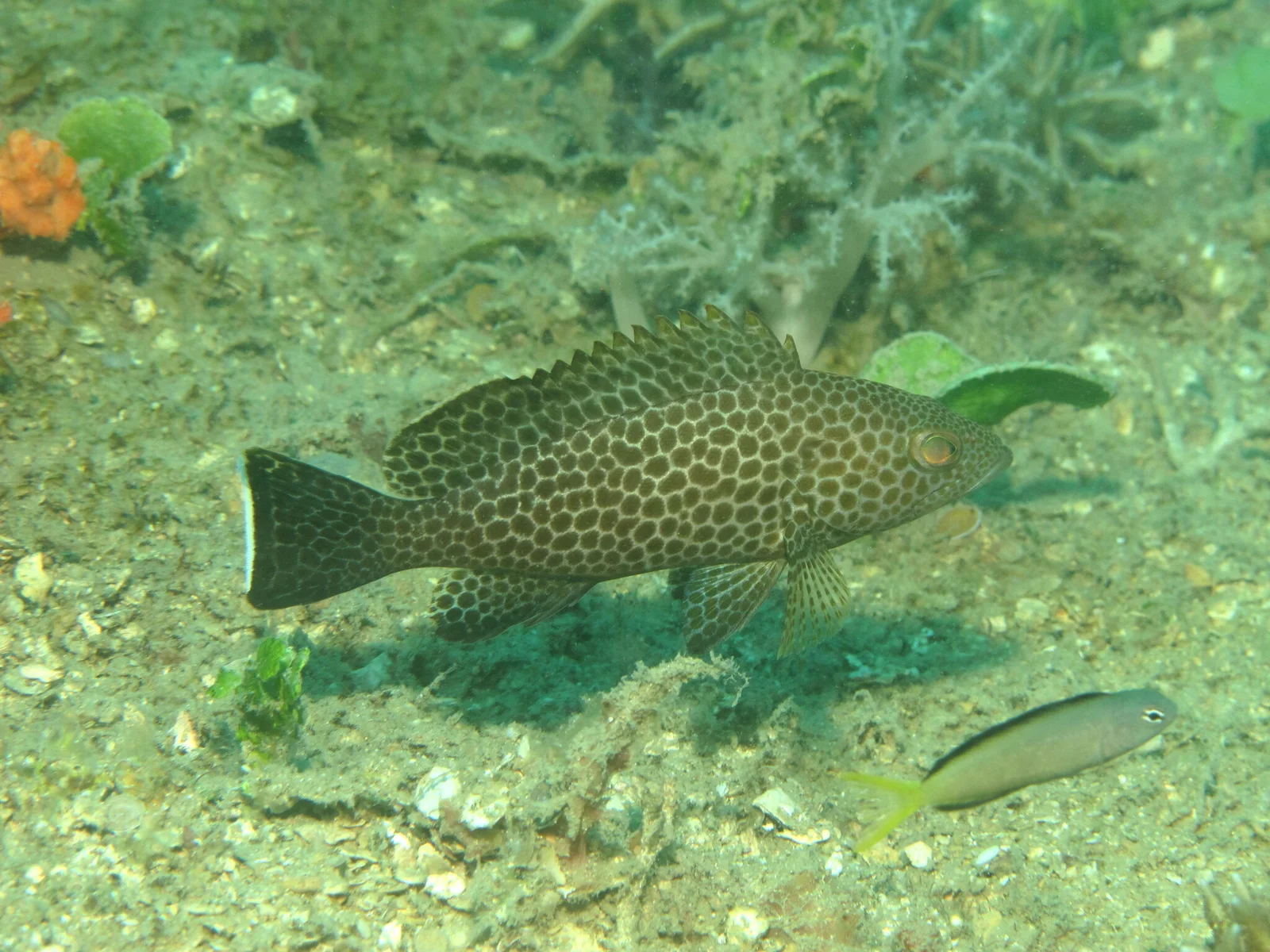
Areolate grouper
- Family
- Epinephelidae
- Depth
- 6–200 m
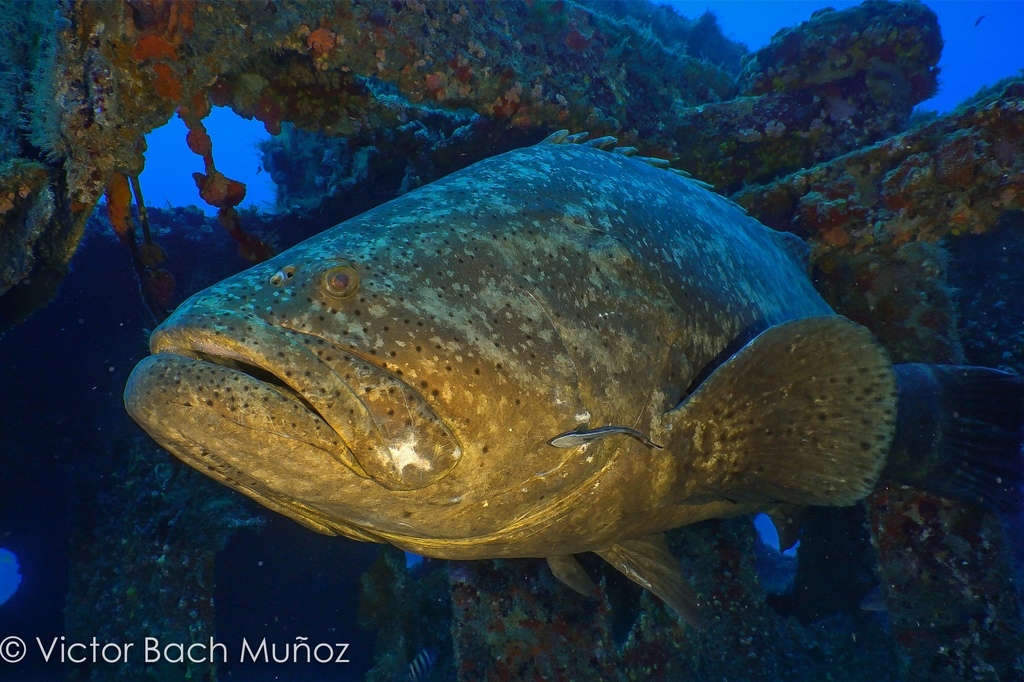
Atlantic goliath grouper
- Family
- Epinephelidae
- Depth
- 0–100 m
- Season
- Jan, Feb, Jun, Jul, Aug, Sep

Black grouper
- Family
- Epinephelidae
- Depth
- 60–250 m
- Season
- Jan, Feb, Mar, Apr, May, Jun, Jul, Aug, Sep, Oct, Nov, Dec
Guides for this water
Technique, gear and safety guides that fit Convict grouper.