
Foursaddle grouper
Most species pages tell you where a fish lives. This one is more useful read backwards. FishBase states plainly that the species is not known from the Red Sea, the Persian Gulf, Sri Lanka, the Philippines, Taiwan, Japan or Australian waters, the single exception being Rowley Shoals off Western Australia. Seven absences and one exception make a better trip filter than the positive list does.
Most species pages tell you where a fish lives. This one is more useful read backwards. FishBase states plainly that the species is not known from the Red Sea, the Persian Gulf, Sri Lanka, the Philippines, Taiwan, Japan or Australian waters, the single exception being Rowley Shoals off Western Australia. Seven absences and one exception make a better trip filter than the positive list does.
A range drawn by what is missing
So the plan starts by crossing places off. A grouper trip built around Sri Lanka or the Philippines is not a foursaddle trip, whatever else it may be. The reason the absences matter more here than usual is that the species is insular: apart from the African coast from Zanzibar down to Ponta Zavora in Mozambique, it belongs to islands rather than continents. Islands are exactly what a travelling angler books, and they are also where the checklist is thinnest.
Four saddles and a white net
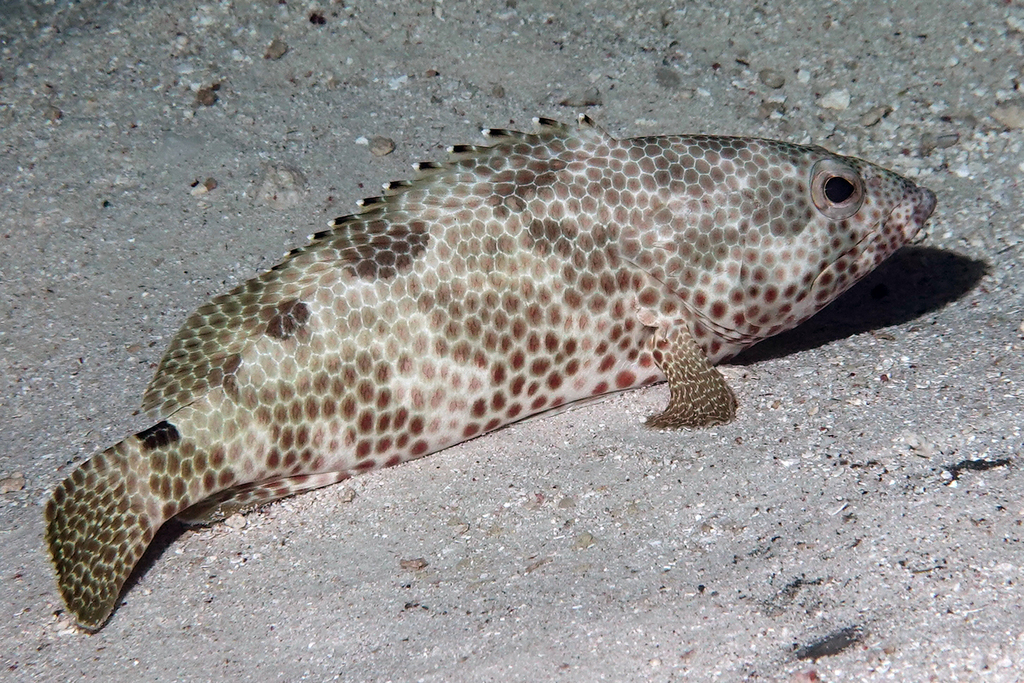
The head and body are packed with close-set dark brown, olive or reddish brown spots. On the upper parts those spots are polygonal and almost touching, and the narrow gaps between them form a white reticulum; on the belly they turn rounder, more separated and often more red. Three dark blotches sit at the base of the dorsal fin and a fourth, saddle-shaped, crosses the caudal peduncle. That last mark is what separates it from Epinephelus merra and E. quoyanus.
Counts: eleven dorsal spines with fourteen to sixteen soft rays; the anal fin carries three spines and eight rays. The preopercle is rounded with a shallow notch, its serrae enlarged but covered in skin, and the upper edge of the operculum is nearly straight. Small dark spots sit on the snout and sometimes between or below the eyes, which is the detail that survives when the light is bad.
Patch reef, channel lip, reef margin
Habitat is given as lagoon patch reefs, the upper slopes of channels and reef margins, in 0 to 30 m. Three landforms, one theme: edges where a coral patch meets open sand or open water. On an atoll that translates into a very specific drift. Find a patch of coral sitting inside the lagoon, work the sand rim around it, then move to the mouth of a channel and fish the top of the slope rather than the floor.
The fish is solitary, so a mark holds one fish, not a school. That changes the arithmetic of a day: more drops, fewer double-headers. It also means a mark that has just produced is not finished, because nothing else on the patch was competing for the bait.
Because the depth stops at 30 m, the whole habitat is reachable without a deep drop. A drift over a lagoon patch can be fished with a single small sinker and a short cast, and the channel lip can be covered on the same tank.
Nothing published on the biology
The record says it outright: nothing has been published on the biology of this species. No spawning months, no temperature range, no age, no growth curve. The only number with a growth meaning is first maturity at about 19 cm. Here the gap is treated as a gap rather than filled with a plausible guess, because a guessed season becomes a booked flight.
What can be used instead is behaviour that is stated: it is carnivorous and it is solitary. A solitary ambush predator on a patch reef means the bait goes to structure and stays there, and the search is a series of small stops rather than one long drift. The trophic level of 3.8 puts it a step above the grazers and a step below the big fish-eaters, which fits a fish that takes what comes past its patch rather than hunting across the lagoon.
One and a half kilos
Maximum 47.5 cm total length and 1.5 kg. That is a modest grouper, small enough that heavy tackle is a disadvantage: a stiff rod and a locked drag will tear the hook hold on a fish this size, and the same outfit will not stop anything larger that lives on the same reef.
A medium rod, 3000 to 4000 reel, 1.0 to 1.5 PE braid and a 20 to 25 lb leader covers the species and still has a chance if something bigger takes the bait. Hooks sized for a 19 cm fish, not for the 47 cm ceiling. Resilience is medium, with a doubling time of 1.4 to 4.4 years, and fishing vulnerability is 39 out of 100, the lowest figure among the groupers in this batch.
One country on the list
Uses are commercial fishing and gamefishing; IUCN places it in Least Concern, with an assessment date of 6 November 2017, and it is classed as harmless to humans, ciguatera not appearing in the record.
Of the countries in this page's working range, only the Maldives carries a regulatory note here. Maldivian law forbids killing reef sharks, applies seasonal closures where grouper gather to spawn, requires a permit before reef fish leave the country, and blocks the sale of anything a visitor catches. Every other coastline in the distribution text falls back on its own national framework, which is exactly the kind of statement that has to be checked rather than assumed.
How to catch it
Boat bottom fishing
Fished with the listed approach, matched to the recorded depth and size.
Where these facts come from
Check these pages before you rely on a size, range or protection status.
- FishBase — Epinephelus spilotoceps — FishBase · T2
- GBIF — Epinephelus spilotoceps occurrence records — GBIF · T2
- IUCN Red List — Epinephelus spilotoceps — IUCN · T1
- Photo record — iNaturalist — iNaturalist · T3
Fish in the same water
These fish live in the same place.

Guides for this water
Technique, gear and safety guides that fit Foursaddle grouper.