
Kingklip
The most useful thing on this page may be what is missing. Kingklip has a maximum length, a maximum weight and a maturity length, but no common length, no recorded gamefish use and a spawning table with a single row whose location reads "Not stated". Those blanks are not decoration; they tell you which parts of a fishing plan the source can support.
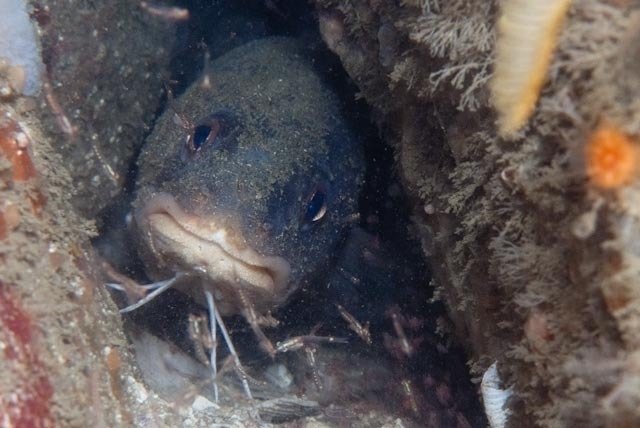
The most useful thing on this page may be what is missing. Kingklip has a maximum length, a maximum weight and a maturity length, but no common length, no recorded gamefish use and a spawning table with a single row whose location reads "Not stated". Those blanks are not decoration; they tell you which parts of a fishing plan the source can support.
What the file does not hold
Three decisions on this page have no number behind them. There is no common length, so no target size separates a keep fish from a release fish; that choice falls to the national minimum for the area, not to FishBase. There is no gamefish designation, so the page does not treat kingklip as a sport catch; a line fisher is working a commercial species and should expect commercial rules. The spawning table has one row, August to October, and its location field says "Not stated", so no local closure can be built from it.
The name adds a second trap. Wikipedia points out that the fish is not an eel despite its shape. On a dock where "kingklip" may be applied to more than one ophidiid, only the binomial survives a regulations check.
180 cm, 15 kg, no common length
Maximum length is 180 cm TL, maximum published weight is 15 kg, and no common length is published. Without a common length there is no target size, only a ceiling; a 180 cm fish is an outlier, and a line fisher should expect most keepable fish to be judged by the national minimum rather than by a species average.
No maximum age is published either. For a fish that reaches 180 cm and 15 kg, that means the page cannot tell you how old a large specimen is; age has to come from otolith work in the fishery, not from this record.
Maturity at 67.5 cm
The only size threshold the page supports is a release rule: below roughly 60 cm, the sample data place the fish below first maturity, so a fish that small is the one to put back. Above 75 cm, every estimate in the published range is mature. Between 60 and 75 cm, which fish has spawned is unresolved, so the local minimum, not the biological estimate, decides what goes in the box.
The 250–350 metre working band
FishBase spans 50–500 m and narrows the working range to 250–350 m. The species is bathydemersal, and the environment line places it in subtropical water from 17°S to 36°S. The 450 m gap between the shallow record and the deep record is the full envelope; the 100 m core is the strip a skipper can actually target.
A 250–350 m drift is deep water. It needs enough lead to hold bottom, and it needs a sounder that can still resolve a fish close to the seabed at that depth. The page gives no substrate detail for that core beyond hard ground, so depth is the stronger planning number.
Two countries on FishBase, three in GBIF
GBIF places the species in South Africa and in the Mozambican exclusive economic zone. FishBase, by contrast, runs it from Walvis Bay in Namibia to Algoa Bay in South Africa. The two ranges agree only on South Africa: Namibia appears in one, Mozambique in the other. A skipper working either edge is therefore outside the area both sources support, and should treat a kingklip there as a range extension rather than a target.
August to October, with no location
The spawning table marks August through October, with one row, and the location is "Not stated". That is a season without a place. It cannot tell a Namibian skipper and a South African skipper the same thing, because the page does not say which stock the months describe.
The honest use of the row is narrow: the species spawns in late winter and early spring somewhere in its range. The page does not support a local closure, a local peak, or a statement that spawning is finished by November.
Rocky slope and open water
Kingklip is caught on hard slope, and the page's ground description points to rock rather than sand. That matters at 250–350 m: a bait on a rocky slope can be kept off snags, while a bait on flat sand has nothing to snag and also no structure to hold fish. Set the drift along the slope, not across it, and keep the lead heavy enough to stay in contact without wedging into crevices.
Commercial, unassessed, rule-bound
Commercial fishing is the only use FishBase records; no gamefish designation appears. The absence of a Red List assessment matters more than the label itself: a South African line fisher has no conservation reference from this page, so the rules that bind the catch are the permit conditions and the bottom-trawl bycatch limits for the area where the fish is landed. Those are national and area-specific, and they are not reproduced here. Wikipedia notes that kingklip is a staple of South African menus, which explains the commercial pressure without supplying a catch limit.
For a skipper, the practical consequence is to treat every kingklip as bycatch until the local permit says otherwise, and to log the depth with the fish. Without a common length or a local spawning date, a catch record with depth and area is the only data this species will get from the recreational side.
Where these facts come from
Check these pages before you rely on a size, range or protection status.
- FishBase — Genypterus capensis — FishBase · T2
- GBIF — Genypterus capensis occurrence records — GBIF · T2
- IUCN Red List — Genypterus capensis — IUCN · T1
- Photo record — iNaturalist — iNaturalist · T3
Fish in the same water
These fish live in the same place.
Ling
- Family
- Ophidiidae
- Depth
- 22–1000 m
- Season
- May, Jun, Jul, Aug, Sep, Oct

Acoupa weakfish
- Family
- Sciaenidae
- Depth
- 1–20 m
- Season
- Jan, Feb, Mar, Apr, May, Jun, Jul, Aug, Sep, Oct, Nov, Dec

American angler
- Family
- Lophiidae
- Depth
- 0–800 m
- Season
- Mar, Apr, May, Jun
Guides for this water
Technique, gear and safety guides that fit Kingklip.