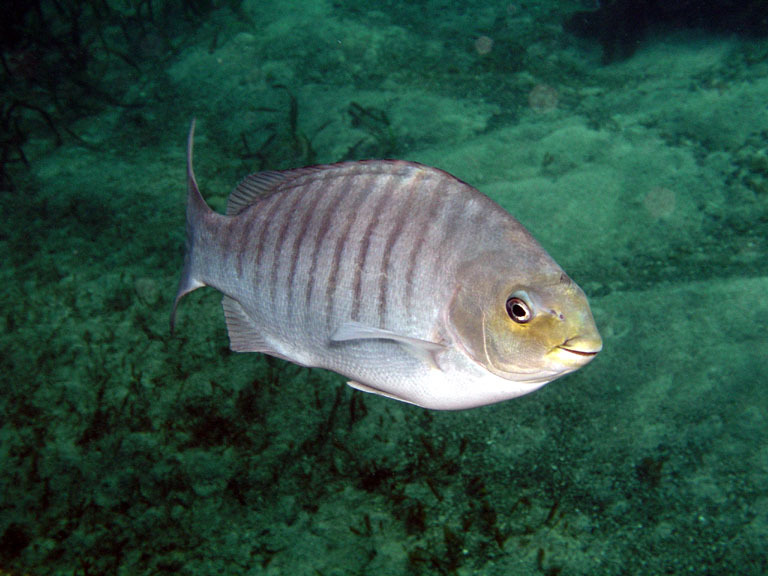
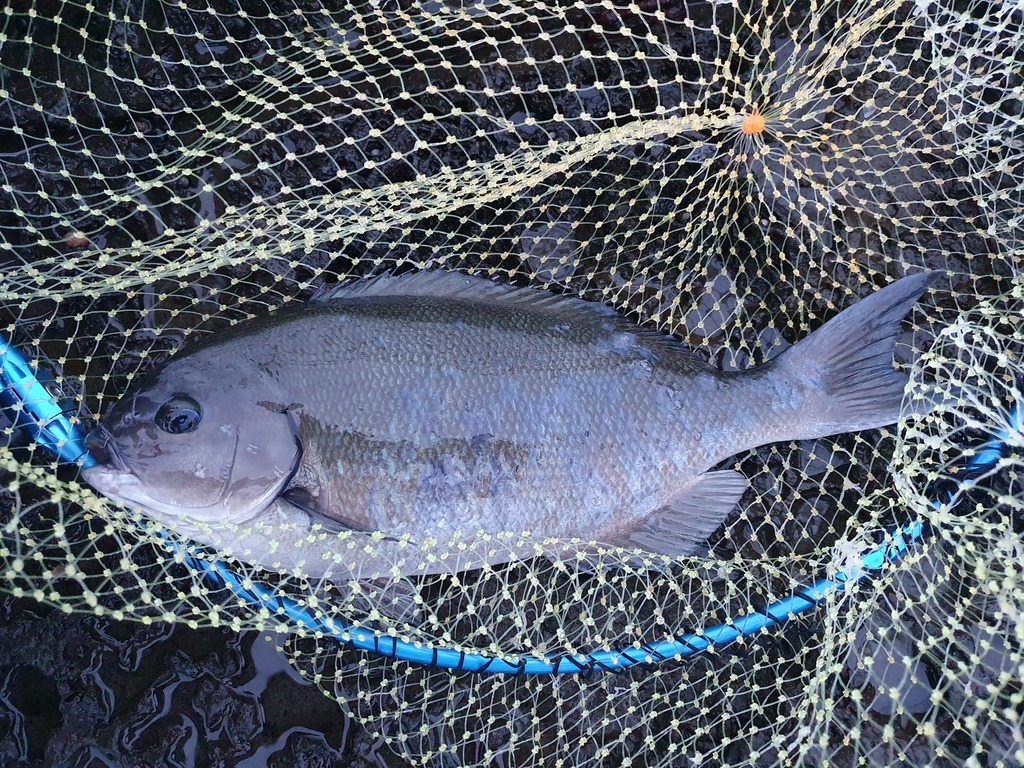
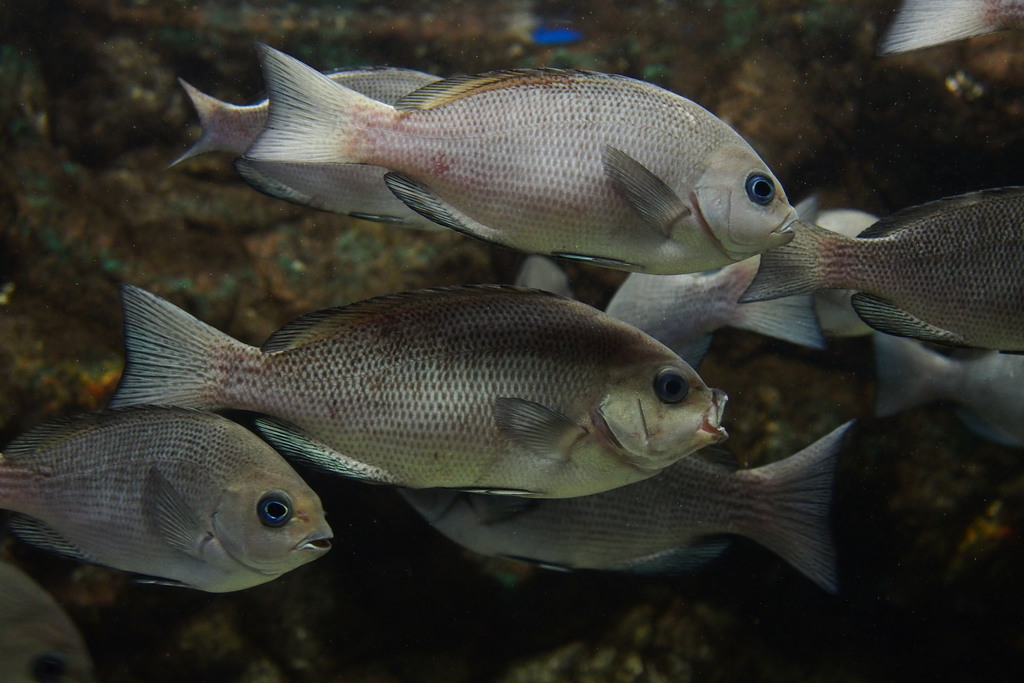
Parore (Girella tricuspidata) is a fish of the family Girellidae. FishBase gives its range as: Western Pacific: southeastern Australia (southern Queensland to South Australia) and New Zealand. It is recorded from 0 to 20 m, in temperate water. The recorded maxima are 71 cm FL, 4 kg, 24 years. Diet includes fishes and algae. IUCN status: Not Evaluated (NE). Chinese name: .
Three rulers in one row
Three size figures sit in one row and none of them uses the same ruler: the maximum is 71 cm FL, the common length is 35 cm TL, and the maturity point is 29.5 with no length type printed at all. FL and TL are different measurements, and the third figure has no label. This article separates the three instead of ranking them, because a comparison built across mixed bases produces a number that looks precise and is not.
Seventy-one, measured to the fork
Maximum length is 71 cm FL, cited to reference 6390. FL is fork length, measured from the snout to the deepest point of the tail fork. It excludes the tips of the caudal fin, so it is shorter than TL for the same fish. The record gives no TL equivalent, and this page will not manufacture one.
Maximum published weight is 4 kg, also cited to reference 6390. The same reference carries both maxima, but the row does not say the 4 kg fish was the 71 cm fish. Two maxima from one source can describe two different specimens; treating them as one animal is an assumption, not a reading.
Thirty-five, measured to the tip
Common length is 35 cm TL, cited to reference 2158. TL is total length, measured to the tip of the caudal fin, so a 35 cm TL fish and a 35 cm FL fish are not the same size: the FL fish is longer in life.
The two figures are from different references and use different bases. On paper, 35 is 49 per cent of 71. That percentage compares a TL figure with an FL figure, which is the one thing the record does not license. The honest statement is narrower: the common fish is described by a smaller number than the maximum, the bases differ, and no conversion appears in the row.
Twenty-nine point five, with no ruler named
The maturity row prints "L m 29.5, range 22 - ? cm". The range is in centimetres, but the length type is absent: the row does not say TL, FL or SL. So the third figure cannot be placed on either of the first two scales.
This is the most consequential blank in the size row. If 29.5 is FL, it sits below the 71 cm FL maximum and can be compared with it. If 29.5 is TL, the comparison crosses bases again. The record does not say which, and a page that picks one without evidence is inventing a unit.
The range also ends in a question mark: 22 to unknown. Even the lower bound is a single number, and the upper bound is not recorded.
Ten months, and two holes
Six spawning rows cover January, February, March, June, July, August, September, October, November and December. April and May appear in none of them, so the union is ten months, not twelve.
The rows are not six independent seasons. Three of them — Clarence River, Tuggerah Lake and Turros River — come from the same sampling window, September 2003 to March 2005, and their coordinates are printed with the localities. A fourth, Gippsland Lakes, gives January–March plus October–December; Central and northern New South Wales gives August–December; Moreton Bay gives July–August.
Four of the six localities are rivers, lakes or lagoons: Clarence River, Gippsland Lakes, Tuggerah Lake and Turros River. The environment line reads "Marine; brackish", so spawning in those waters is inside the record rather than an exception to it.
Zero to twenty, and a seagrass word
Depth runs 0 to 20 m, cited to reference 9002, with no usual band. A zero minimum puts the surface inside the range; a 20 m maximum is a boat drop, and the 20 m span is the whole vertical statement the page makes.
The habitat keywords are reef, rocky, coastal and seagrass. Seagrass is the only one of the four that names a plant rather than a rock or a zone, and it is the keyword that best matches the lake and river localities in the spawning table. The diet keywords are fishes and algae.
Luderick and parore
The species runs along southeastern Australia, from southern Queensland to South Australia, and around New Zealand. Wikipedia gives the two common names that carry the fishery: luderick in Australia and parore in New Zealand. FishBase's English alias list adds blackfish, blackperch, darkie, nibbler, Pacific bream and rockperch.
Human uses are commercial and gamefish. The IUCN category is Not Evaluated, and both CITES and CMS are marked Not Evaluated. With no assessment, the record carries no stock judgement at all.
Rigging across three rulers
The deck plan has to name its unit every time. A 35 cm TL common fish sets the net and the rod; a 71 cm FL maximum sets the upper bound but is measured on a different scale, so it is not a 71 cm TL fish. The 29.5 cm maturity figure cannot set a release size until someone establishes whether it is TL or FL.
The 4 kg maximum is the only weight in the row, and it is not tied to a length. A scale on board is the only way to compare a fish with it.
The seasonal plan uses the ten recorded months and treats April and May as blanks rather than as closed months. The depth plan uses 0–20 m with no usual band, and the habitat keywords point at rock, reef, coast and seagrass rather than at open water.
iNaturalist holds 2,648 observations. That is documentation, not abundance, and it is large relative to the GBIF record: GBIF carries two distribution assertions, one with a country code (New Zealand) marked PRESENT and one regional label, Australasian. Two assertions cannot map a coastline that runs from southern Queensland to New Zealand.
Regulations before you keep it
These are the published regulations for this fish. Read the number first. The notice below it is the actual regulation.
Minimum size3
≥27 cm
Australia — New South Wales · AU-NSW
New South Wales sets a 27 cm minimum legal length for luderick (Girella tricuspidata).
The NSW common name is luderick; species.json lists the same species as Parore with luderick as an alias.
Luderick Luderick 27 cm 10. 20 in possession.
≥30 cm
Australia — Queensland · AU-QLD
Queensland sets a 30 cm minimum size for luderick.
Luderick | Min: 30cm | Limit: 10
≥23 cm
Australia — Victoria · AU-VIC
Victoria sets a 23 cm minimum legal length for luderick.
Minimum legal size: 23cm
Bag limit3
10 fish per person per day · 20 in possession
Australia — New South Wales · AU-NSW
New South Wales allows 10 luderick per person per day and 20 in possession.
The NSW common name is luderick; species.json lists the same species as Parore with luderick as an alias.
Luderick Luderick 27 cm 10. 20 in possession.
10 fish possession limit
Australia — Queensland · AU-QLD
Queensland sets a possession limit of 10 Parore.
A possession limit is the total number of fish you may keep at any time, including fish at home or in the freezer; it is not a daily take limit.
Luderick | Min: 30cm | Limit: 10
10 fish per person per day
Australia — Victoria · AU-VIC
Victoria allows 10 luderick per person per day.
Bag limit | 10
Every record above names its source and the date it was retrieved. See the regulation register for the full list, or how to read these regulations.
Where these facts come from
Check these pages before you rely on a size, range or protection status.
-
FishBase — Girella tricuspidata
— FishBase · T2
-
GBIF — Girella tricuspidata occurrence records
— GBIF · T2
-
IUCN Red List — Girella tricuspidata
— IUCN · T1
-
Photo record — iNaturalist
— iNaturalist · T3