
Spottedtail morwong
A shallow rocky-reef fish that reaches 45 cm, with nine oblique brown bands and pale spots on the tail. It is solitary, omnivorous, and takes bait so readily that it often arrives before the fish an angler wanted. Handled properly it gives clean white flesh; in summer, when the weed rots, it can carry a shore smell.
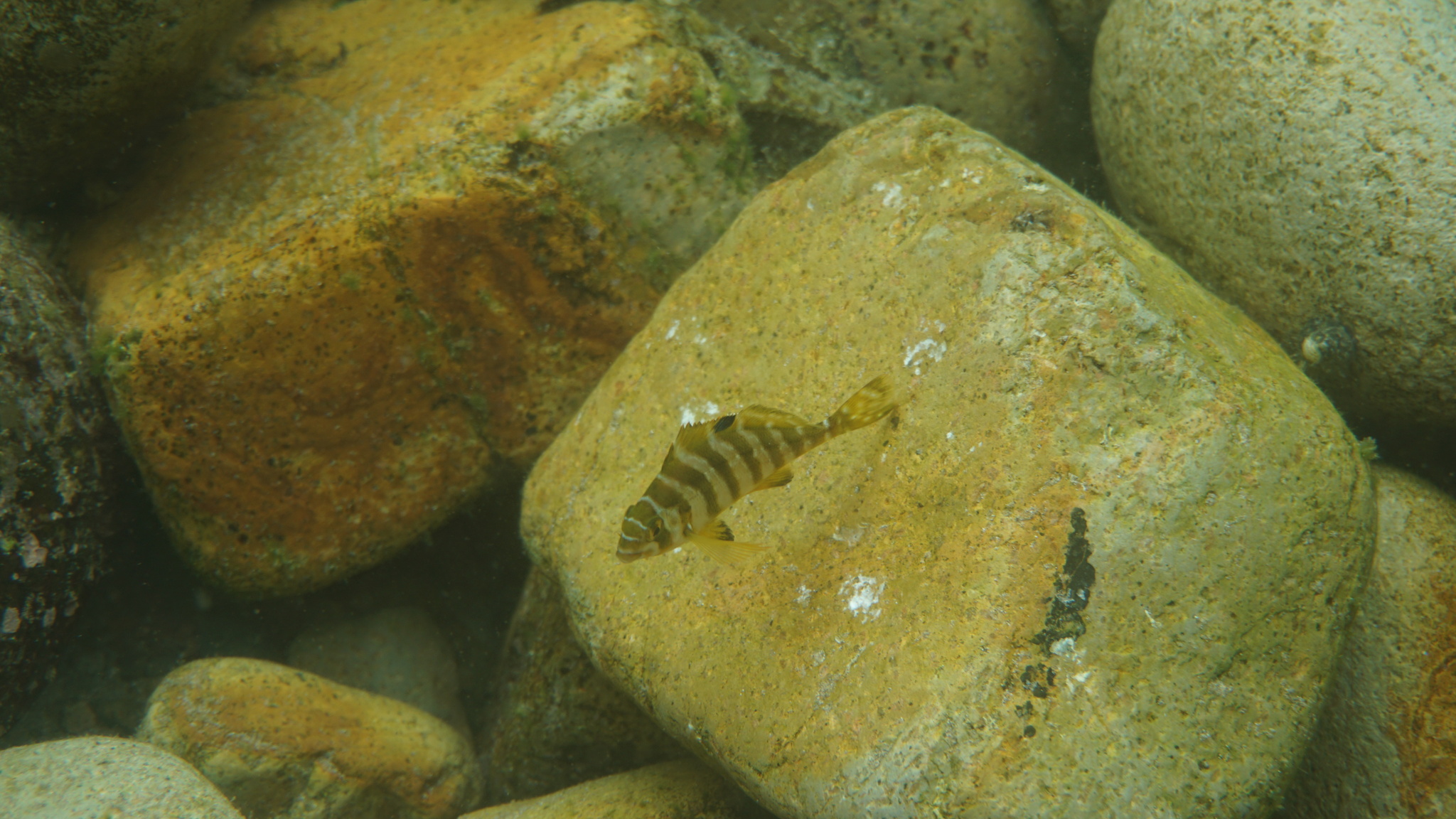
A shallow rocky-reef fish that reaches 45 cm, with nine oblique brown bands and pale spots on the tail. It is solitary, omnivorous, and takes bait so readily that it often arrives before the fish an angler wanted. Handled properly it gives clean white flesh; in summer, when the weed rots, it can carry a shore smell.
Nine oblique bands and a spotted tail
Goniistius zonatus is compressed with a deep body, a hump behind the eye, a small head, thick lips and a small mouth. The lower soft rays of the pectoral fin are long and thick, and the fish uses them to steady itself while resting on the bottom. The body is pale blue-brown to pale yellow-brown with nine oblique brown bands across the flank, a dark brown patch at the rear edge of the operculum, yellowish-brown fins, and pale blue-white spots on the caudal fin. The close relatives are easy to mix up: G. zebra is yellower, has red around the mouth and no white caudal spots, with the upper half of the tail yellow and the lower half brown; G. quadricornis has no caudal spots and its band through the eye does not split into three above the eye. Band completeness and the tail spots are the reliable checks.
A shallow rock fish that lives alone
FishBase records the species from the Pacific, central Honshu southward, the South China Sea and Taiwan. The Japanese account is finer: the Pacific coast from the Tsugaru Strait through Miyagi's Kesennuma to southern Kyushu, the Japan Sea and East China Sea from Tsugaru to southern Kyushu, and the Seto Inland Sea, with fewer records from the Izu Islands, Ogasawara, Amami, Kikai, Tokunoshima and Okinawa, plus Taiwan, southern Korea and Hong Kong. It lives on shallow rocky reef and in weed beds, is visible at the foot of a breakwater, and is solitary rather than schooling. The ground to choose is shallow, with algae, gravel and crevices mixed together, rather than clean sand.
A spawning season both sources only guess at
The fish is omnivorous, taking small crustaceans and algae. It also presses its thick lips against the bottom and sucks up sand and gravel, filtering the benthic life out with its gill rakers. Spawning is given as October to December in one Japanese source, with the wording presumed, and as autumn to winter in the other; both are tentative, and neither is converted into a fixed month here. The eggs are about 1 mm, pelagic and separate, hatching in 24 to 48 hours, and juveniles appear in tide pools in early summer before moving deeper as they grow. The fish can be caught all year. The market season is April to September, with a competing claim that it is good year-round. In summer, rotting weed can leave the flesh with a shore smell; in winter it is cleaner. Fishing season and eating season are not the same thing.
It arrives before the fish you wanted
From the Boso Peninsula south, both rock ledges and breakwaters produce fish, and the standard approach is the ukifukase float rig used for mebina, with krill, kneaded bait or seaweed. A standing float works from a breakwater. A bottom rig with caddis larvae also takes fish from the lower layers. The problem is that it feeds readily and often arrives before the intended species; Chiba anglers say that once this fish appears, the mebina and the black sea bream stop coming. The countermeasures are a larger, harder bait ball, or a presentation deeper and further into the current, where the fish is less concentrated. No special tackle is needed, which is part of why it turns up so often as a bycatch.
Thick lips, sharp spines
Iso tackle is a 1 to 2 rod at 5.3 m, 2 to 3 main line, 1.5 to 2 leader and mebina hooks in sizes 5 to 7. For a standing float from a breakwater, a 3.6 to 4.5 m rod with 2 main line and 1.5 leader is enough. The dorsal spines are sharp, so a glove or a towel over the fish comes before unhooking. The leader does not need to be fine: the lips are thick and hard, and a light line abrades against them rather than cutting through.
Hard scales, and flesh that rewards care
The flesh is white and translucent with little blood line, and it suits sashimi, a seared preparation, yubiki — a Nagasaki treatment — frying, simmering, butter sauté and miso soup. The scales are very hard, and on the coast the usual trick is to pour hot water over the fish to soften them before scraping. The skin is thick and stands up to cooking. A fish that has been killed cleanly and kept cold tastes better than its reputation suggests. Japan has no nationwide recreational size or closed season; sea fishing follows prefectural fishery adjustment rules and cooperative angling rules. No published species-level restriction was found, but the rules of Chiba, Kanagawa, Shizuoka and Tokushima still need checking. That check was not completed and is marked deferred.
Where each fact came from, and the guess left as a guess
Taxonomy, distribution and length come from FishBase. The Japanese distribution, the separation from its relatives, the diet, spawning, cooking and fishing method come from the market encyclopedia; the fishing encyclopedia adds the methods and the seasonal assessment. In both Japanese sources the spawning period is expressed as a guess, and the wording is kept that way here: presumed October to December in one, autumn to winter in the other, never as a confirmed month.
How to catch it
Float fishing
Fished with the listed approach, matched to the recorded depth and size.
Rock fishing
Fished with the listed approach, matched to the recorded depth and size.
Shore casting
Fished with the listed approach, matched to the recorded depth and size.
Where these facts come from
Check these pages before you rely on a size, range or protection status.
- FishBase — Goniistius zonatus — FishBase · T2
- GBIF — Goniistius zonatus occurrence records — GBIF · T2
- IUCN Red List — Goniistius zonatus — IUCN · T1
- Photo record — iNaturalist — iNaturalist · T3
Fish in the same water
These fish live in the same place.

Yellowstriped butterfish
- Family
- Centrarchiformes
- Depth
- 0–50 m
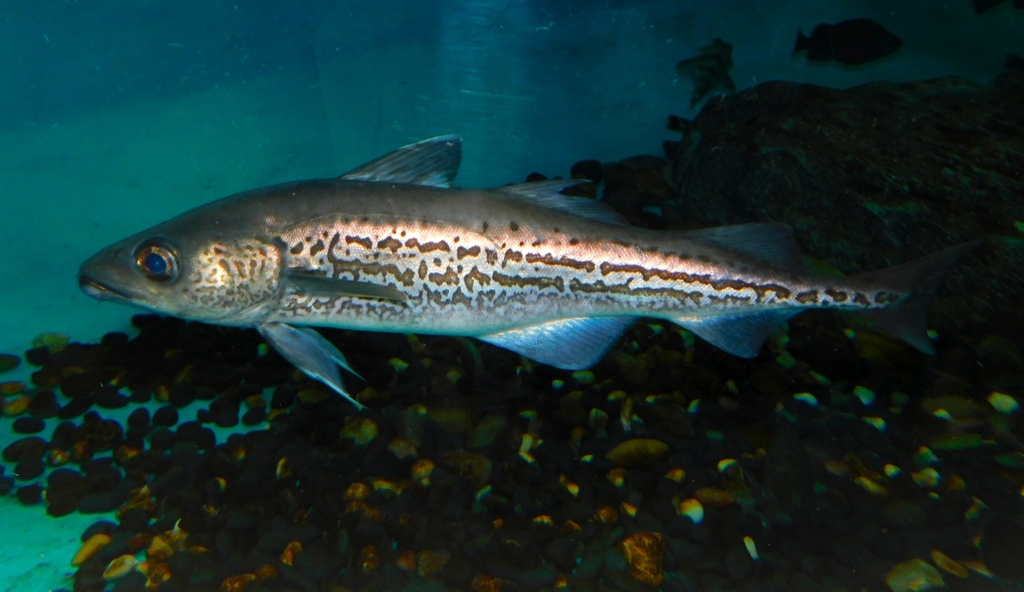
Alaska pollock
- Family
- Gadidae
- Depth
- 0–1280 m
- Season
- Jan, Feb, Mar, Apr, May, Jun, Jul, Aug

Albacore
- Family
- Scombridae
- Depth
- 0–600 m
- Season
- Jan, Feb, Mar, Apr, May, Jun, Jul, Aug, Oct, Nov, Dec
Guides for this water
Technique, gear and safety guides that fit Spottedtail morwong.