
White grunt
White grunt is a schooling haemulid of the western Atlantic, from Chesapeake Bay through the Gulf of Mexico and Caribbean down to Brazil. It is a shallow fish, caught between 3 and 40 m, and feeds on crustaceans and small fish. Adults reach 53 cm TL and 4.4 kg and live up to 13 years. It is present year-round, and faint yellow and blue stripes separate it from other grunts.
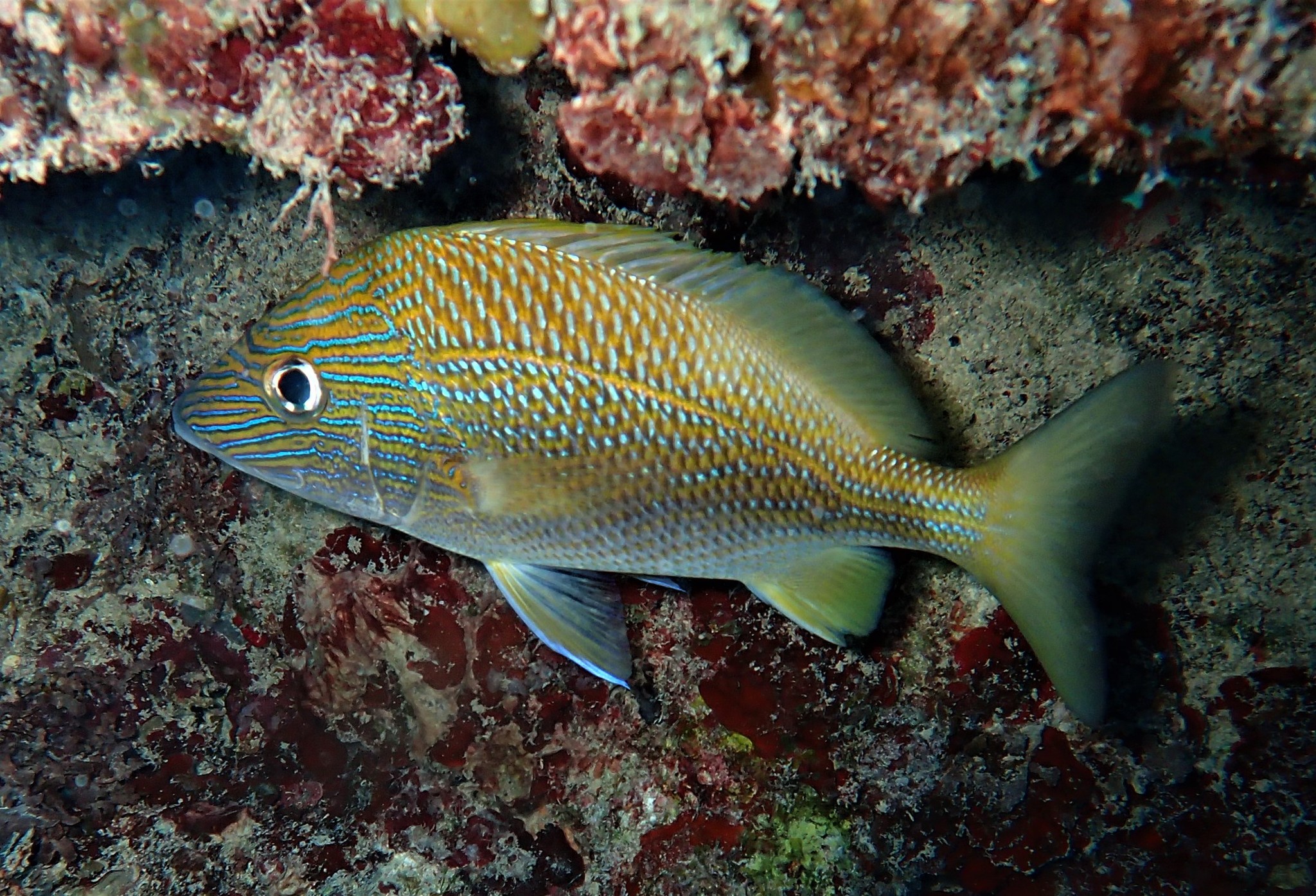
White grunt (Haemulon plumierii) is a fish of the family Haemulidae. FishBase gives its range as: Western Atlantic: Chesapeake Bay, through the Gulf of Mexico and Caribbean southward to Brazil. Including Antilles. Wikipedia describes a silvery-cream body with narrow yellow and blue longitudinal stripes, colour that can be modified to match surroundings, and a close relationship with the bluestriped and French grunts, with which it often schools. It is recorded from 3 to 40 m, in subtropical water. The recorded maxima are 53 cm TL, 4.4 kg, 13 years. Diet includes crustaceans and fishes. IUCN status: Least Concern (LC). Chinese name: .
Identification
Haemulon plumierii is a haemulid grunt with a laterally compressed body and an anal fin of three spines and nine soft rays. The record gives a 53 cm total-length maximum, a 30 cm common length, 4.4 kg maximum weight, 13 years maximum age and 18.3 cm length at maturity, with a maturity range of 11–23.23 cm. Those figures mix three measurement conventions: two total lengths, a weight in kilograms and a maturity length. A 30 cm grunt is the common adult size, while 53 cm and 13 years are separate maxima and do not describe the same fish. iNaturalist holds 3,132 observations under taxon 49951. Wikipedia describes a silvery-cream body with narrow yellow and blue longitudinal stripes, colour that can be modified to match surroundings, and a close relationship with the bluestriped and French grunts, with which it often schools. FishBase also reports ciguatera poisoning, so "edible" is not the same as "safe to eat everywhere".
Habitat and distribution
FishBase labels the species marine, reef-associated and subtropical, with a depth range of 3–40 m. Its habitat keywords are reef and sand. The written range runs from Chesapeake Bay through the Gulf of Mexico and the Caribbean to Brazil, including the Antilles; the country table lists 40 territories from Anguilla and Antigua to Venezuela. Spawning records are not a single season: Ceará in Brazil appears in October–November and in January, June–August, while Cuba appears in January–July and October–December. Read together, the 3–40 m band is not a single "reef" depth. It is a slope from shallow reef crest to deeper sand, and the useful part for an angler is the seam where the two meet.
Season and fishing approach
Because the spawning records cover most of the year at different localities, a spawning calendar is a poor reason to plan a trip. The stronger positional fact is the depth band and the reef/sand pair. Start at the shallow end of the band, where reef structure first meets sand, and move down the slope until fish appear; that is an inference from the two habitat words, not a recorded "usual depth". The diet list — shrimp, other crustaceans, annelids and mollusks — supports bottom baits and small crustacean imitations rather than surface lures. The schooling habit means a single fish is often a sign of a mixed grunt school, so the first hook-up is worth marking rather than moving on immediately. The sources give no tide or current data, so the tide is a variable to record, not a rule to quote.
Edibility and regulations
The FishBase uses tab records minor commercial landings, a gamefish entry and public-aquarium supply; Wikipedia confirms that flaky white flesh and the aquarium trade are the two reasons people handle it. The Red List assessment dated 10 October 2015 returns Least Concern, but the database's international fields carry no CITES or CMS listing for the species. Across the 40 territories in the country table, no legal minimum, take cap or seasonal closure is named, so a size rule from Florida or Puerto Rico has to be checked in that jurisdiction rather than assumed for the whole range. Ciguatera is the only health warning on the record; it is a reef-level risk, not a landing rule, and the sources do not tie it to a size class.
Where these facts come from
Check these pages before you rely on a size, range or protection status.
- FishBase — Haemulon plumierii — FishBase · T2
- GBIF — Haemulon plumierii occurrence records — GBIF · T2
- IUCN Red List — Haemulon plumierii — IUCN · T1
- Photo record — iNaturalist — iNaturalist · T3
Fish in the same water
These fish live in the same place.
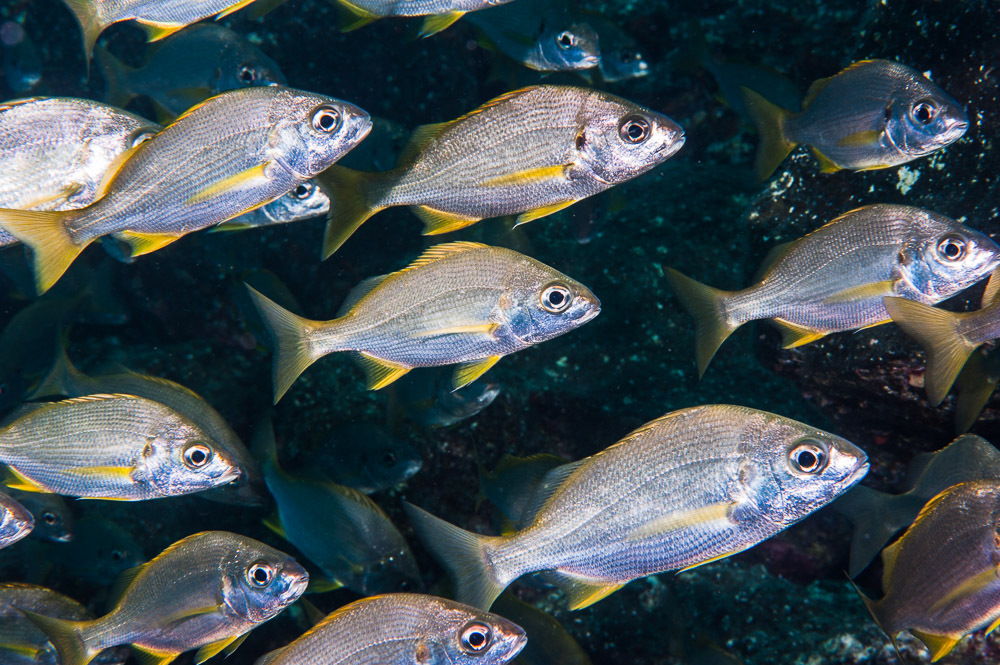
Bastard grunt
- Family
- Haemulidae
- Depth
- 10–100 m
- Season
- Jun, Jul, Aug
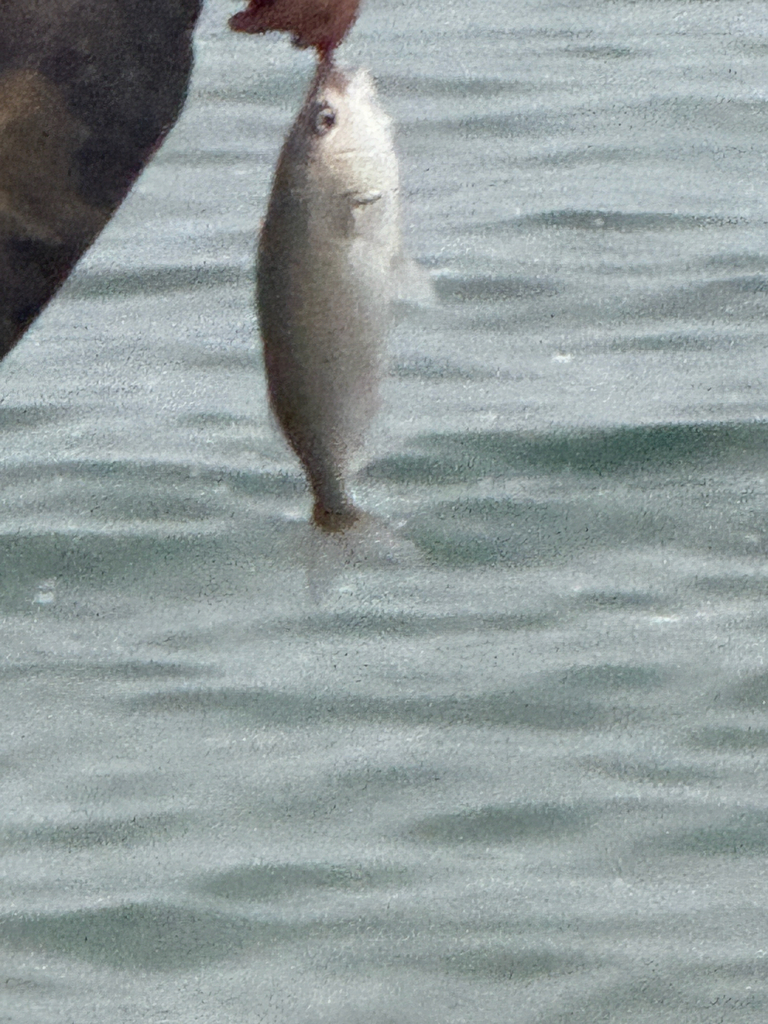
Cabinza grunt
- Family
- Haemulidae
- Depth
- 0–50 m
- Season
- Jan, Oct, Nov, Dec
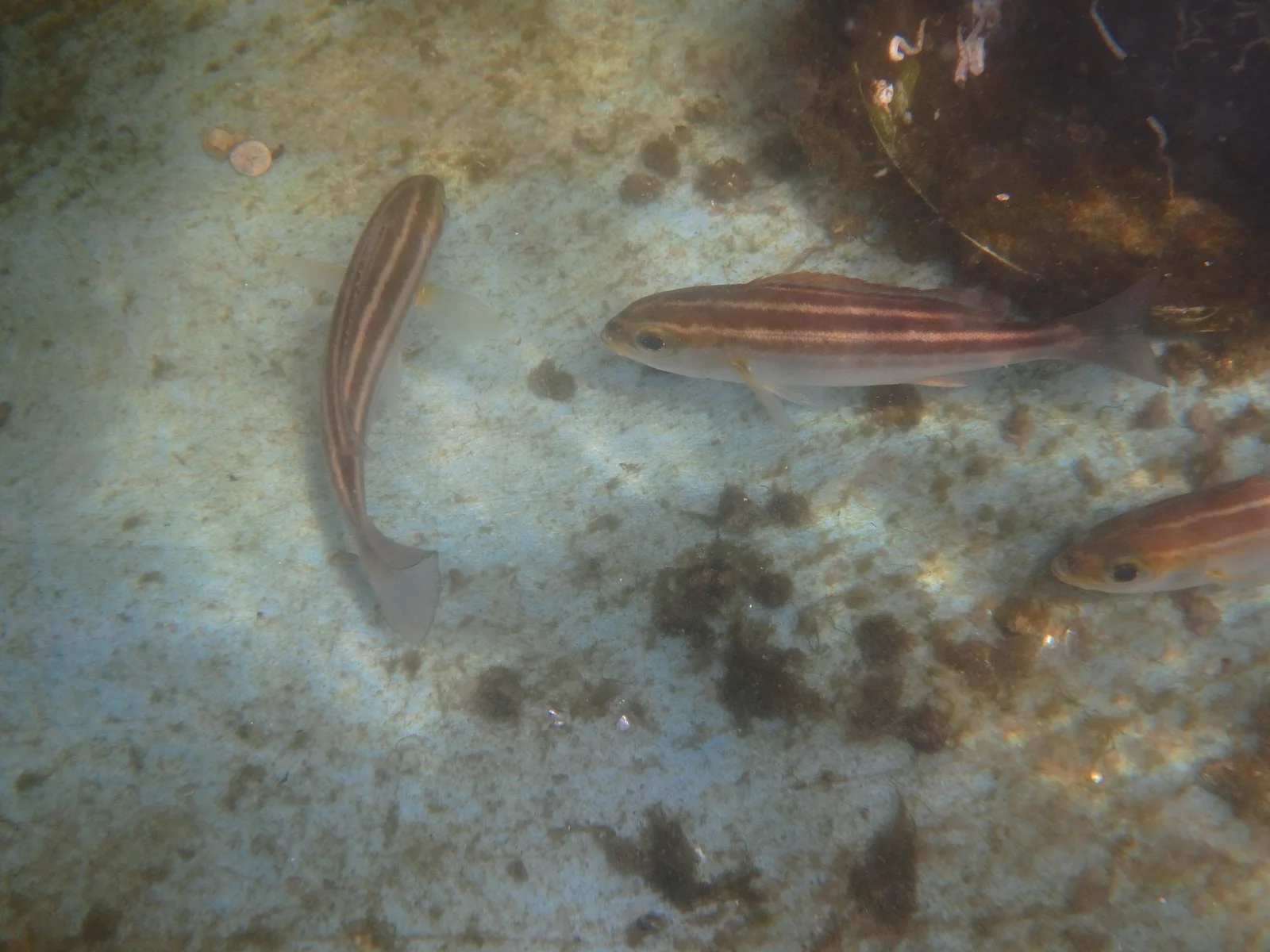
Chicken grunt
- Family
- Haemulidae
- Season
- Jun, Jul, Aug
Guides for this water
Technique, gear and safety guides that fit White grunt.