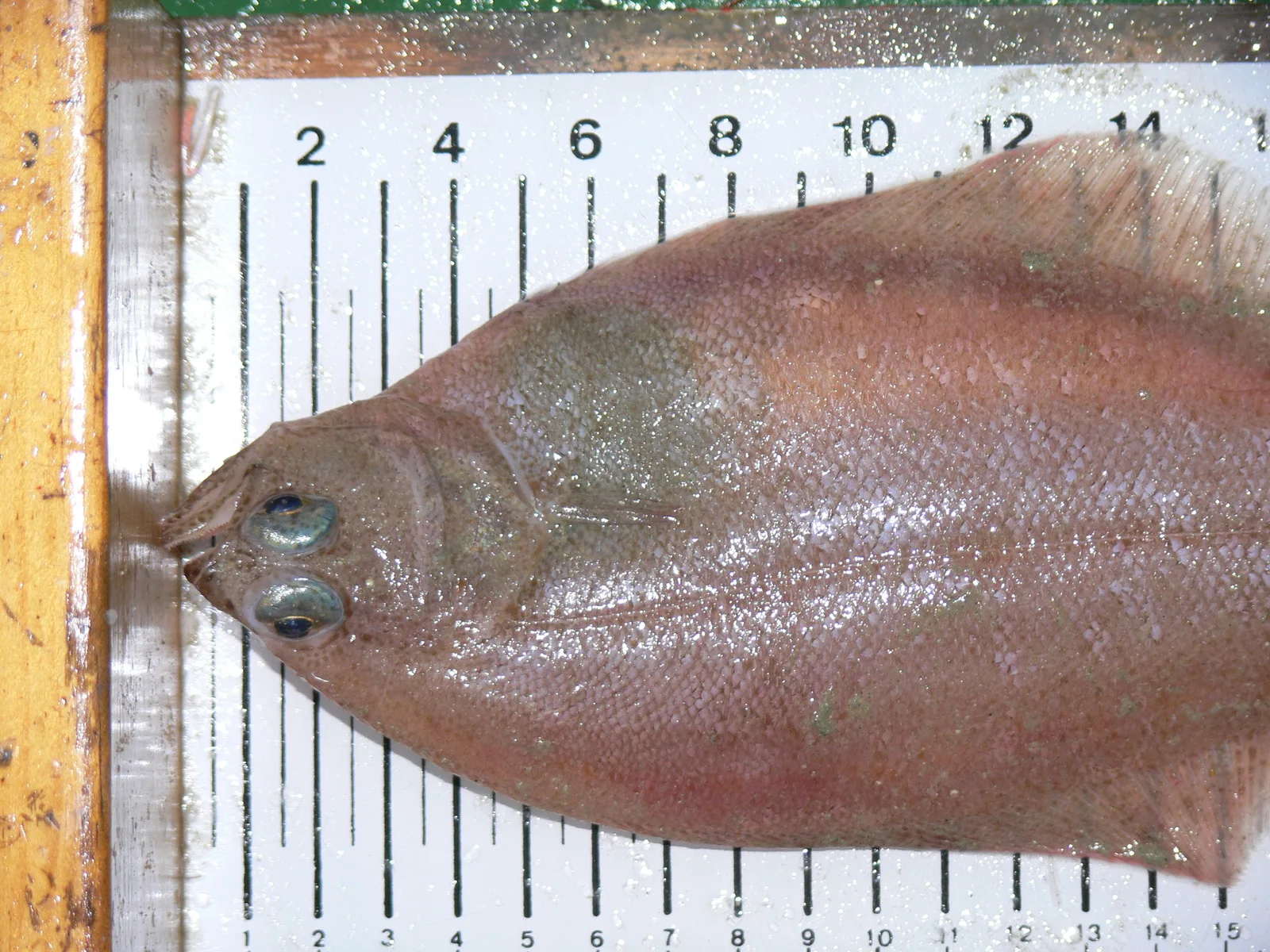
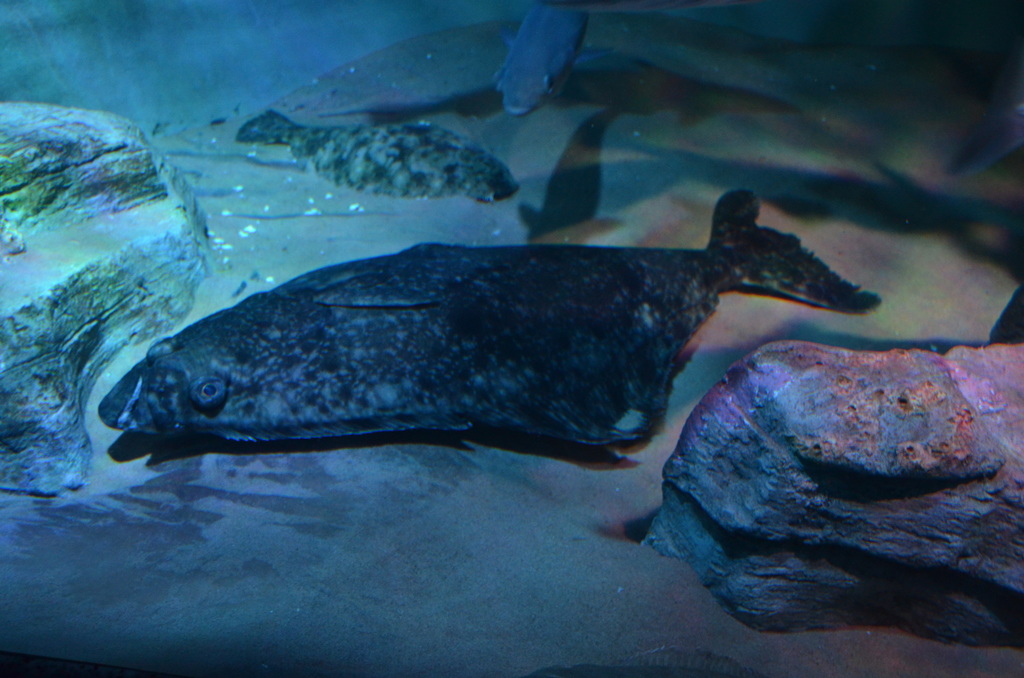
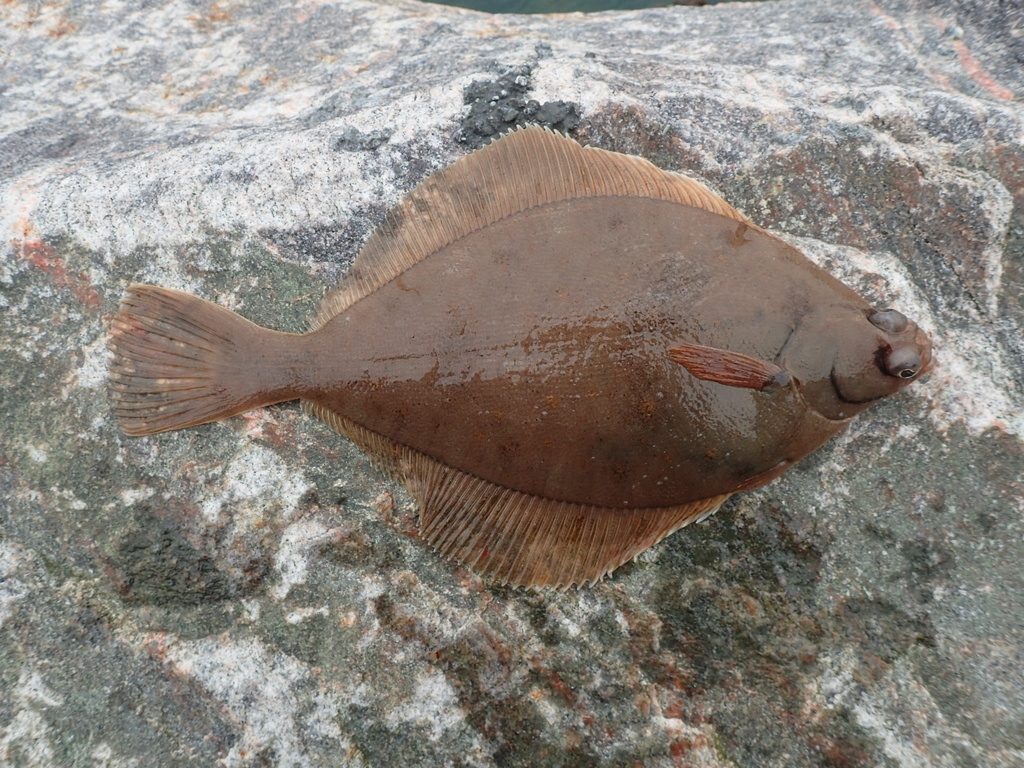
American plaice is a North Atlantic flatfish in the family Pleuronectidae, split into two subspecies across the western and eastern shores of the ocean. It sits on the bottom from about 10 to 3000 m, though anglers meet it most often in the usual 90–250 m band, and it reaches a maximum of 82.6 cm and 6.4 kg. The species is assessed Endangered and supports a highly commercial fishery. A gamefish flag is recorded, but the working depth still makes it a boat target rather than a shore one, so local rules matter before keeping any fish.
One fish, two vernacular traditions
FishBase lists three English vernaculars for Hippoglossoides platessoides: American plaice, recorded for Canada and France and on both the FAO alternative and AFS lists; Canadian plaice, Canada; and long rough dab, the United Kingdom, again as an FAO alternative and as a vernacular. The split is not a set of synonyms invented by different authors. It follows the ocean: American plaice is the North American usage, long rough dab the British one, and the two names sit on either side of the same fish. Wikipedia adds American sole and keeps long rough dab in its opening sentence. iNaturalist prefers American Plaice.
Chinese is narrower: as the FAO form, with and the traditional-character as variants. The FAO name rewards a second look. reads as something like "resembling the halibut", and the genus name says the same thing in Greek: ippos for horse, glossa for tongue, oides for similar to. The fish was named as a small relative of Hippoglossus, the halibut, so both the Latin and the Chinese carry a comparison rather than a description.
Two vernacular traditions and one etymology produce a page that has to name the fish before it can describe it. A reader arriving with "long rough dab" will not recognise without the scientific name, and the reverse is also true.
The morphology block is empty
Taxonomy places the species in Pleuronectidae, order Pleuronectiformes. Wikipedia adds the character the family name implies: it is a right-eyed flounder, one of the flatfishes with both eyes on the right side of the head.
Beyond that, the capture has nothing on anatomy. Dorsal and anal counts, vertebral number, body shape and cross-section are all blank. For most species that is a gap in one section; for a flatfish it removes the part of the description that separates species. Pleuronectidae holds many similar right-eyed forms, and a page with no fin formula and no eye-side photograph cannot key any of them. What remains is a size table, a depth range and a distribution — enough to place the fish, not enough to identify one in the hand.
The blank is stated rather than hidden. It is better to say that the record has no meristic data than to borrow a fin formula from a key that was never captured.
Ten metres to three thousand
The environment line reads: marine, demersal, oceanodromous, depth 10–3000 m with a usual 90–250 m, temperate, between 80°N and 41°N and 72°W and 55°E. The two ends of the depth range are not equally useful. Ten metres is shallow enough for a small boat; three thousand is far beyond any recreational gear. The usual band, 90–250 m, is where the species is actually encountered, and that is the figure a reader should carry away.
Two habitat keywords are recorded: deep, with the diet given as fishes. One physical keyword for a fish that spans shelf and slope is a thin description, and a single prey category says nothing about what juveniles eat. No temperature is captured, so the latitudinal range is the only climate information on the page.
The migration term deserves care as well. Oceanodromous says the fish moves within the ocean; it does not say the fish enters fresh water. That separates it from the anadromous clupeids treated elsewhere on this site, whatever the English name may suggest.
Two subspecies, one ocean
FishBase's distribution text is short: the North Atlantic and adjacent Arctic, with two subspecies, H. p. platessoides in the north-west Atlantic and H. limandoides in the north-east. That is the whole geographical statement. The eighteen country rows are all native — from Canada and Greenland through Iceland, Norway and the Russian Federation to the United Kingdom and the contiguous United States. None is introduced.
Wikipedia supplies the coastlines the database text omits. In the north-west Atlantic the fish runs from Greenland and Labrador to Rhode Island; in the north-east from Murmansk to the English Channel, Ireland and Iceland, and it is rare in the Baltic. Read together, the two accounts describe one species divided by an ocean, which is what the subspecies split records.
GBIF returns 24 distribution rows: 14 without a country code, then Sweden 3, France 2, and Belgium, Denmark, the United Kingdom, Ireland and Norway one each. Nineteen rows mark the taxon present, two native, two doubtful, and one row carries no status. A country table counts what a source asserts; a GBIF dump counts what datasets happen to have published. The fourteen unassigned rows are the clearest sign that the second number is not a range map. iNaturalist holds 141 observations — few for a fish that supports a commercial fishery.
A single spring spawning row
The spawning list carries one row: north-east Atlantic, March to May. Nothing is recorded for the north-west Atlantic stock, even though the distribution text treats that stock as a separate subspecies. So the capture documents a spring spawn on the eastern side and is silent on the western side, and the page should not translate one into the other.
Wikipedia does not add a spawning season, and no temperature threshold is captured, so the timing cannot be tied to a thermal cue. What the page can say is narrow: in the north-east Atlantic, spawning falls in spring. Anything beyond that would be an inference from a different stock.
Eighty-two centimetres and thirty years
The size line gives a maximum of 82.6 cm TL for a male or unsexed fish. Maximum published weight is 6.4 kg, maximum reported age 30 years, and the length at first maturity 35.0 cm. No common length is recorded. The single length basis is total length, so the figures are comparable with one another — a rarity in this dataset, where maximum and common lengths often sit on different bases.
The maturity point is the most informative number in the table. At 35 cm the fish breeds at well under half its maximum length, which makes adults the bulk of the population and the largest fish the oldest. Thirty years is a long life for a flatfish, and a late-maturing, long-lived stock is slow to replace itself when mortality rises. That inference belongs to the reader; the capture supplies the numbers and no stock assessment.
Endangered, and highly commercial
IUCN lists the species as Endangered, assessed 12 February 2021. The human-use line marks it highly commercial and gamefish yes. Both flags sit in the same record, which is unusual: a fish can be a commercial target and an angling target at once, but the page is given no method, no bait and no regulation that would tell a rod-and-line angler what to do with the second flag.
Wikipedia does not discuss conservation status, and the capture carries no landing figures, so the distance between an Endangered assessment and a highly commercial fishery is stated here without being explained. That explanation needs stock assessments and management papers, neither of which is in this bundle.
What the page supports
Put together, the record supports a narrow description: a right-eyed flatfish of the North Atlantic and Arctic, on soft bottom, usually 90–250 m, spawning in spring in the north-east Atlantic, maturing at 35 cm, living up to 30 years, assessed Endangered, and fished commercially on both sides of the ocean.
For an angler the operative facts are the depth band and the bottom. A fish that usually sits below 90 m is a boat fish, and the page offers no method for taking it. No size limit, season or bag rule appears in the capture, so the only responsible instruction is to check the local regulation before keeping one — particularly in waters where an Endangered assessment applies.
Regulations before you keep it
These are the published regulations for this fish. Read the number first. The notice below it is the actual regulation.
Minimum size3
≥14 in · unlimited possession · all year
United States — federal (Atlantic) · US-FED-ATL
Federal Atlantic rules set a 14-inch American plaice minimum with unlimited possession.
American Plaice (Dab)
Open season: All year
Minimum size: 14 inches
Possession limit: Unlimited
≥14 in · no possession limit · year round
United States — Massachusetts · US-MA
Massachusetts sets a 14-inch minimum for American plaice (dab) with no possession limit.
Dab (plaice) (4, 5) Min: 14" Year Round No Limit
≥14 in · unlimited possession · fishing year May 1 – Apr 30
United States — Rhode Island · US-RI
Rhode Island sets a 14-inch American plaice minimum with no possession limit.
3.12.1 Recreational
A.Minimum size: Fourteen inches (14”).
B.Fishing year: May 1 through April 30.
C.Possession limit: Unlimited.
Every record above names its source and the date it was retrieved. See the regulation register for the full list, or how to read these regulations.
Where these facts come from
Check these pages before you rely on a size, range or protection status.
-
FishBase — Hippoglossoides platessoides
— FishBase · T2
-
GBIF — Hippoglossoides platessoides occurrence records
— GBIF · T2
-
IUCN Red List — Hippoglossoides platessoides
— IUCN · T1
-
Photo record — iNaturalist
— iNaturalist · T3