
Bluenose
Bluenose is a southern-hemisphere deep-water fish, recorded from Argentina in the southwest Atlantic and known elsewhere as blue-eye trevalla. It is benthopelagic, with a 1,460 m envelope and a much narrower working band of about 230 m, generally between 40 and 1,500 m. It reaches 140 cm TL and 63 kg and lives about 15 years.
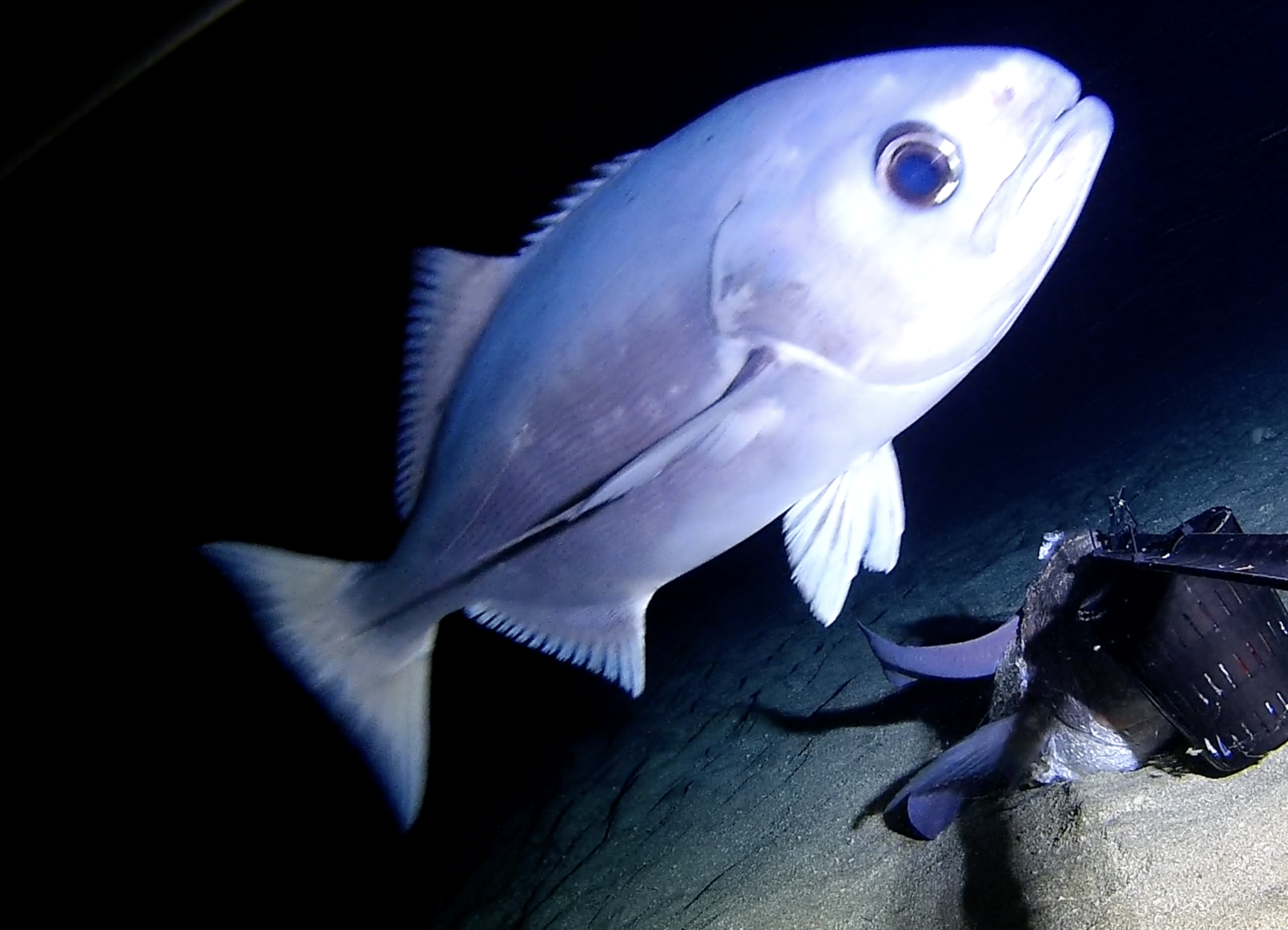
Bluenose is a southern-hemisphere deep-water fish with a 140 cm ceiling, a 63 kg record and a 15-year lifespan. It is benthopelagic, with a 1,460 m depth envelope and a much narrower 230 m working band. FishBase uses Bluenose as the English name; blue-eye trevalla is the iNaturalist preferred name, and blue-eye is one of the FishBase alternatives.
140 cm, 63 kg, 15 years
The maximum is 140 cm TL, the common length is 60 cm TL, the heaviest published weight is 63 kg and the oldest reported age is 15 years. Maturity is estimated at 70.6 cm, with a range that opens at 59 cm and leaves the upper bound blank.
The common length is 10.6 cm below the maturity estimate. That is the unusual part: the ordinary fish is under the published maturity midpoint, and the bottom of the range, 59 cm, is also under the common length. Read together, the two lines say a 60 cm fish may or may not be mature, and the page cannot settle it.
The envelope is 1,460 m; the working band is 230 m
The depth range is 40–1500 m, usually 260–490 m. The envelope is 1,460 m from top to bottom, and the usual band is 230 m wide.
A third figure sits in the biology note: most common over or near rocky areas at 100–300 m. That band is shallower and narrower than the usual band, and the two overlap only between 260 and 300 m. The page carries both without reconciling them. For a trip, the usual band is the safer number; the biology note explains why a 100 m hook-up is possible.
It leaves the bottom at night
The species is benthopelagic. It stays close to the seabed during the day and moves up in the water column at night, following concentrations of food. It appears to prefer cold water. It is found over rough ground, at the edges of canyons and along steep drop-offs.
The main prey is the pelagic tunicate Pyrosoma atlantica, which sits near the seabed by day and disperses through the column at night. The diet also includes squid, molluscs, crustaceans and fish ranging from small lanternfish to gemfish. Juveniles live in surface waters, sometimes with floating debris, and eat small plankton.
Seven to eight dorsal spines
The morphology field gives 7–8 dorsal spines and 19–21 soft rays, with 3 anal spines and 15–17 soft rays. These are the only meristic counts on the page, and they are the only hard identification characters in the record.
No body-shape field and no colour note are published. The English names split between bluenose and blue-eye, and the iNaturalist preferred name blue-eye trevalla carries no count.
February to July, five regional rows
The spawning table marks February to July. The regional rows are: Atlantic and Indian Ocean seamounts off southern Africa, March–April; mainland Australia, April–June; northern New South Wales, July; Tasmania, March–May; Tasmania, February–March.
The union is six months. None of the rows is New Zealand, although New Zealand is one of the two range centres. That is a sourcing gap, not evidence that the species does not spawn in New Zealand waters. A February start and a July end describe the species, not a local season; the rows nearest the chosen port are the ones to read.
4,162 records, two centres
FishBase gives the range as the southwest Atlantic (Argentina), the southeast Atlantic and western Indian Ocean (South Africa) and the southwest Pacific (New Zealand and Australia, including Western Australia). The country list adds Kermadec Islands, Lord Howe Island, New Caledonia, Norfolk Island and Tristan da Cunha.
GBIF holds 4,162 records: 2,715 from Australia, 1,171 from New Zealand, and 276 spread across the rest. The two centres hold 93 percent of the records, and the remainder is what a southern-ocean range looks like in a database.
Deep water is a gear problem
Boat bottom fishing is mainstream, with jigging and trolling secondary. The terrain list is deep water, open water and shelf.
At 260–490 m the lead does more work than the rod, and the usual band is the number to rig for. The page publishes no hook size, line class or lead weight, so the only hard tackle numbers are the depth band and the fish sizes. The 63 kg maximum is a record, not a working weight; the 60 cm common length is what most of the tackle will meet. Trolling is listed for a benthopelagic fish because it covers water between the bottom and the surface, which suits the night rise. Jigging covers the same column and needs no bottom contact.
Twenty observations, no assessment
iNaturalist carries 20 observations for the species, against 4,162 GBIF records. That is roughly one observation for every two hundred records, which is what a commercially landed deep-water fish looks like.
FishBase records a commercial fishery and no other use: no gamefish entry, no aquaculture, no aquarium trade. The IUCN category is Not Evaluated, and CITES and CMS are both Not Evaluated; the species is harmless to humans. Not Evaluated means no category has been assigned, not that the stock is healthy.
New Zealand rules govern the catch
In New Zealand, MPI sets the amateur saltwater rules: daily bag limits, minimum sizes, method restrictions and accumulation limits, applied by fishery management area (FMA). Marine reserves under the Marine Reserves Act 1971 are no-take, and Hauraki Gulf, Fiordland and Marlborough Sounds carry additional rules, as do temporary closures and rāhui.
No bag number, size limit or closure date is given here, and the page publishes no national size limit to compare with the 70.6 cm maturity estimate. The deep-water band, the FMA rule and the reserve map all have to be checked before a trip.
Where these facts come from
Check these pages before you rely on a size, range or protection status.
- FishBase — Hyperoglyphe antarctica — FishBase · T2
- GBIF — Hyperoglyphe antarctica occurrence records — GBIF · T2
- IUCN Red List — Hyperoglyphe antarctica — IUCN · T1
- Photo record — iNaturalist — iNaturalist · T3
Fish in the same water
These fish live in the same place.
Guides for this water
Technique, gear and safety guides that fit Bluenose.