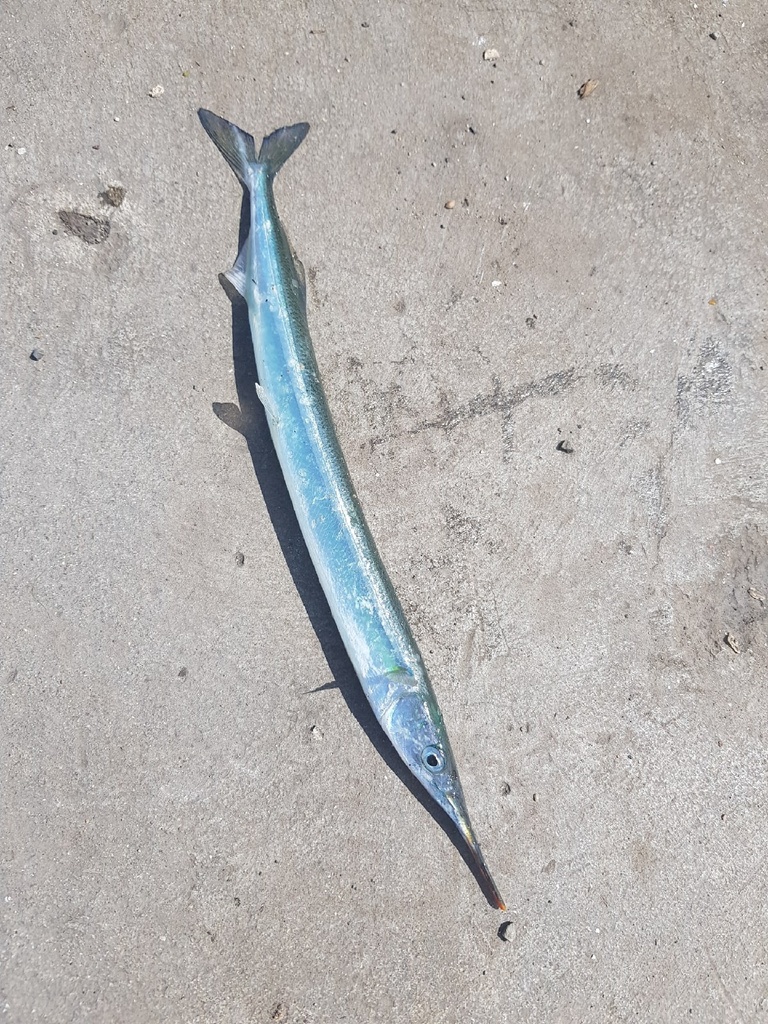
Japanese halfbeak (Hyporhamphus sajori) is a fish of the family Hemiramphidae. FishBase gives its range as: Northwest Pacific: Yellow Sea, Pohai Sea, Japan Sea, and the Pacific coast of Japan, extending north to Sakhalin and to Preobrazheniye Bight and Vladivostok in the Gulf of Peter the Great. Recorded from the lower part of the Yangtze River in China. of this species south to the Ryukyu Islands and Taiwan needs verification. It is recorded deeper than 30 m, in temperate water. The recorded maximum is 40 cm TL. Diet includes zooplankton. IUCN status: Least Concern (LC). Chinese name: .
Three blanks are the brief
The FishBase entry for Hyporhamphus sajori leaves three size fields empty that most gamefish pages fill: maximum weight, common length and maximum age. That is not a gap to be filled with imagination. It tells you what kind of fish this is. There is no trophy weight to chase, no average size to plan a bag around and no long-lived stock to protect. What the page does give is a 40 cm maximum total length and a maturity range that starts at 17 cm. The useful reading is a fast-growing table fish with a small upper size, not a sport fish that rewards a bigger rod.
A surface fish with a 30-metre floor
The environment line says marine, freshwater and brackish, pelagic-neritic, amphidromous, with a depth range of 30 m to an unspecified maximum. Wikipedia describes the same animal as slender and surface-dwelling. Those two statements pull in different directions. The 30 m figure reads like a floor, but a pelagic-neritic halfbeak works the top of the water column, and the rest of the depth range is unknown. Treat the 30 m as a data-entry floor rather than an instruction to fish deep. The rig belongs at or near the surface, and the depth question is about how far the bait is below the film, not how far the lead is above the bottom.
The beak tells you the hook size
The family name is the method. A halfbeak has an elongated lower jaw, and the mouth that goes with it is small. The diet keyword is zooplankton, which fits a fish that picks small items out of the surface layer rather than swallowing a whole baitfish. A small hook, a light line and a bait or fly that sits in the top metre are a better fit than a heavy bottom rig. The jaw also means a strike can miss even when the fish is committed, so a fine point and a short shank matter more than a strong hook.
Two spawning tables, two seas
FishBase records spawning in June and July, with a single locality row in Peter the Great Bay, Russia. The Kagawa Prefectural Fisheries Experiment Station found a different window in the Seto Inland Sea: eggs on floating seaweed from April to June, a gonad index that rises sharply in April and peaks in May and June, and spawning water temperatures of 14.0 to 24.3°C. Both can be right. The species spawns across a long coast, and what counts is the timing in the water in front of the boat. In Kagawa, April to June is the spawning season; in Peter the Great Bay, the table says June and July.
Eggs ride the drifting weed
The Kagawa study did not just time the spawn; it found where the eggs were. Floating seaweeds carrying halfbeak eggs appeared from April to June, with the highest attachment rate from late April to early June, and the author notes that eggs are laid on floating material, especially brown algae of the Sargassum group. That is a direct fishing instruction. A weed line is not just cover; in spring it is a spawning substrate. Fish the edge of the drifting weed rather than the open water beside it, and avoid dragging a rig through the raft if you are not keeping the weed.
What the net shows that the database does not
The same Kagawa study measured 434 fish and found a standard length range of 174 to 295 mm, with monthly means mostly between 194 and 240 mm. That fills the missing common-length field with local data rather than a global average. The global page still gives a 40 cm maximum and a 17 cm lower bound for maturity. The two can be used together: a fish under 17 cm is immature by the global record, while most of the Kagawa catch sits well above that line. The blank in the database is not a blank in the sea; it is a blank in the summary.
Keep and season are separate
Prefectural fishery adjustment regulations are the only binding text for this species in Japan; there is no national length to quote. Think of the check as two gates on the way to the esky. The first gate is access: is this water open this month, or has the prefecture shut it around the spawn? The second gate is possession: does the fish meet the length the prefecture sets, and is it inside the day's count? A fish that passes the second gate but came through a shut first gate goes back. With a 17 cm maturity figure, the biological case for releasing smaller fish is strong, but that figure is a personal guideline, not the legal test.
Where to look
The range runs through the Yellow Sea, the Bohai Sea, the Sea of Japan and the Pacific coast of Japan, north to Sakhalin and the Gulf of Peter the Great, with a record from the lower Yangtze. The southern records from the Ryukyu Islands and Taiwan, China are flagged in the same text as needing verification. GBIF returns only two distribution statements for the species, one Palaearctic and one global, so it cannot settle the southern limit. iNaturalist holds 76 observations and is a better guide to where people actually see the fish. Work the surface along warm-current coasts and river mouths, especially around drifting weed in the local spawning window, and check the prefecture before you keep anything.
Regulations before you keep it
These are the published regulations for this fish. Read the number first. The notice below it is the actual regulation.
Minimum size1
≤7 cm body length may not be taken
Japan — Hiroshima · JP-34
Hiroshima Prefecture prohibits taking Japanese halfbeak (sayori) of 7 cm body length or less.
Hiroshima couples this size limit with the closed season: the 7 cm prohibition applies during 1 March–30 September.
Season / closure1
Closed 1 March – 30 September
Japan — Hiroshima · JP-34
Hiroshima Prefecture closes the sea area to Japanese halfbeak (sayori) fishing from 1 March to 30 September.
The closed season couples with the 7 cm size limit: undersized fish may not be taken while the season is closed.
Every record above names its source and the date it was retrieved. See the regulation register for the full list, or how to read these regulations.
Where these facts come from
Check these pages before you rely on a size, range or protection status.
-
FishBase — Hyporhamphus sajori
— FishBase · T2
-
GBIF — Hyporhamphus sajori occurrence records
— GBIF · T2
-
IUCN Red List — Hyporhamphus sajori
— IUCN · T1
-
Photo record — iNaturalist
— iNaturalist · T3