
Hawaiian grouper
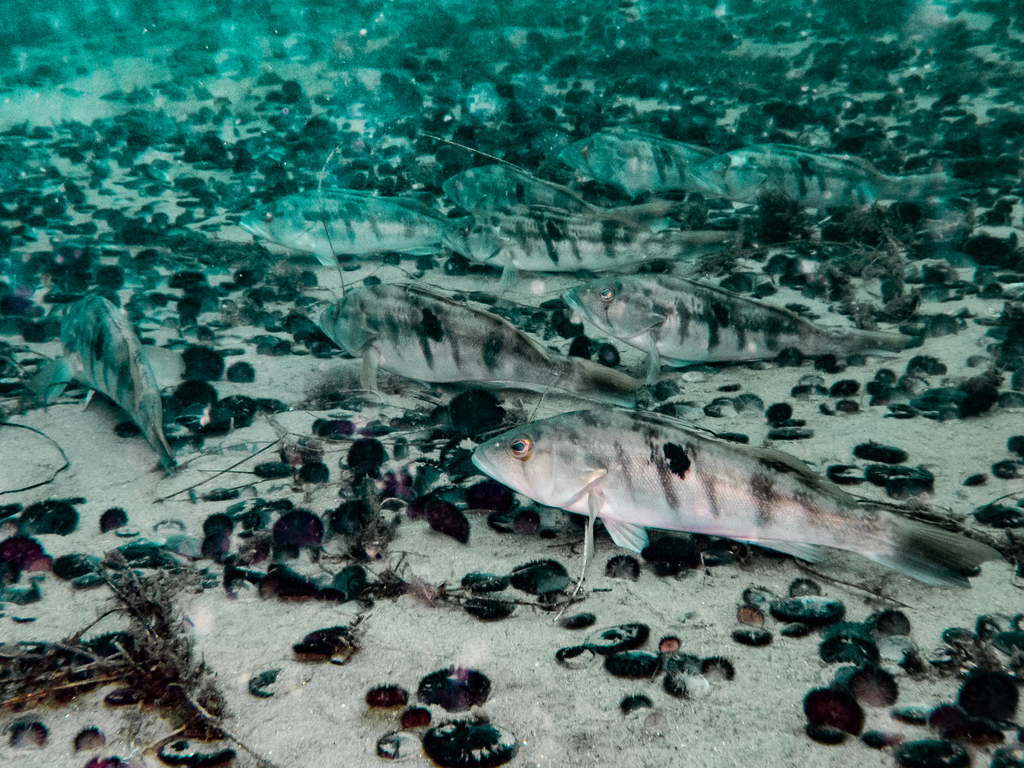
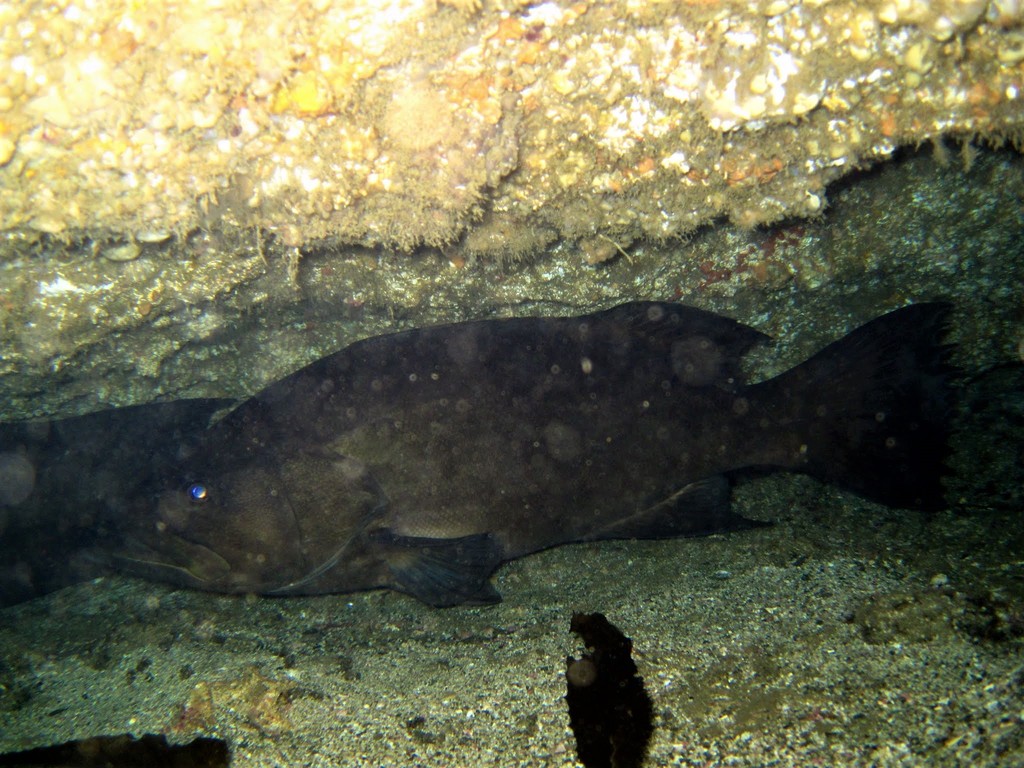
Start with the counts: eleven dorsal spines, fourteen to fifteen soft rays, three anal spines and nine soft rays. Juveniles wear eight vertical rows of white spots over a grey-brown to dark brown body. Adults keep the dark ground colour, but the rows break up under a scatter of pale spots and blotches of mixed size, and the fins remain largely unspotted.

Start with the counts: eleven dorsal spines, fourteen to fifteen soft rays, three anal spines and nine soft rays. Juveniles wear eight vertical rows of white spots over a grey-brown to dark brown body. Adults keep the dark ground colour, but the rows break up under a scatter of pale spots and blotches of mixed size, and the fins remain largely unspotted. Standard length is 2.3 to 2.7 times the body depth and 2.3 to 2.5 times the head length, so the fish reads as deep-bodied and thick-headed rather than streamlined. The preopercle is subangular with three to five enlarged serrae at the angle and a fleshy, unserrated lower edge, a detail worth knowing when you handle one. Adults also develop enlarged, ovate posterior nostrils that are visibly bigger than the anterior pair.
An island chain, not an ocean
FishBase limits the species to the Hawaiian Islands and Johnston Island, and the country list adds Midway Islands to the same small set. The coordinate box runs from 30°N to 11°N and 179°W to 153°W, which wraps the archipelago rather than describing an ocean-wide range. GBIF holds 133 occurrences, split into 88 from the United States, 15 from UM and a single Philippine record. That lone Philippine dot does not fit an endemic reading and is best treated as an anomaly until someone verifies the specimen. Depth is given as 5 to 380 m, but the working band for rod and reel is the hard bottom, steep slope and deep ledge around 100 to 250 m. This is a benthic and benthopelagic fish that stays close to the rock rather than cruising mid-water.
No spawning month on record
FishBase supplies no spawning months and no monthly season table for this species, so a month-by-month forecast would be invention. The stock lives in tropical water and the deep slope stays fishable through the year; what changes is sea state and the status of the fishery, not a temperature trigger. When a closed season is declared, fishing, possession and sale stop together, which makes the notice more important than the calendar. Bottom-fishing vessels also have to be registered and marked with a BF number, a requirement that applies on every trip rather than in one season. In practice, treat the settled days as the season. Long swell or a steady blow makes the deep marks difficult to hold, and that is the real closure most anglers face.
Bait has to reach the rock
Of the Deep 7 group this is the most bottom-bound, and a bait stopped halfway down is a bait wasted. The standard approach is heavy handline or electric reel over rugged ground between roughly 100 and 250 m, with whole fish as the main offering. Lower with a lift-and-drop rhythm so the weight taps the bottom and you learn the height of the reef before committing to a fishing depth. Whole fish, squid and large cut bait all match a diet of fish and crustaceans. Leave a wide gap between hook point and shank, because the mouth is built for substantial prey. When small fish begin pecking, moving is faster than downsizing: a small bait usually disappears before the target sees it. Expect dead weight through the first part of the fight and a sudden surge near the ledge, so keep drag in reserve for that last stretch. Slow-pitch jigging with a heavy jig is the alternative on the same structure, and it suits days when the current lets the lure stay vertical.
Gear sized for a 122 cm fish
FishBase records 122 cm and 22.7 kg as the maxima and leaves the common length empty, so build for the top and expect the middle. Reel capacity deserves more attention than the drag number: a hundred metres of line plus current leaves very little margin in a shallow spool. Use braid as the main line, a heavy carbon leader against the rock, and a stiff medium-heavy boat rod that still transmits the change from hard to soft bottom under several hundred grams of lead. An electric reel saves labour, but set its drag conservatively so a surge can still take line. Choose a large circle or J hook with thick wire and a wide gap, and carry a net or gaff rated for a metre-plus fish rather than an average one. Keep line cutters within reach; when the rig wedges in the ledge, cutting free is cheaper than bending a rod.
Deep 7 rules and the table
The flesh is firm and, by the FishBase note, good eating in any style except raw. The rule that governs everything else is the combined bag: non-commercial anglers may keep five Deep 7 fish per person per day across all seven species, not five of each. State rules also prohibit traps, trawls, bottom longlines and nets, require bottom-fishing vessels to register with DLNR and display a BF number, and require commercial catch reports within five days. In federal waters an EEZ bottomfish permit is needed, the 2025–2027 MHI Deep 7 ACL is 493,000 lb, and NWHI and Papahānaumokuākea are closed. Non-residents need an NRMFL to fish recreationally and a CML to sell. Because the bag is counted for the boat, do the arithmetic before you keep a second fish.
What the record leaves out
The account rests on FishBase for taxonomy, range, size, depth, diet and IUCN status, on GBIF for occurrences, and on the DAR and NOAA pages for rules. iNaturalist carries only four observations, far too few to say anything about abundance or distribution. Maximum age and length at maturity are blank in FishBase and are left blank here. The single GBIF record from the Philippines conflicts with the stated range and is flagged in the distribution section. Regulations change by year, so treat size, bag and closure dates as local and current rather than fixed.
How to catch it
Deep bottom fishing
Fished with the listed approach, matched to the recorded depth and size.
Deep bottom fishing
Fished with the listed approach, matched to the recorded depth and size.
Where these facts come from
Check these pages before you rely on a size, range or protection status.
- FishBase — Hyporthodus quernus — FishBase · T2
- GBIF — Hyporthodus quernus occurrence records — GBIF · T2
- IUCN Red List — Hyporthodus quernus — IUCN · T1
- Photo record — iNaturalist — iNaturalist · T3
Fish in the same water
These fish live in the same place.

Guides for this water
Technique, gear and safety guides that fit Hawaiian grouper.