
Thumbprint emperor
FishBase gives this species 0 to 20 m, reef-associated, non-migratory, and tolerant of brackish water. A twenty-metre ceiling is not a boat depth. It is the depth of reef flats, shallow bommies and harbour mouths, so the vertical part of the search is settled before you leave the beach. What changes through the day is not how deep the fish is, but how much water sits above the flat.
FishBase gives this species 0 to 20 m, reef-associated, non-migratory, and tolerant of brackish water. A twenty-metre ceiling is not a boat depth. It is the depth of reef flats, shallow bommies and harbour mouths, so the vertical part of the search is settled before you leave the beach. What changes through the day is not how deep the fish is, but how much water sits above the flat. On a rising tide the coral head that was dry at dawn is waist-deep by mid-morning, and the fish move up with it. Treat 20 m as the outer boundary of a band that slides up and down the reef, not as a number to drop a bait into.
The mark the name is built on
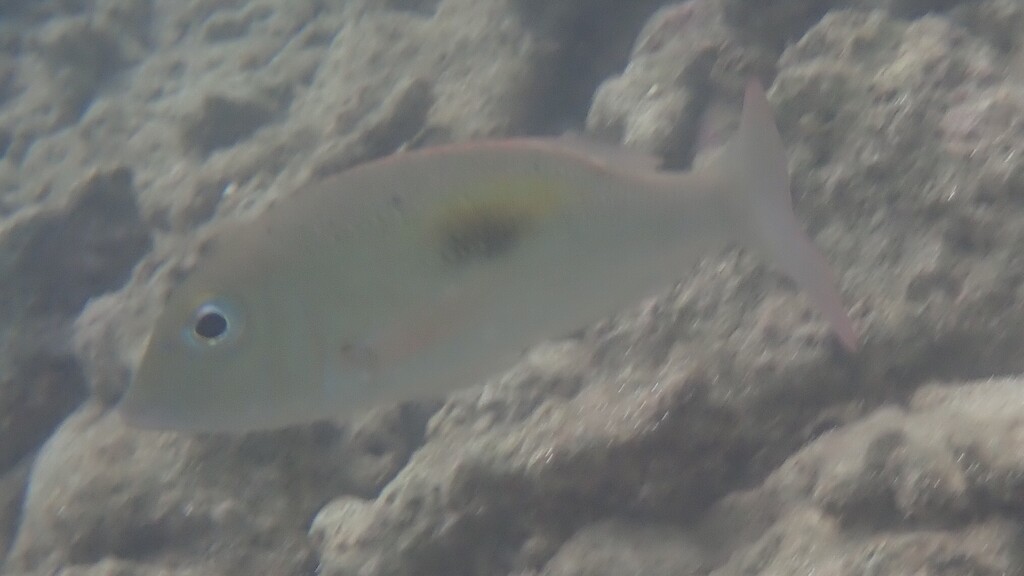
English speakers call it the thumbprint emperor for the dark smudge behind the shoulder, and in decent light that smudge is the fastest field mark. The rest of the fish is a generalist emperor: a body 2.6 to 2.8 times in standard length, a short blunt snout, a cheek without scales, and a posterior nostril reduced to a narrow slit. Fin counts are D X, 9 and A III, 8, with 13 pectoral rays and 46 to 47 lateral-line scales. Adults carry molar-like teeth at the sides of the jaws, which is not a detail for taxonomists. It tells you what the fish does to a bait.
Molars decide the bait
An emperor with crushing teeth will not nibble a strip of soft fish flesh and leave politely. It worries the bait, flattens it, strips it. Shell-on prawn, a piece of crab, a small whole squid or a chunk of bivalve stays on the hook longer and matches what the jaw is built for. The same teeth make a heavy wire hook unnecessary; a fine-wire hook in the 1 to 2/0 range sets faster and shows less in the bright shallow water this fish lives in.
Fishing the flat, not the drop
Because the fish is shallow, the useful structure is horizontal: the edge where coral meets sand, the lip of a flat that falls from two metres to six, the channel that drains a lagoon. On the flood, baitfish and the emperors that follow them push onto the flat; on the ebb they filter back through the same drains. A rolling sinker beats a fixed one because it can be walked along the edge without wedging in coral. Cast uptide, let the sinker bounce down the slope, and keep the rod tip low so the line does not bow and drag the bait into the reef.
Thirty centimetres is the working fish
The common length is 30 cm total length. The maximum is 54.9 cm fork length, and the maximum published weight 2.9 kg. Those figures use different measuring conventions, so they cannot be read as a simple ratio; a 55 cm FL fish is a big one, but the number is not directly comparable with the 30 cm TL common figure. Maturity comes at 19.5 cm, with a recorded range to 21.1 cm. Most keepers are therefore mature, and a fish under 20 cm should go back without much debate.
Tackle that matches a thirty-centimetre fish
A medium shore rod, PE 0.8 to 1.2 braid, a 12 to 16 lb leader and 20 to 50 g of lead cover most flats. Line class should follow the bottom rather than the fish. Sharp coral cuts a light leader on the first run, and a leader heavy enough to survive the reef is worth more than one light enough to cast a metre further. A wide-gap, short-shank hook comes out of a small mouth cleanly, and a landing net is faster than swinging a 30 cm fish over coral.
Harmless, Least Concern, and still landed
FishBase records commercial fishing as the only use, lists the species as Least Concern in an assessment dated 9 March 2015, and puts the threat-to-humans field at harmless. There is no ciguatera report for this species in that field, so this page does not manufacture one; a large emperor from a reef flat is still handled according to local advice. Thailand closes Similan and Surin national parks through the monsoon, when reef entry is prohibited. Indonesia zones its marine protected areas and manages reef-fish export and size separately. The Philippines works through RA 8550 as amended by RA 10654, with closed seasons and MPAs set by national and local government. The Maldives sets seasonal closures at spawning aggregations, requires export permits and bars sale of tourist catch.
What the record leaves out
The spawning table carries no months for this species, and the environment line gives a climate zone of Tropical without a temperature range. The age record is 15 years, a long life for a 30 cm fish, and one reason the stock is not automatically fragile. Climate vulnerability is scored 79 out of 100, described as very high; for a fish that never leaves the top 20 m, that score is about water temperature rather than fishing pressure. The page carries no local size limit, because the sources checked do not provide one.
How to catch it
Shore fishing
Fished with the listed approach, matched to the recorded depth and size.
Boat bottom fishing
Fished with the listed approach, matched to the recorded depth and size.
Where these facts come from
Check these pages before you rely on a size, range or protection status.
- FishBase — Lethrinus harak — FishBase · T2
- GBIF — Lethrinus harak occurrence records — GBIF · T2
- IUCN Red List — Lethrinus harak — IUCN · T1
- Photo record — iNaturalist — iNaturalist · T3
Fish in the same water
These fish live in the same place.

Guides for this water
Technique, gear and safety guides that fit Thumbprint emperor.