
Ornate emperor
Ornate emperor is an Indo-West Pacific lethrinid, from the Maldives and Sri Lanka east to the Ryukyu Islands, Papua New Guinea and northeastern Australia. It is a shallow reef fish of 5 to 30 m and reaches 45 cm TL. Vietnamese records exist but are probably misidentifications, so a country list that repeats Vietnam without that caveat is only half right. Boat bottom fishing and shore casting are the methods listed.

FishBase gives the range as the Maldives and Sri Lanka east to the Ryukyu Islands, Papua New Guinea and northeastern Australia, and then adds a sentence that changes how the page should be used: it is reported from Viet Nam, but probably as a misidentification. That is not a small footnote. Viet Nam appears in this species' regional list, and any article that repeats the country without the caveat is repeating half a fact. The Vietnamese name, Cá hè mõm ngắn, does not help, because cá hè is a general term for emperors and is applied across several species. The honest position is that the fish is well documented from Sri Lanka to southern Japan, and unconfirmed west of that in the South China Sea. A country list that includes a doubtful record is not wrong; it is just not a distribution.
A short snout and a deep body
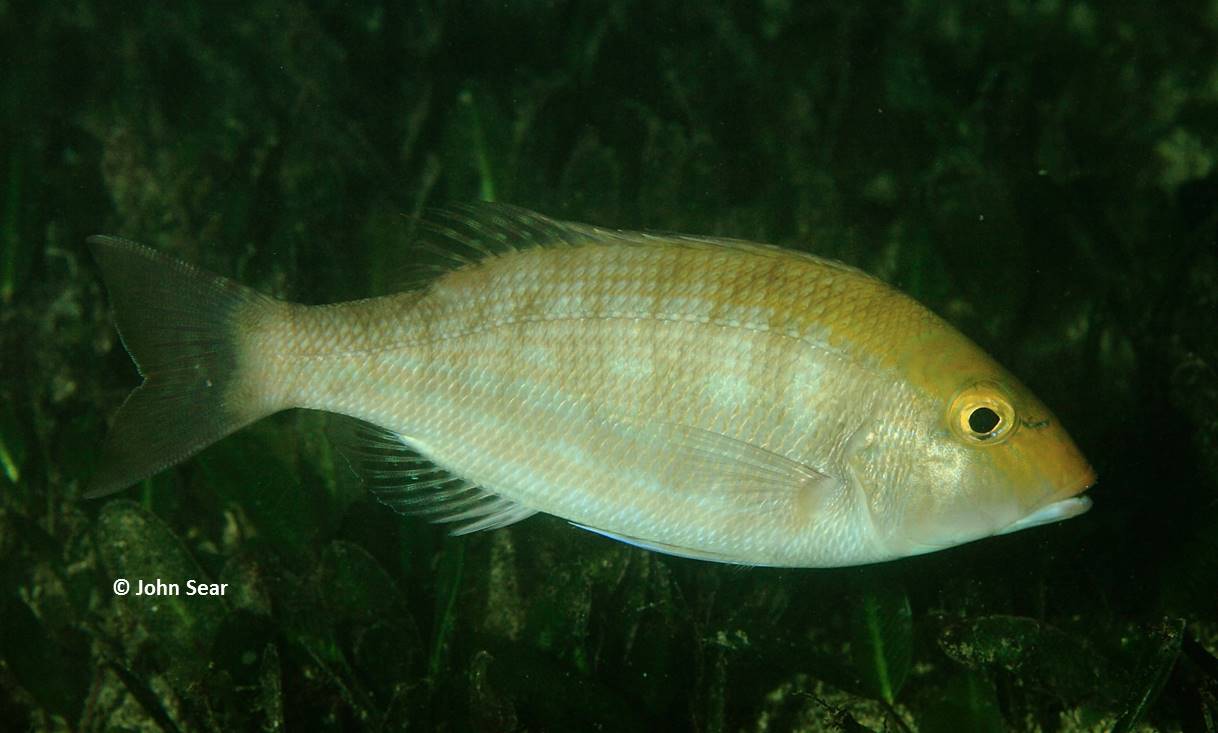
The body is relatively deep, 2.3 to 2.6 times into standard length, and the head is 2.7 to 3.0 times into standard length. The snout is short, 2.0 to 2.5 times into head length, with the dorsal profile almost straight or slightly concave, and the snout angle runs 65 to 75 degrees. The eye sits close to the dorsal profile, the posterior nostril is a longitudinal oblong set closer to the orbit than the anterior one, and the cheek carries no scales. There are 46 or 47 lateral-line scales, ten dorsal spines with the fourth or fifth longest, and nine soft dorsal rays. The rounded, pointed or molar-like lateral teeth are the genus character, not a species one. What separates this fish from its congeners is the combination of a short snout, a deep body and an unscaled cheek, so check all three.
Five to thirty metres, no migration
The recorded depth range is five to thirty metres, and the species is listed as non-migratory. That combination makes it one of the few fish in this batch that a shore angler can reach without a boat, on a reef flat or a rubble slope, and one of the few whose whereabouts do not change with the season. It also means a local depletion will not be refilled from somewhere else. A mark that stops producing has probably been fished out rather than vacated, and the recovery has to come from the same small area. That is an argument for spreading your effort across several marks instead of working one to nothing.
Bait on the reef surface
The mouth is at the front of a short snout with thick lips, and the feeding habit is to take food off the reef surface rather than chase it. That dictates the rig: a small bait, a narrow hook, and enough lead to hold bottom without dragging. Shrimp, crab meat, a strip of fish or a piece of sandworm all work. Let the bait settle, tighten the line, and lift the rod tip every ten or fifteen seconds to make it hop once. Emperors work along the reef in loose groups, so a fish or two from one spot is a reason to fish it more carefully, not a reason to move. When the bites stop, move ten metres along the contour. That distance is enough to find a new group without losing the feature you have already located.
Twenty centimetres to maturity
The maturity entry is unusual: it gives only an upper figure of 20 cm and no lower bound. The maximum length is 45 cm. Growth is fast, with K between 0.4 and 0.5 and a minimum population doubling time under fifteen months, and fishing vulnerability is 27 out of 100. Read together, those numbers say the species matures early and replaces itself quickly, and that a 45 cm fish is the ceiling rather than the routine catch. Most of what an angler meets will be around or just above the maturity line, which is the size class the stock depends on. Keeping the 40 cm fish buys nothing that the 25 cm fish does not already provide.
Harmless, minor, and easy to misname
The species is a minor commercial catch, the threat-to-humans field says harmless, and no ciguatera report is attached to it. The Red List category is Least Concern, assessed on 9 March 2015. The practical risk is not toxicity but naming. A fish caught in the Gulf of Thailand, photographed, and labelled with the Vietnamese name would look like a range extension it probably is not. In Thailand, Vietnam and Malaysia the same reef is managed under three different frameworks, from national park closures to marine park core zones and the 2017 Vietnamese fisheries law, so the local rule is a better guide than the regional name list. The name is the weakest part of the file, and the honest response is to record what you caught with a photograph and a length rather than with a country. A correctly labelled fish from Thailand is worth more than a doubtful one from Vietnam.
How to catch it
Boat bottom fishing
Fished with the listed approach, matched to the recorded depth and size.
Shore casting
Fished with the listed approach, matched to the recorded depth and size.
Where these facts come from
Check these pages before you rely on a size, range or protection status.
- FishBase — Lethrinus ornatus — FishBase · T2
- GBIF — Lethrinus ornatus occurrence records — GBIF · T2
- IUCN Red List — Lethrinus ornatus — IUCN · T1
- Photo record — iNaturalist — iNaturalist · T3
Fish in the same water
These fish live in the same place.

Guides for this water
Technique, gear and safety guides that fit Ornate emperor.