
Longface emperor
One hundred centimetres total length is the record. Seventy centimetres is the common length. Between those two figures sits the entire argument of this page: a longface emperor in a photograph is usually the second number, while the first number is what sells tackle, books trips and ends up in the caption.
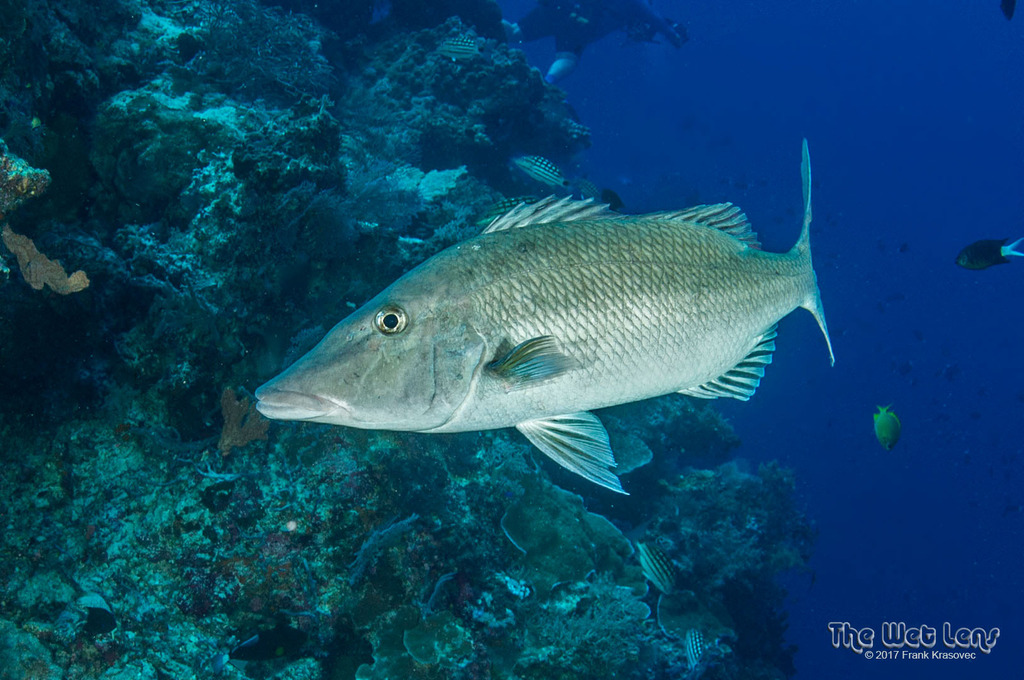
One hundred centimetres total length is the record. Seventy centimetres is the common length. Between those two figures sits the entire argument of this page: a longface emperor in a photograph is usually the second number, while the first number is what sells tackle, books trips and ends up in the caption.
Two numbers, one fish
The maximum published weight is 14 kg. No weight is given for the common size, which is a small mercy, because it stops anyone from building an outfit around a hypothetical 100 cm fish. Fish the 70, land the occasional 90, and treat the metre mark as a fish you may see once.
The snout is a tool, not a decoration
The snout measures 1.7 to 2.2 times in head length, the cheek carries no scales, and the lateral teeth in the jaws are conical. The dorsal fin counts ten spines and nine soft rays, the anal fin three spines and eight rays, the pectorals thirteen rays, and the lateral line 46 to 48 scales. Body depth is 2.9 to 3.4 times in standard length, so the fish is slender for an emperor.
That long face is what separates it from the shorter-snouted members of the genus at a glance, and the bare cheek is the detail to check in hand. The Chinese name is built on the same feature, which is rare enough to be worth noting: the name describes something you can actually see.
One metre of water to one hundred and eighty-five
The recorded depth range runs from 1 to 185 m and the record gives no usual depth. That is not a helpful fishing number on its own. What is useful is that the species is reef-associated and non-migratory: it belongs to a slope, not to a current line, and it does not leave on a schedule.
The practical reading is a bottom line that follows the reef down. Start where the coral meets sand in 15 to 30 m, and walk the bait down the slope until the sounder shows a hard edge under a softer one. Beyond 60 m the same fish is still possible, but the outfit, the sinker and the drift all change, and most of the catch a visiting angler will see comes from far shallower.
A pink jig and a strip of fish
The record lists commercial fishing and gamefishing, with no method detail. Sri Lankan trip reports add one useful observation: large longface emperors take metal jigs, including pink ones, worked near the bottom. That fits an emperor's habit of rising a metre or two off the slope to meet something that flashes.
Bait still does the bulk of the work: a strip of fish or a whole small fish on a single hook, enough lead to hold in current, and the rod left in the holder while the line is watched rather than felt. The take is often a slow load rather than a knock, so the drag should be set light enough that a pick-up is visible before the fish feels resistance.
Fifteen years, and four to six to get there
Resilience is low: K between 0.06 and 0.25, age at maturity 4.1 to 6 years, maximum age 15 years, doubling time 4.5 to 14 years. First maturity sits at 34 cm. Those four numbers describe a fish that takes years to replace itself, and a 34 cm minimum is a floor set by biology, not by a rule book.
Fishing vulnerability is 40 out of 100, moderate. Read with the growth figures, that score argues for releasing the big ones: at 15 years maximum, a 90 cm fish is old, and old fish carry both the reproductive output and, on this species, the ciguatera load.
Ciguatera at the top end
FishBase's human-threat field lists ciguatera poisoning reports. The toxin comes from benthic dinoflagellates and accumulates through the food chain, so risk rises with size and age; liver, head and viscera should not be eaten. There is no field test for it. Tingling around the mouth, nausea or stomach pain after a meal means medical attention, not another helping. Individual fish from the same reef differ enough that one safe dinner proves nothing about the next.
Four coastlines, four rulebooks
Its IUCN category is Least Concern, from an assessment dated 9 March 2015. Access to the Similan and Surin park waters is shut for the monsoon months, and the fisheries management plan adds separate closures and tackle limits. In India the minimum size is a state matter: Kerala and Tamil Nadu publish their own thresholds on CMFRI advice, and the Andaman and Nicobar islands apply tribal and reserve restrictions. Sri Lanka closes the core of Bar Reef, Hikkaduwa and Pigeon Island and leaves the national minimum size unset. The Maldives prohibits killing reef sharks, seasons off grouper aggregations, licenses reef-fish exports and disallows selling the catch of visiting anglers.
How to catch it
Boat bottom fishing
Fished with the listed approach, matched to the recorded depth and size.
Where these facts come from
Check these pages before you rely on a size, range or protection status.
- FishBase — Lethrinus olivaceus — FishBase · T2
- GBIF — Lethrinus olivaceus occurrence records — GBIF · T2
- IUCN Red List — Lethrinus olivaceus — IUCN · T1
- Photo record — iNaturalist — iNaturalist · T3
Fish in the same water
These fish live in the same place.


Guides for this water
Technique, gear and safety guides that fit Longface emperor.