
Pink ear emperor
Walk through a fish market between the Red Sea and the Gulf and the odds are good that a pink-eared emperor is on ice somewhere: FishBase lists the species as highly commercial, with a common length of 40 cm total length against a maximum of 52 cm. That narrow gap is the first thing to notice.

Walk through a fish market between the Red Sea and the Gulf and the odds are good that a pink-eared emperor is on ice somewhere: FishBase lists the species as highly commercial, with a common length of 40 cm total length against a maximum of 52 cm. That narrow gap is the first thing to notice. A market dominated by fish close to the maximum is not a market of juveniles, and it is not a market of trophies either. The everyday animal and the ceiling are almost the same animal. For an angler, that changes the size expectation: the fish you meet on the reef will look like the fish on the slab, and neither will look like a record.
Reading the ear and the jaw
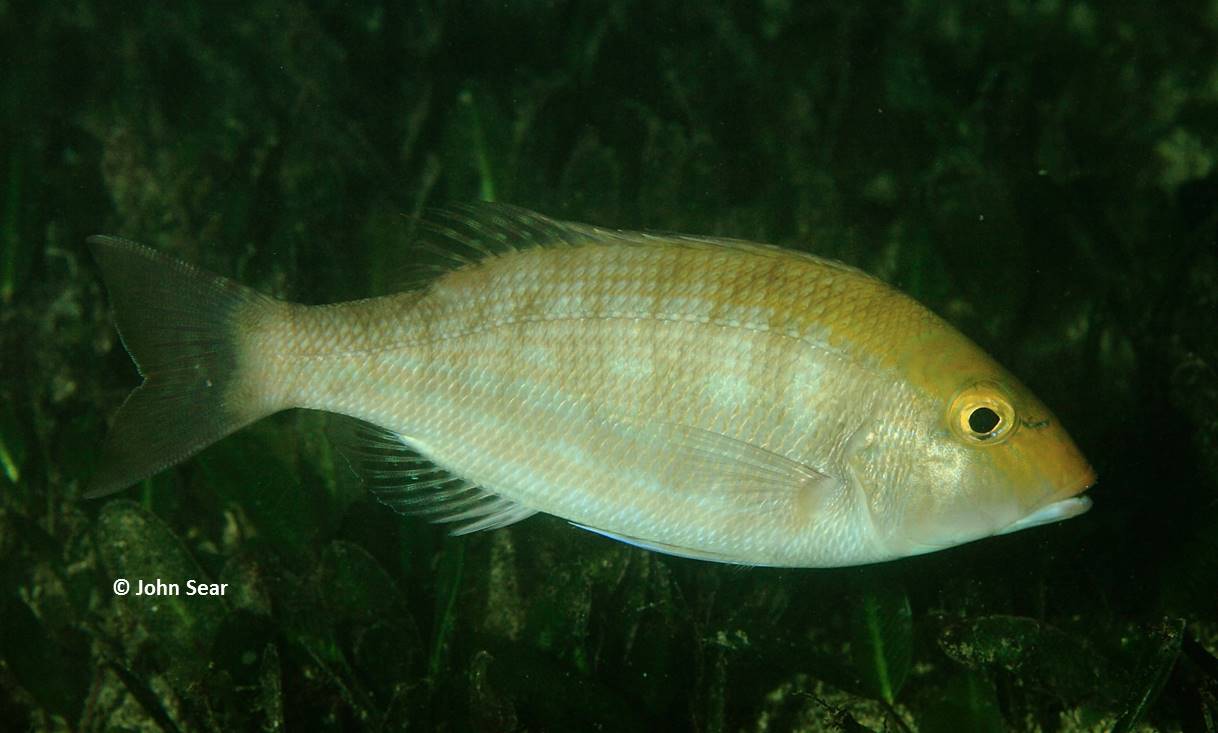
The pink to red patch at the rear edge of the gill cover supplies the English name. Otherwise it is a standard emperor shape: the body depth sits between 2.5 and 2.8 SL, the dorsal profile is close to straight above the eye, the cheek carries no scales, and the rear nostril is an elongated slit. Meristics are dorsal X with 9 soft rays, anal III with 8, pectoral 13, and 46 or 47 scales along the lateral line. Lateral jaw teeth are rounded, sometimes conical-tipped, sometimes molar with tubercles. Those crushing teeth point to a bait that can take punishment.
Ten to ninety metres without a migration
The range takes in the Red Sea and the Arabian Gulf, continues down East Africa to the Ryukyus and Tonga, and the species is marked non-migratory. Depth is given as 10 to 90 m, with brackish water included. Non-migratory is a useful word for a reef angler: the population on a given piece of slope is not replaced by a seasonal run, so a mark that produced one year is likely to hold fish the next, provided the reef is still there. The 10 m lower bound also means the shallowest part of the range is boat water, not beach water.
Fishing the slope
Most of the depth range is slope, not flat. A bait dropped on the top of a reef or on the sand beside it is in the wrong place; the fish works the face where coral gives way to rubble and sand. A single-hook bottom rig with prawn, crab or squid is the standard approach, and the sinker should reach bottom before the bait is allowed to roll down the face. The bite is rarely a single thump. An emperor will test the bait, move a metre, and take properly on the second or third pull; striking at the first tap usually returns a stripped hook.
Tackle for the forty-centimetre class
The common length of 40 cm TL is the number to rig around. PE 1.0 to 1.5, a 16 to 20 lb leader and 60 to 120 g of lead hold bottom in the depths this fish occupies. The reel drag matters more than the rod: a slope fish that reaches a hole wins, and the first ten seconds decide whether it does. Set the drag before the bait goes down, not while the fish is running.
Two ages and a missing spawning table
The record gives a maximum reported age of 19 years. The resilience note, drawing on other parameters, uses tmax = 15. Both sit on the same FishBase page and they do not agree; the page keeps 19 years in the age field and leaves the discrepancy visible rather than averaging it. The spawning table has no months for this species. No temperature range is given beyond Tropical. Those blanks are not filled here. What they mean in practice is that a closed season, if one exists, has to be read from national rules rather than from a biological calendar.
Least Concern with a commercial landing
Least Concern, assessed 9 March 2015, harmless to humans, and the ciguatera field is blank. Highly commercial is still the operative word: this is a fish that reaches markets in quantity, and a healthy assessment is not a reason to fill a box. Seven jurisdictions share the range, and none of them applies one rule to the whole stock. The UAE, Oman and Saudi Arabia each work through national fisheries law, with reef protection, gear and export terms set by their environment ministries. Thailand bars reef entry at Similan and Surin while the parks are closed for the monsoon. Vietnam's 2017 fisheries law sits alongside marine protected areas and a banned-gear schedule. India sets no national minimum size and leaves the number to states advised by CMFRI. The Maldives closes spawning aggregations on a seasonal roster, licenses exports, and keeps tourist catch off the market.
What the twelve-centimetre gap means
The 40 cm common length and the 52 cm maximum are close enough that a 45 cm fish is unremarkable. That has a management consequence: a minimum size set near the common length removes almost nothing from the catch, while a maximum size protects the largest spawners. The species matures at 24.1 cm, well below the common length, so nearly every fish landed has already spawned at least once. The argument for releasing the biggest fish is therefore about egg output, not about letting fish reach maturity.
How to catch it
Boat bottom fishing
Fished with the listed approach, matched to the recorded depth and size.
Handline
Fished with the listed approach, matched to the recorded depth and size.
Where these facts come from
Check these pages before you rely on a size, range or protection status.
- FishBase — Lethrinus lentjan — FishBase · T2
- GBIF — Lethrinus lentjan occurrence records — GBIF · T2
- IUCN Red List — Lethrinus lentjan — IUCN · T1
- Photo record — iNaturalist — iNaturalist · T3
Fish in the same water
These fish live in the same place.

Guides for this water
Technique, gear and safety guides that fit Pink ear emperor.