
Sky emperor
FishBase carries this Indian Ocean emperor as Endangered under criterion A2bd, assessed on 28 June 2018. The same page lists it as highly commercial and as a gamefish. Those two lines are the whole tension of the species: a fish whose past decline was large enough to meet the Endangered threshold, and a fish that still reaches markets and rod-and-line catches from the Red Sea to Sri Lanka.
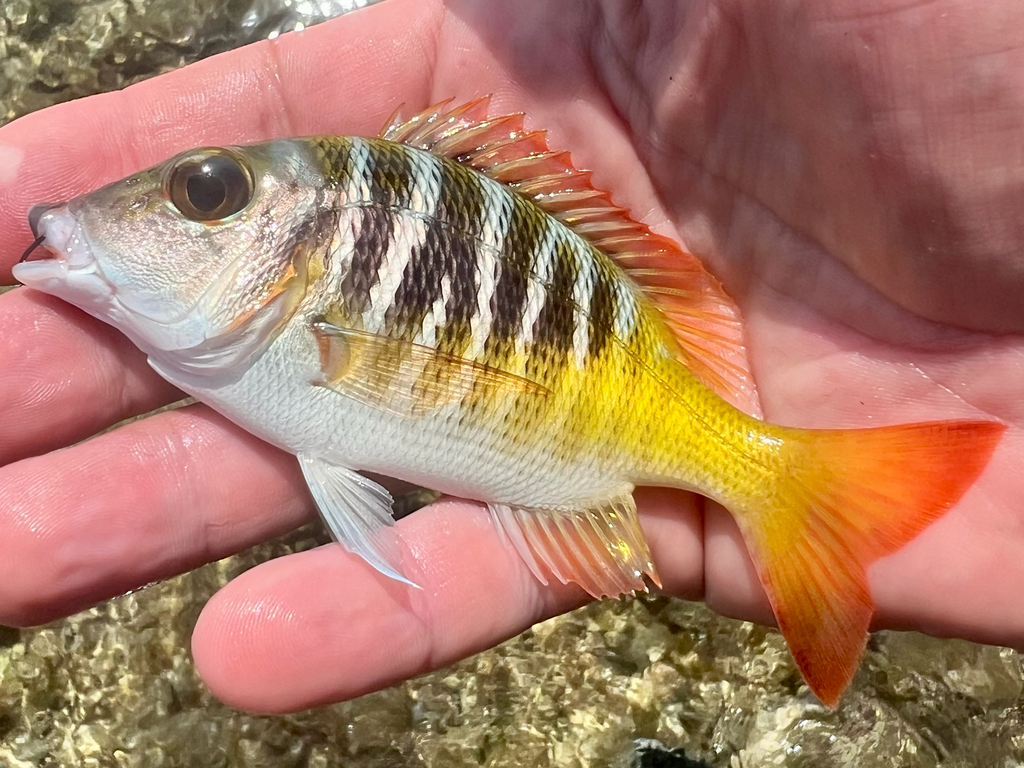
FishBase carries this Indian Ocean emperor as Endangered under criterion A2bd, assessed on 28 June 2018. The same page lists it as highly commercial and as a gamefish. Those two lines are the whole tension of the species: a fish whose past decline was large enough to meet the Endangered threshold, and a fish that still reaches markets and rod-and-line catches from the Red Sea to Sri Lanka. The listing is not a possession ban, and the sources checked do not present it as one. It is a statement about trend, and trend is what a long-lived, sex-changing reef fish cannot reverse quickly.
What A2bd commits the assessment to
The two-letter qualifier is not decoration. A2 means a past reduction, b means an index of abundance, and d means actual or potential levels of exploitation. The assessment therefore rests on an observed abundance trend plus fishing pressure, not on a single survey or a habitat model. That matters when the category is quoted in an argument about fishing: the criterion already assumes exploitation as part of the cause. It also means the category can be revised if the trend reverses, which is why the 2018 date belongs beside the letters.
A fish that changes sex
The species is a protogynous hermaphrodite. Females change into males, so the largest individuals in a population are disproportionately male. A fishery that selects the biggest fish is therefore not just removing old fish; it is removing the male segment of the breeding stock. Add a maximum age of 27 years and a fecundity figure of about 26,700 eggs, and the recovery arithmetic becomes slow. The practical rule follows directly: release the largest fish, keep a middle-sized one for the table, and do not treat a legal minimum as the target size. The 65 cm maximum and the 40 cm common length are far apart. A 60 cm fish is not a fast-growing outlier; it is one that has survived decades, and in a protogynous species it is likely to be male. That is why a slot limit fits this fish better than a minimum size: the fish worth protecting sit at the top of the range.
Sea urchins decide the mark
Stomach work summarised by FishBase puts echinoderms first, with sea urchins the most frequent item, followed by crustaceans and fish. That is a habitat clue. A reef with a healthy urchin population and grazing scars on the rock is more likely to hold feeding mahsena than a bare sand flat. The fish also works reef, adjacent sand and seagrass. A bait presented 20 to 30 cm off the bottom, over the edge of an urchin patch, sits where the fish is hunting rather than where it is travelling.
Two metres to a hundred
Depth is recorded from 2 to 100 m, and the species is non-migratory. The shallow end is reef flat and upper slope; the deep end is boat water. Nothing in the record suggests that the same fish commutes between them, and no separate depth band is given for juveniles. The species is recorded between the Red Sea and East Africa in the west and Sri Lanka in the east, roughly 32 to 82 degrees east. References from the Central Pacific are treated on the same page as probably belonging to Lethrinus atkinsoni, a reminder that old wide-range records for emperors need checking before they are used.
The coral smell
FishBase's biology text says the species is considered an excellent food fish in most of the Red Sea, but in certain areas of the Indian Ocean it may carry an unpleasant coral smell and taste. Same species, opposite verdicts, and no way to tell from the fish on the line. The note is worth carrying because it changes the decision to keep a fish: where the local verdict is poor, a 60 cm emperor is not a trophy, it is a waste. Ask before you keep.
Rules across six jurisdictions
Threat to humans is listed as harmless and there is no ciguatera report in that field. The IUCN category is Endangered and the assessment date is 2018. The Gulf states apply their own fisheries laws, with reef and export rules that differ country by country. India has no national minimum size, and states issue their own under CMFRI advice. Sri Lanka closes the core zones of Bar Reef, Hikkaduwa and Pigeon Island and has no single national minimum length. The Maldives, for its part, ties spawning aggregations to a seasonal closure and licenses every export.
The blanks that matter
No spawning months and no length at maturity are recorded. For an Endangered protogynous fish, those are the two numbers a manager would want most, and their absence is a real limitation. It also means a local rule is likely to rest on landings and judgement rather than on a published biological reference point. That is not a reason to ignore the rule; it is a reason to ask what it is built on.
How to catch it
Boat bottom fishing
Fished with the listed approach, matched to the recorded depth and size.
Handline
Fished with the listed approach, matched to the recorded depth and size.
Where these facts come from
Check these pages before you rely on a size, range or protection status.
- FishBase — Lethrinus mahsena — FishBase · T2
- GBIF — Lethrinus mahsena occurrence records — GBIF · T2
- IUCN Red List — Lethrinus mahsena — IUCN · T1
- Photo record — iNaturalist — iNaturalist · T3
Fish in the same water
These fish live in the same place.

Guides for this water
Technique, gear and safety guides that fit Sky emperor.