
Yellowfin goatfish
Count the fins: eight dorsal spines and nine soft rays, one anal spine and seven rays. The back is red-orange, the sides and belly whitish, and a yellow longitudinal band runs the length of the flank. The diagnostic detail is a negative one — there is no dark blotch under the middle of the first dorsal fin, which separates it from relatives that carry one.
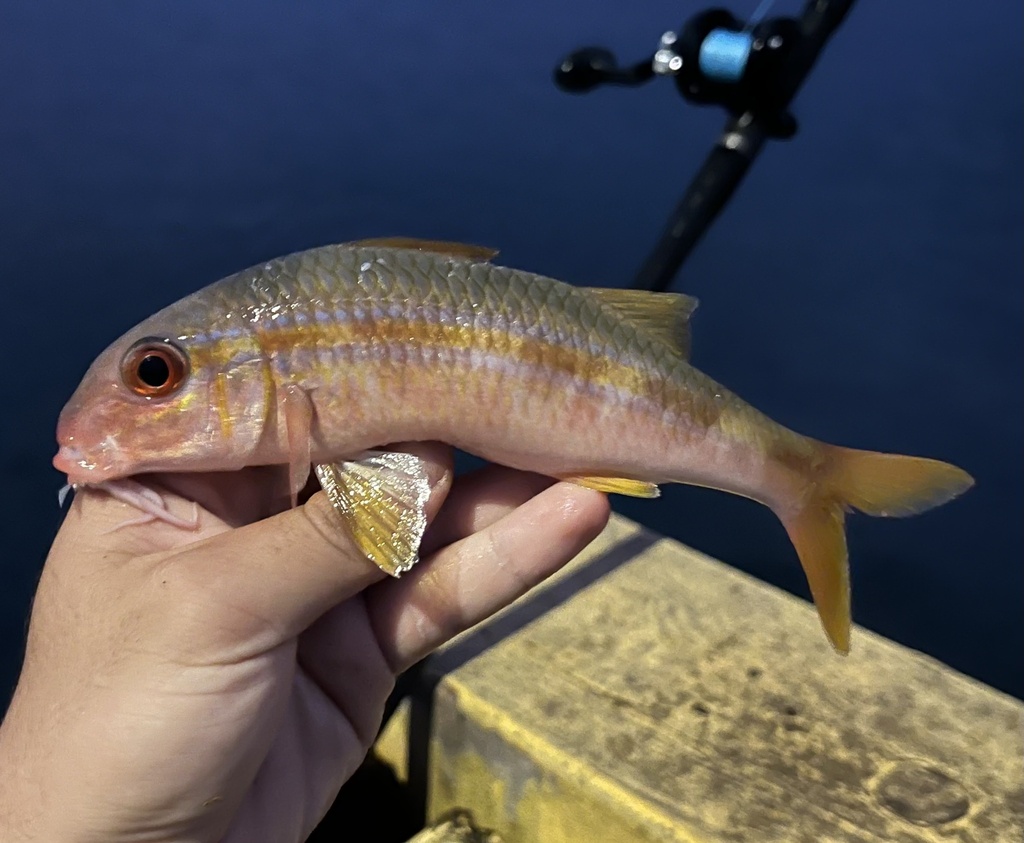
Count the fins: eight dorsal spines and nine soft rays, one anal spine and seven rays. The back is red-orange, the sides and belly whitish, and a yellow longitudinal band runs the length of the flank. The diagnostic detail is a negative one — there is no dark blotch under the middle of the first dorsal fin, which separates it from relatives that carry one. All fins are yellow. The barbels are short relative to the head, and the body is moderately deep, roughly a third to a quarter of standard length. Hawaiian anglers use weke and weke ʻula as local names; they sit alongside the scientific name rather than replacing it. Several congenerics share the yellow band, so the missing blotch, the all-yellow fins and the body depth should be read together rather than one at a time.
Red Sea to Hawaii, with one uncertain record
The range runs from the Red Sea and East Africa through the Comoros and Mascarenes east to the Hawaiian Islands, the Line Islands and the Pitcairn group, north to southern Japan and south to northern Australia, New South Wales, Lord Howe, Norfolk, the Kermadecs, New Caledonia, Tonga and the Gambier Islands. Easter Island is on the list, and records from the eastern Pacific off Mexico and Panama are flagged as needing confirmation. That flag is why the fishing notes here stay inside the Indo-Pacific. The species lives from 1 to 113 m over the sandy floors of reef flats, lagoons, coastal reefs and seaward reefs, and it is benthopelagic rather than strictly bottom-bound. Hawaii sits near the eastern edge of that band, and the amount of sand flat around each island, windward or leeward, explains more about local numbers than latitude does.
Daylight is for resting
The record lists no spawning months, which leaves a daily rhythm as the useful one. By day the fish gather in large, inactive aggregations; at night they spread over sand flats to feed on small worms and crustaceans. That single habit reorganises the whole approach: the fish hanging in a grey cloud at noon are not feeding, and the ones scattered across the sand at night are. In Hawaii the practical season is warm water, and the practical hour is after dark or first light. Set the trip by tide and light, then by month. A missing spawning window costs little here, because the feeding rhythm is easier to observe than the reproductive one: what the same sand flat looks like on three consecutive nights is better information than any month table.
Fish the sand, not the coral
Work the sand patches beside reef, the rubble flats and the reef edge, and keep the bait on the bottom. A small hook with shrimp or worm is the standard presentation, and small cut fish works when the pickers are active. A small metal jig or soft plastic bounced over sand and rubble covers water faster and finds fish that have spread out. At night, a light rig with shrimp around sandy gaps is enough, and the edge of the lamp usually beats the bright centre. Because the species schools, a good patch can produce several fish in a row; leave some, since the local rules treat this fish as a staple. The barbels are the reason a bait lying on the sand beats one suspended above it; let it settle for a second or two before lifting, and give the fish time to find it.
Light tackle, small hooks, a ruler
The record maximum is 39.8 cm and 1.1 kg, with a common length of 25 cm. This is light-tackle work: a small hook, a fine leader, and just enough weight to hold bottom in the current. Over pure sand abrasion is not the issue, but the reef edge cuts line, so a short carbon leader earns its place. Keep the drag light and the rod tip up; the take is often a tap rather than a run, and a heavy hand pulls the hook from a soft mouth. A measuring device matters more here than on most species, because the legal minimum is a number you have to check rather than estimate. A dim setting on the headlamp is part of the rig; sweeping the whole flat on full beam pushes fish out of the zone you meant to fish.
Seven inches, fifty ʻoama, and a licence
Hawaii sets a minimum of 7 inches for weke and ʻoama when sold, statewide except Maui, and a bag of 50 ʻoama per person per day for fish under 7 inches. Maui applies separate rules to weke ʻā, weke ʻula and ʻoama, so the island you fish changes the answer. Non-resident recreational sea fishing requires an NRMFL, and commercial sale requires a CML. Measure before you keep: the difference between a legal fish and a released one is a ruler, not an impression.
What the numbers do not cover
iNaturalist carries 2,835 observations, which reflects where people snorkel and shore-fish rather than how the population is doing. The GBIF page for the species holds no overall total. FishBase lists a long country table and, in the same entry, flags the eastern Pacific records from Mexico and Panama as unconfirmed, which is why the notes here stay inside the Indo-Pacific. There is no maximum age and no maturity length in the record, and the Hawaiian names are treated as aliases only. The Chinese name history and the local names are kept separate so that weke is not read as the only name for one species.
How to catch it
Shore fishing
Fished with the listed approach, matched to the recorded depth and size.
Jigging
Fished with the listed approach, matched to the recorded depth and size.
Boat fishing
Fished with the listed approach, matched to the recorded depth and size.
Where these facts come from
Check these pages before you rely on a size, range or protection status.
- FishBase — Mulloidichthys vanicolensis — FishBase · T2
- GBIF — Mulloidichthys vanicolensis occurrence records — GBIF · T2
- IUCN Red List — Mulloidichthys vanicolensis — IUCN · T1
- Photo record — iNaturalist — iNaturalist · T3
Fish in the same water
These fish live in the same place.
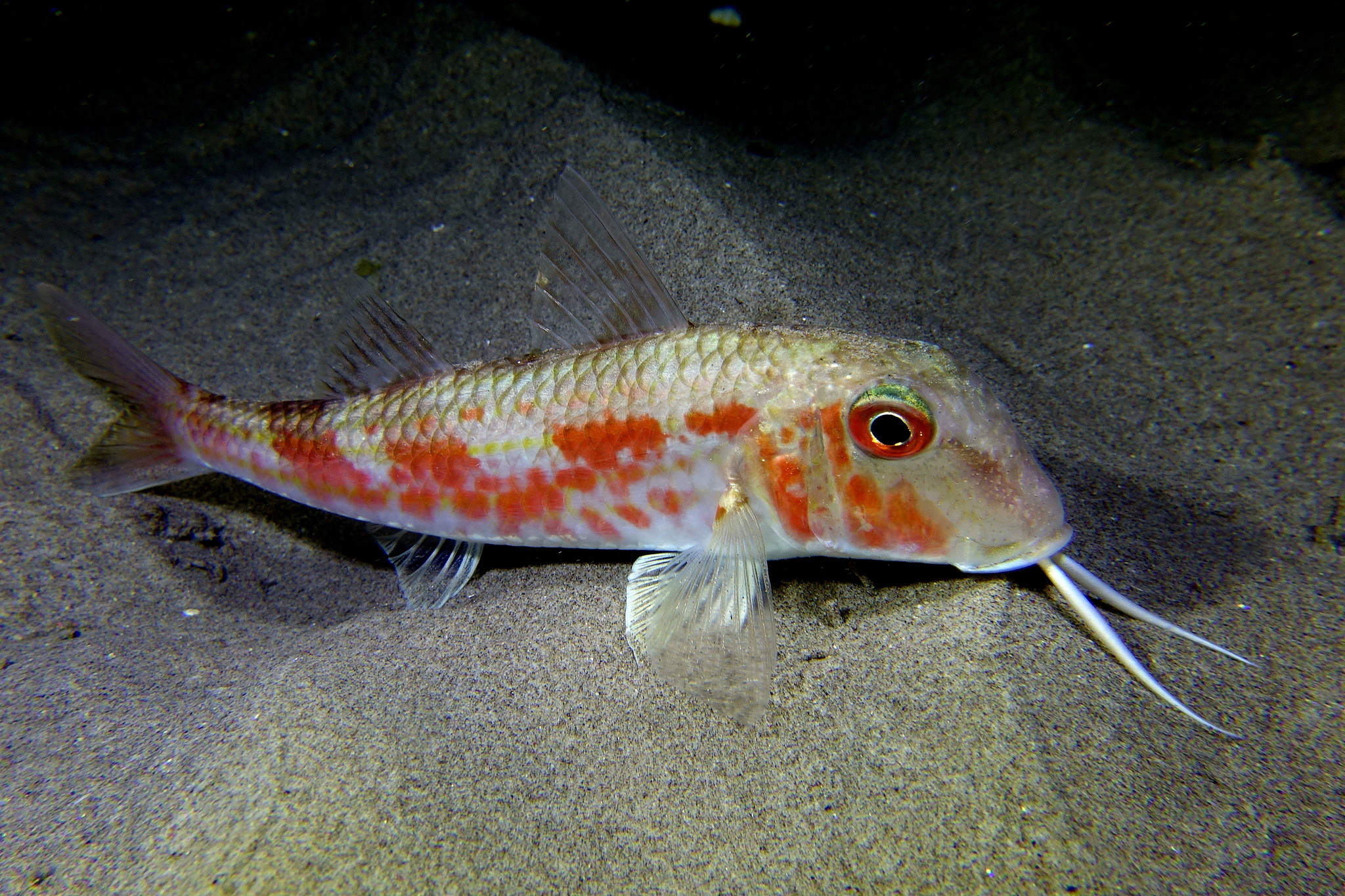
Blunt-snouted mullet
- Family
- Mullidae
- Depth
- 10–328 m
- Season
- Feb, Mar, Apr, May, Jun, Jul, Aug, Sep, Oct
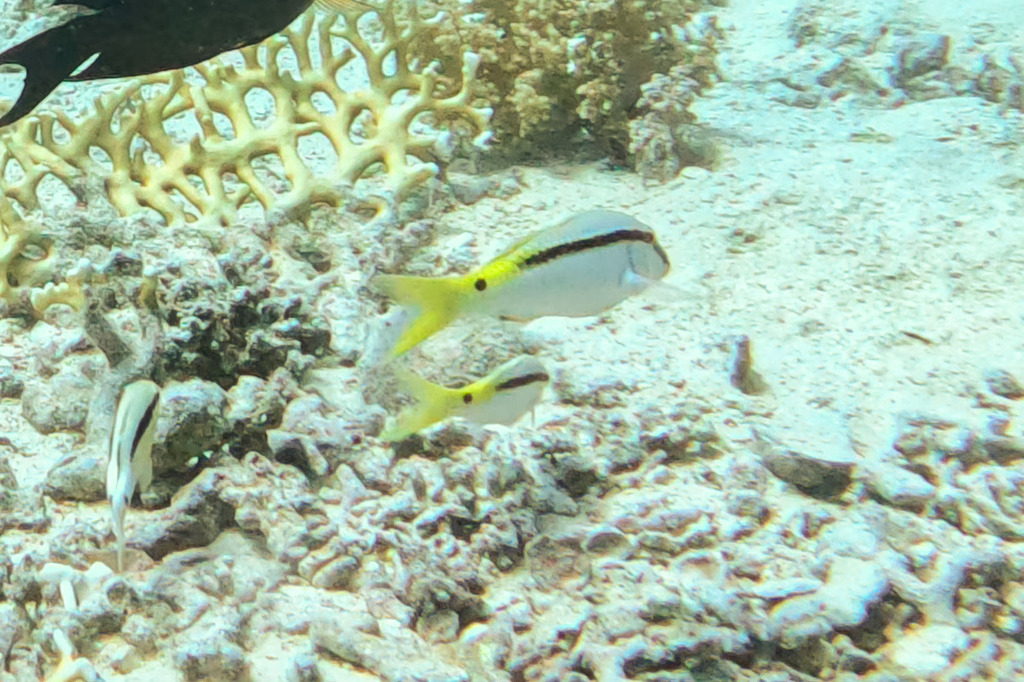
Forsskål's goatfish
- Family
- Mullidae
- Depth
- 1–45 m

Manybar goatfish
- Family
- Mullidae
- Depth
- 0–161 m
- Season
- Jan, Feb, Mar, Apr, May, Jun, Jul, Aug, Sep, Oct, Nov, Dec
Guides for this water
Technique, gear and safety guides that fit Yellowfin goatfish.