
Leopard grouper
Leopard grouper is an epinephelid of the Gulf of California and the southwest coast of Baja California, south to Jalisco. It lives from 1 to 50 m in tropical water, reaches 86 cm TL and 9.6 kg, and feeds on crustaceans and fish.

Leopard grouper (Mycteroperca rosacea) is a fish of the family Epinephelidae. FishBase gives its range as: Eastern Central Pacific: southwest coast of Baja California throughout the Gulf of California to Jalisco, Mexico. It is recorded from 1 to 50 m, in tropical water. The recorded maxima are 86 cm TL, 9.6 kg. Diet includes crustaceans and fishes. IUCN status: Least Concern (LC). Chinese name: .
Identification
On a Mexican fish stall this species is sold under two names, leopard grouper and golden grouper. Neither name is a diagnosis. The fish on the ice is identified by the pattern on its flank and the shape of its head, and the label tells you what the seller calls it, not what the animal is. The recorded ceiling is 86 cm and 9.6 kg, which is small enough that a market fish and a reef fish can be the same size, and that is exactly where the confusion starts.
Its dorsal count runs from 16 to 18 soft rays, with three anal spines and ten or eleven soft rays. The cross-section is oval, not flattened. The page gives a maximum and no common length, so the number a buyer sees on a slab is not anchored to any stated average. A market that sells by weight and a record that publishes only a ceiling leave the middle of the size range undescribed.
The useful distinction is not between two common names. It is between the fish as a product and the fish as an event. In the market it is a fillet or a whole fish on ice; on the reef it is an animal that gathers in late spring at a small number of sites, and that gathering is what the market never shows.
Habitat and behaviour
This leopard grouper lives at 1 to 50 m in tropical water between 32°N and 18°N. The substrate word is rocky, and the shallow end of that range is unusual for a grouper: one metre is within reach of a snorkel, which makes this fish visible to people who never set foot on a boat.
Crabs and fishes are both on the prey list. That mix supports both a bait fisherman and a lure fisherman, but it also describes a predator that stays close to structure rather than ranging over open ground. The behaviour that matters for management is not the feeding but the spawning: the species forms aggregations, and the study that mapped them found the fishing zones sitting on top of the aggregation sites.
Seasonal window
The dated event in this file is the spawning peak in May and June. That is the window that decides everything else: it is when fish are easiest to find, and it is when a removal does the most damage to the spawning group. Outside that window the fish are dispersed across rocky ground and the same effort produces fewer encounters.
The Red List assessment is Least Concern, dated 18 November 2016. LC describes the species across its range; it does not describe a single aggregation in a single month. Those are different scales of question, and the spawning study answers the smaller, sharper one.
Gear and approach
An 86 cm ceiling and no common length point to medium tackle: a rod that casts a bait accurately to rock, 30–40 lb leader, and a reel that can turn a fish away from a ledge. Heavier gear is not needed for the size, but it shortens a release if the local rule protects this fish.
The release decision should be made before the trip, not at the rail. Since the record gives no length at maturity, there is no biological threshold to fall back on; the local figure is the only defensible line. In the aggregation months, that line matters more than in the dispersed months, because every fish taken is taken from the spawning group.
Edibility and regulations
The species is a minor commercial and gamefish species in Mexico, and the regulation that governs the take is a Mexican instrument, not a global one. The spawning study is the local warning: it mapped 17 spawning sites in the Midriff Island region of the Gulf of California, found that fishing zones overlap them, and identified the no-take reserve network as the protection tool. That is the sentence that should change a plan: the reserve boundary is not decorative, and the aggregation sites are the reason it exists.
The Red List rank is LC. Least Concern is not a harvest permit; it is a statement that the species as a whole is not currently at high risk. A local aggregation can be depleted while the range-wide category stays unchanged, which is why the study and the list are read together rather than instead of each other.
Where to look
GBIF's distribution list for the taxon holds three entries: an East Pacific claim from ITIS, an IUCN global outline, and a Mexican checklist. Those are jurisdictional labels, not fishing marks. The written range is the southwest coast of Baja California through the Gulf of California to Jalisco. iNaturalist holds 484 observations under taxon 106312, a large enough set to show that this fish is seen often by divers and shore anglers, not that it is abundant.
The practical search is rocky ground in the upper half of the 1–50 m band, and in May and June, the Midriff Island region where the spawning study worked. Go to look, not to take from the aggregation.
What the market hides
Two names on a slab hide one animal and one event. Leopard and golden are sale labels; the 86 cm ceiling is a record, not a market average; the spawning peak in May and June is the event that the supply chain never displays. A buyer sees the product and a fisherman sees the aggregation, and the two views produce different decisions about the same fish. The useful rule is to keep the market question and the reef question separate: ask what the label is, then ask where and when the fish was caught. The second question is the one that decides whether the stock is still there next spring.
Where these facts come from
Check these pages before you rely on a size, range or protection status.
- FishBase — Mycteroperca rosacea — FishBase · T2
- GBIF — Mycteroperca rosacea occurrence records — GBIF · T2
- IUCN Red List — Mycteroperca rosacea — IUCN · T1
- Photo record — iNaturalist — iNaturalist · T3
Fish in the same water
These fish live in the same place.
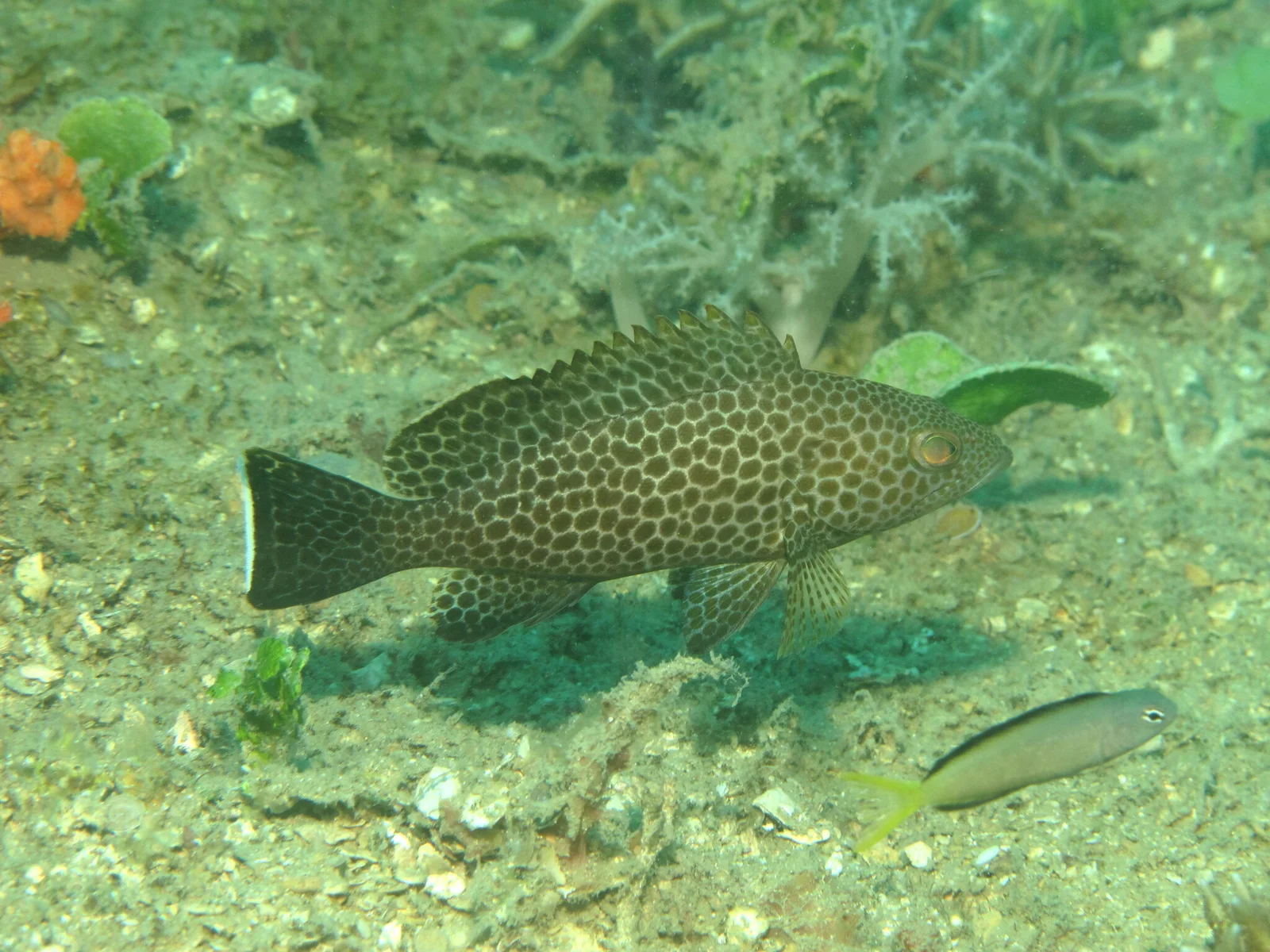
Areolate grouper
- Family
- Epinephelidae
- Depth
- 6–200 m
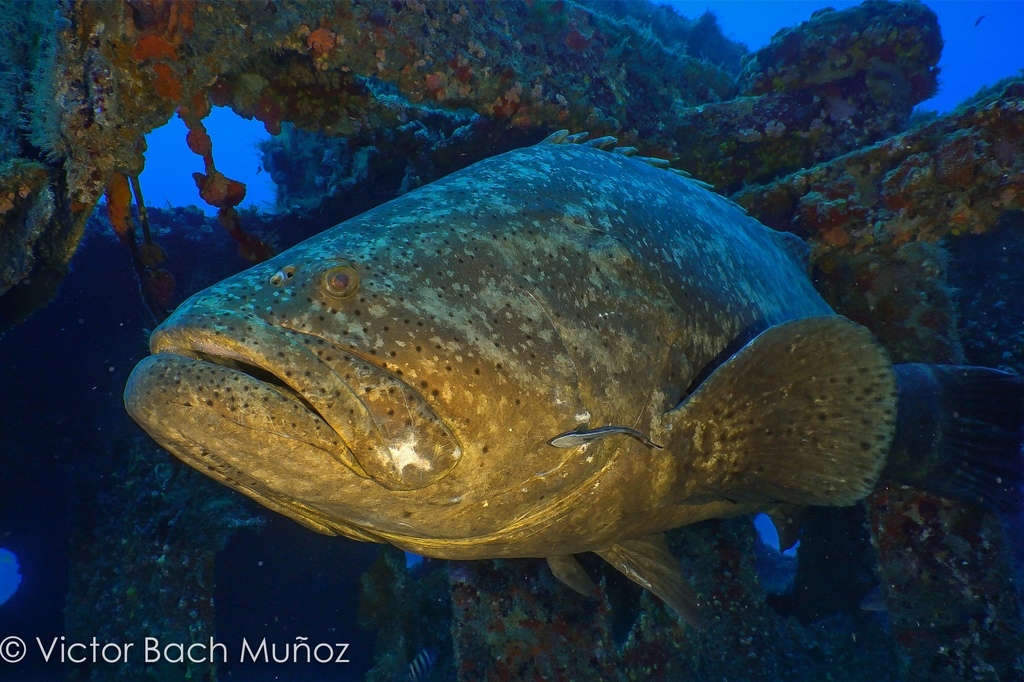
Atlantic goliath grouper
- Family
- Epinephelidae
- Depth
- 0–100 m
- Season
- Jan, Feb, Jun, Jul, Aug, Sep

Black grouper
- Family
- Epinephelidae
- Depth
- 60–250 m
- Season
- Jan, Feb, Mar, Apr, May, Jun, Jul, Aug, Sep, Oct, Nov, Dec
Guides for this water
Technique, gear and safety guides that fit Leopard grouper.