
Mottled grouper
Mottled grouper is an epinephelid of the eastern Atlantic, from Portugal to southern Angola. It lives from 15 to 200 m in subtropical water, reaches 144 cm TL and 49.7 kg, and feeds on fish and molluscs. It is one of the larger groupers in the region.
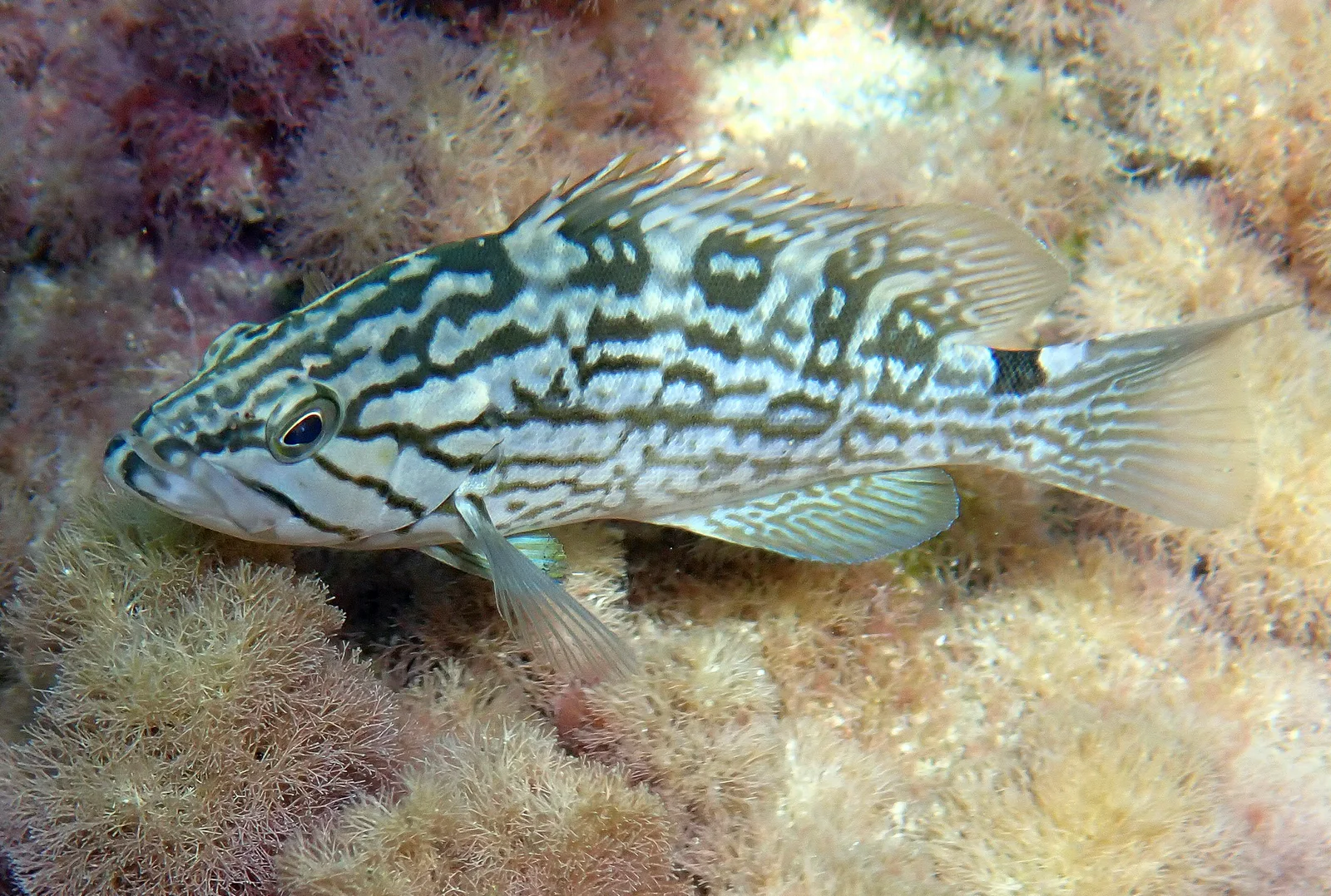
Mottled grouper (Mycteroperca rubra) is a fish of the family Epinephelidae. FishBase gives its range as: Eastern Atlantic: Portugal to southern Angola; reports from islands require confirmation. Specimens from Madeira, Azores, Canary Islands, and Cape Verde have been examined by Heemstra (1991, ) and are identified to be Mycteroperca fusca. It is recorded from 15 to 200 m, in subtropical water. The recorded maxima are 144 cm TL, 49.7 kg. Diet includes fishes and molluscs. IUCN status: Least Concern (LC). Chinese name: .
Identification
This is one of the few grouper records that gives a middle as well as a ceiling: 144 cm and 49.7 kg are the maximum, and 80 cm is the common length. That common figure is the useful one. It says the fish an experienced angler meets is roughly half the record length, and it gives a number to build tackle around instead of a trophy to dream about.
The dorsal fin carries eleven spines followed by 15 to 17 soft rays, and the anal fin has three spines and 10 to 12 soft rays. First maturity sits in the low 30s of centimetres. Treat that as a put-back line rather than a keep size: anything under about 32 cm has yet to breed, and releasing it costs you nothing. Any legal floor sits above that biological line, and the two should not be confused.
The name changes with the language, and one of those names matters later. In English it is the mottled grouper; in Italian it is cernia rossa, the red grouper. That Italian name is the one a Ligurian regulation uses when it carves out an exception, which is why the identification section is not only about fins.
Habitat and behaviour
The record puts the species at 15 to 200 m, usually between 15 and 50, on rock and sand. The two substrates are not interchangeable background: rock is where the fish hides, sand is where it feeds. A demersal grouper built for that pairing sits at the contact line, looking across open sand from cover, rather than in the middle of a reef or the middle of a flat.
Fishes and molluscs are what it takes. That is a broad offer — a fish bait, a squid strip, a piece of mollusc — and it fits an ambush hunter that takes whatever crosses the edge. The 200 m end of the range is outside most recreational reach; the fishable part is the 15–50 m band, and even its deeper half needs a boat that can hold position.
Seasonal window
The range runs from Portugal to southern Angola, so most of it is subtropical to tropical water. No spawning month is recorded for the species; the season has to be read from water temperature and from whether the 15–50 m band is workable, not from a breeding month. In the north of the range, winter weather is the limiting factor; in the south, it is less so.
That absence also means no spawn mass forms for a boat to find. Effort on this stock is distributed along the contact line all year, which makes the choice of where to drop the bait more important than the choice of which week to go.
Gear and approach
With an 80 cm common length, a medium-heavy outfit is the right default: enough backbone to raise a fish from the bottom in 50 m, 40 lb leader for the rock, and a reel that holds line without bellying. The 144 cm ceiling is a surprise fish, not the design target, but the drag should be capable of going up if one appears.
The release line is simple at the small end. Below roughly 32 cm, the fish has yet to breed, and it goes back without a debate. Above that, the question is legal rather than biological, and the answer depends on which jurisdiction you are in — see the exception below.
Edibility and regulations
The RAMOGE document for the Ligurian Sea sets a 45 cm minimum catch size for groupers and then explicitly excludes cernia rossa, this species, from that minimum. That exception is the most useful sentence in the file: the headline number does not apply to the red grouper, so an angler who assumes "45 cm for all groupers" is applying a rule that was written for the others. It governs what you may keep, not whether you may go out; a closed season would be a different rule.
On the Red List the fish stands as Least Concern, assessed 22 November 2016. The only use the page records is minor commercial fishing. The distribution table lists 42 countries and territories from Portugal to Angola, and that is a range, not a rulebook: each of those countries can set a different size, and none of them is described by the FishBase page.
Where to look
GBIF lists six distribution entries: Eastern Atlantic, a worldwide IUCN layer, European Marine Waters, and country records for Greece, Israel and Norway. Six declarations include one, Norway, that sits outside the written Portugal-to-Angola range, which is a reminder that these records describe where a presence has been asserted rather than where the fish lives. The written range is Portugal to southern Angola. iNaturalist holds 372 observations under taxon 64452.
Within that range, the search is the 15–50 m contact line between rock and sand. The fish is not a reef-centre species, and a mark in the middle of a sand flat is the wrong mark.
Reading the bottom
Three things decide this fishery, and they come from three different places. The substrate decides the method: rock for cover, sand for feeding, and the edge for the ambush. The common length decides the tackle: 80 cm is the fish you should expect. The regulation decides the keep: the 45 cm headline does not cover this species in the Ligurian Sea, and the exception has to be read. Collapse those three into one habit — "grouper, 45 cm, rocky bottom" — and you get the method right, the tackle wrong and the rule wrong at the same time.
Where these facts come from
Check these pages before you rely on a size, range or protection status.
- FishBase — Mycteroperca rubra — FishBase · T2
- GBIF — Mycteroperca rubra occurrence records — GBIF · T2
- IUCN Red List — Mycteroperca rubra — IUCN · T1
- Photo record — iNaturalist — iNaturalist · T3
Fish in the same water
These fish live in the same place.
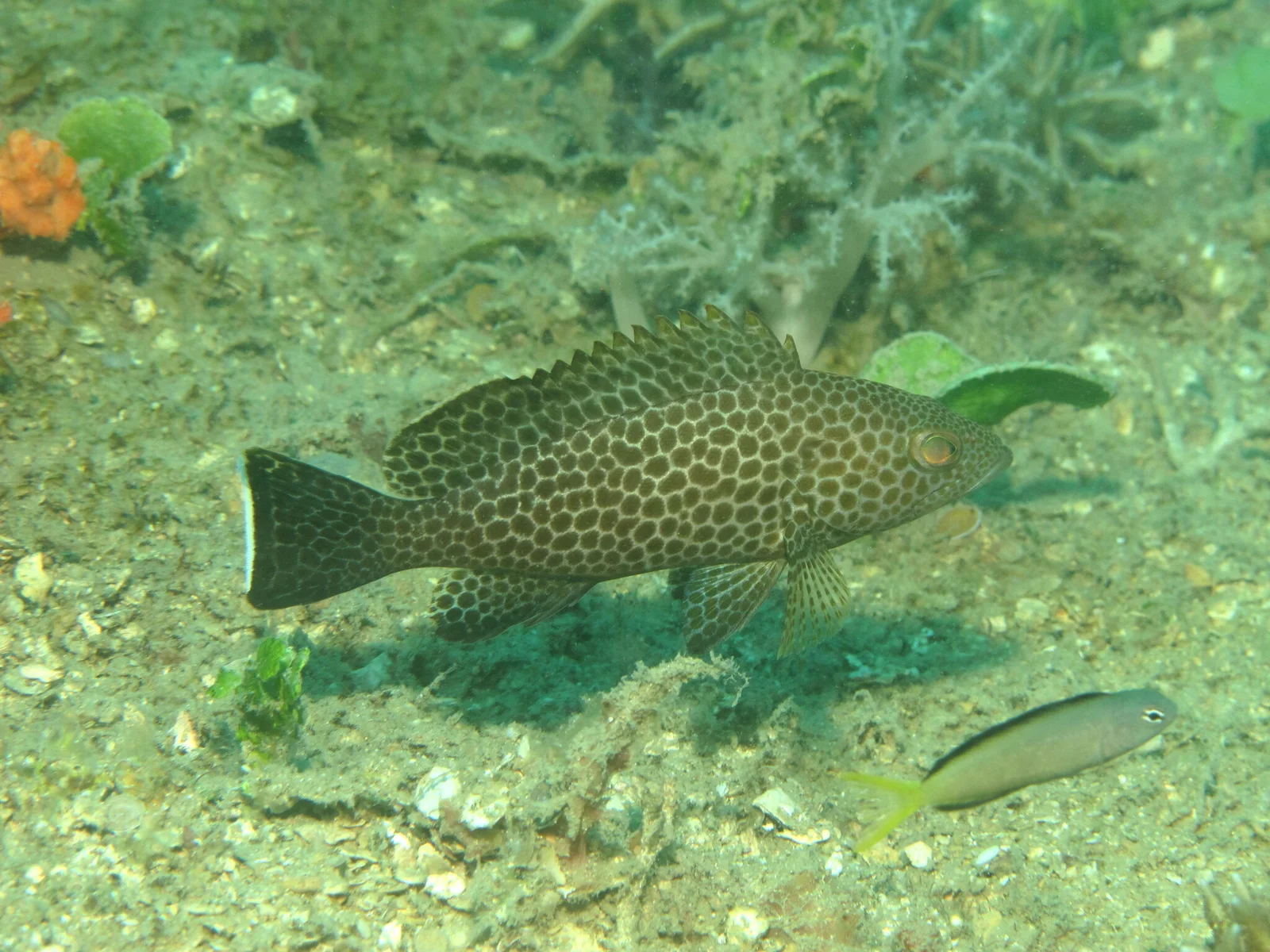
Areolate grouper
- Family
- Epinephelidae
- Depth
- 6–200 m
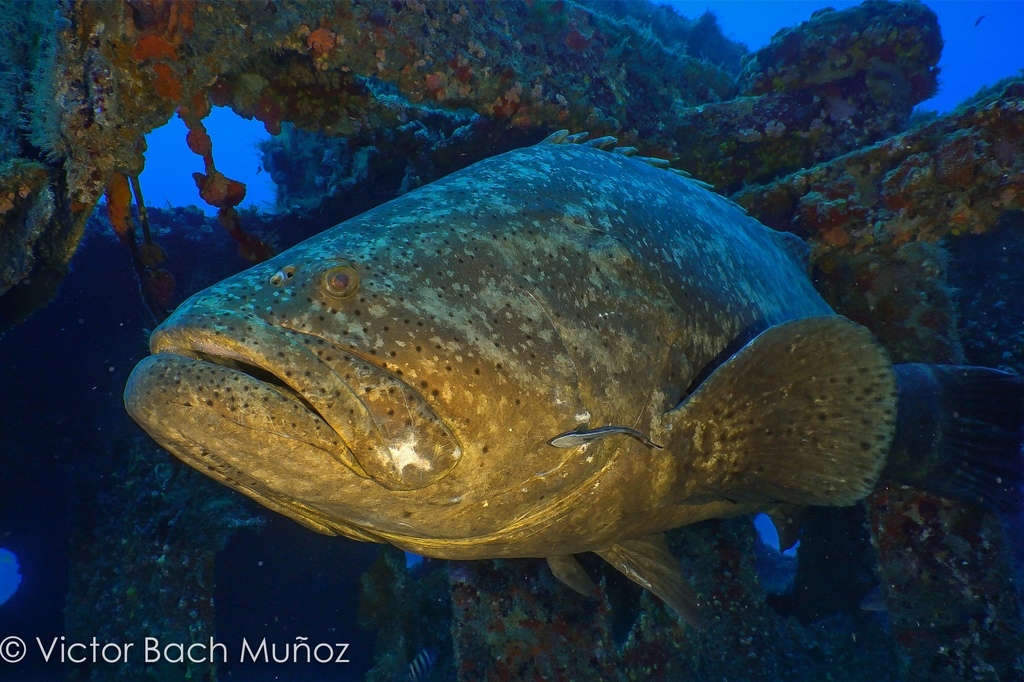
Atlantic goliath grouper
- Family
- Epinephelidae
- Depth
- 0–100 m
- Season
- Jan, Feb, Jun, Jul, Aug, Sep

Black grouper
- Family
- Epinephelidae
- Depth
- 60–250 m
- Season
- Jan, Feb, Mar, Apr, May, Jun, Jul, Aug, Sep, Oct, Nov, Dec
Guides for this water
Technique, gear and safety guides that fit Mottled grouper.