
Spotted sand bass
Of the three Paralabrax basses, this is the one that speaks in spots: small dark speckles cover the upper body and fins, with none of the pale blotches of a kelp bass and none of the vertical bars of a barred sand bass. It is also the smallest of the three at 60 cm, and it stays in bays and eelgrass, which makes it a quieter target than the other two.
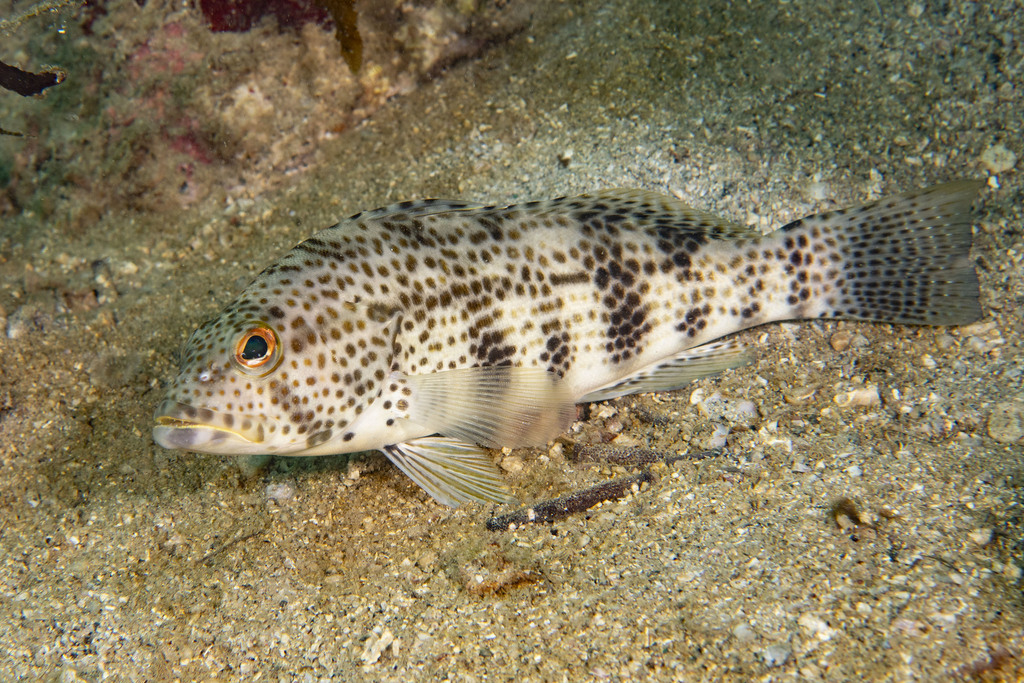
Of the three Paralabrax basses, this is the one that speaks in spots: small dark speckles cover the upper body and fins, with none of the pale blotches of a kelp bass and none of the vertical bars of a barred sand bass. It is also the smallest of the three at 60 cm, and it stays in bays and eelgrass, which makes it a quieter target than the other two.
Small dark spots instead of bars or blotches
Hold the fish to the light and look along the flank. Small dark speckles cover the upper body and run out onto the dorsal, anal and tail fins, and there are no vertical bars. A kelp bass shows pale blotches, while a barred sand bass carries roughly five dark bars and a third dorsal spine about twice the length of the fourth. Maximum size is the easiest secondary check: this species stops at 60 cm, the other two reach 72 and 67 cm. At the boat, confirm the absence of bars, then the spot pattern, then the spines.
Bay water, eelgrass and sand next to rock
The recorded range runs from Monterey in California to Mexico, including the Gulf of California, with a report from Nicaragua. The fish sits over sand or mud near rock and eelgrass, from the shore out to 60 m. In Southern California the working water is inside bays, harbours, around pier structure and along the edge of eelgrass; an exposed beach with heavy surf is not its ground. The range leans further south than the other two basses, and Southern California sits at its northern end, where cold winter water limits activity.
A bay fish with a wide temperature record
FishBase gives a tolerance of 7.5 to 32°C, more specific than the entries for the other two basses, which explains how it spends summer in shallow bay water. It is a pelagic spawner with no month-by-month table. Southern California catches start in late spring, hold through summer and autumn inside the bays, and thin in winter. Bay water changes faster than open coast water, so the difference between morning and afternoon can matter more than the difference between months; plan the session around the tide and the light.
Slow presentations in shallow bay water
Bay fishing is slow by design. Work a soft plastic with small hops along the bottom, or fish a piece of squid or shrimp on a 1/0 to 2/0 hook and let it sit at the eelgrass edge. Under pier lights, a small swimbait or a live shrimp cast at the edge of the shadow does the work. The fish feeds by day as well, but it is secretive, and bites come when the retrieve slows down. Choose natural colours, keep the head weight light, and pause for two seconds after the lure lands. It eats small fish and benthic crustaceans, so a two or three inch bait beats a bigger one.
One step lighter than the kelp bass rig
A 7 foot medium-light rod with a 3000 size spinning reel, 15 to 20 lb braid, a 12 to 15 lb fluorocarbon leader and a 1/0 to 2/0 hook covers the fishery. Shallow bay water and low structure let you fish one step lighter than you would for kelp bass. The mouth is small, so do not strike hard; once hooked, pull the fish away from the eelgrass before it wraps. On a pier, keep the rod tip low so the line does not loop around the pilings. A soft tip also shows the moment the lure touches down, and that is when many of the bites come.
Five bass across three species, fourteen inches minimum
FishBase gives no eating quality and describes the species as an important game fish in bays and harbours. The flesh is white and flakes small, good fried whole or in soup. California's three Paralabrax basses share a five-fish limit, with a 14 inch total length minimum or the 10 inch alternate length (14 CCR § 28.30), and no closed season. A 60 cm maximum means legal fish are not rare in theory, but large fish are uncommon in the bays, so decide before you keep one. Parts of the Southern California bays and harbours lie inside marine protected areas, so check the CDFW MPA map and the current year's notice. A licence is required from 16, plus the Ocean Enhancement Validation south of Point Arguello.
A thin record with one unusually specific number
The 60 cm maximum, the 1 to 61 m depth band, the Monterey to Mexico range, the sand and mud habitat next to eelgrass, and the 7.5 to 32°C tolerance all come from FishBase. The family follows GBIF's Serranidae, and the IUCN listing is Least Concern, assessed in 2008. This FishBase entry has no weight or age field, and none is supplied here. The 60 cm figure is the only size datum on the page, and it is a maximum rather than a typical length, so it says nothing about the size most fish reach. Spawning months and local population data are missing; the month-by-month strength is arranged from Southern California bay reports. The separation from the other two basses uses visible field characters only, with no fin-ray counts.
How to catch it
Soft plastic along the eelgrass
A 3 inch bait on a 1/4 oz head, landed on the grass edge, hopped twice and left to sink through the shadow.
Bait fishing
Cast a small swimbait or live shrimp at the edge of the light and retrieve slowly with pauses, working the line between light and dark.
Drift fishing
With the boat drifting, drag a squid strip on a 2/0 hook along the bottom, lifting the rod tip over structure and setting it back down.
Where these facts come from
Check these pages before you rely on a size, range or protection status.
- FishBase — Paralabrax maculatofasciatus — FishBase · T2
- GBIF — Paralabrax maculatofasciatus occurrence records — GBIF · T2
- IUCN Red List — Paralabrax maculatofasciatus — IUCN · T1
- Photo record — iNaturalist — iNaturalist · T3
Fish in the same water
These fish live in the same place.

Guides for this water
Technique, gear and safety guides that fit Spotted sand bass.