
Whitesaddle goatfish
Start with the fin counts: the dorsal fin carries eight spines and nine soft rays, the anal fin seven soft rays, and the vertebral count is twenty-four. The pectoral fin usually carries fifteen rays, rarely fourteen or sixteen, and the gill rakers total thirty to thirty-four. Proportions: body depth close to one third of standard length, snout moderately long, barbels short at roughly a fifth of head length, and the posterior margin of each caudal lobe convex.

Start with the fin counts: the dorsal fin carries eight spines and nine soft rays, the anal fin seven soft rays, and the vertebral count is twenty-four. The pectoral fin usually carries fifteen rays, rarely fourteen or sixteen, and the gill rakers total thirty to thirty-four. Proportions: body depth close to one third of standard length, snout moderately long, barbels short at roughly a fifth of head length, and the posterior margin of each caudal lobe convex. Colour does the rest. The body is red to reddish brown above and light red below, with a white saddle-like spot on the caudal peduncle flanked by dusky spots, the rear one darkest. A reddish brown band runs from the snout through the eye and along the body above the lateral line, fading and broadening under the second dorsal fin. The barbels are white and the fins are mainly red. Other goatfish share the reef, so the white saddle, the reddish band and the white barbels should be checked together; a red body on its own is not enough.
One archipelago, and a country list that argues
FishBase gives the distribution as the eastern central Pacific: Hawaii. The coordinate box, 24°N to 18°N and 164°W to 153°W, is the Hawaiian chain and nothing else. Treat it as endemic to the Hawaiian Islands. The species lives on lagoon and seaward reefs from 1 to 140 m, in small groups under ledges or among corals by day. The country table on the same page also lists American Samoa, Fiji, Seychelles and Taiwan, which does not fit an endemic Hawaiian fish and is best read as records awaiting review rather than as range. GBIF gives no consolidated count. A one-metre lower bound puts reef tops inside the range, while 140 m is far beyond anything a shore angler can reach; the shallow end is the only part a cast can test.
Spawning runs most of the year
Here the record is unusually specific: spawning appears to be year-round, with a peak from December to July, and females may spawn more than once a year. That is a long window, and it means the closed-season logic used for temperate species does not apply. The daily rhythm is the sharper tool. These fish shelter in small groups by day and disperse at night to feed among rocks and corals on benthic crustaceans. A night session on a reef edge is therefore aimed at a feeding fish rather than a resting one, which is why the hours after dark outperform the middle of the day.
Small hooks after dark
Night shore fishing is the main method: a small hook with shrimp or squid, fished around rocky shoreline and reef edges after dark. Put the bait down at the structure first and lift it gently rather than casting long. The mouth is small, so hook size follows the bait rather than the fish. Small jigs and soft plastics worked along sand-and-coral edges cover more ground and pick up fish that have moved off the reef. Working the edge of a light rather than the bright centre keeps the bait in the zone where a nocturnal feeder is hunting. When a fish is hooked, lead it away from the ledge before lifting; the first run is toward cover. There is no need to walk far along the shore: one sand channel can hold fish for a whole night, and moving usually means leaving the fish that had just gathered.
Light line and sharp senses
At 51 cm maximum, with no common length or weight recorded, this is a light-tackle target. Fine leader, small hooks and a sensitive tip matter more than strength; the take is delicate and the mouth is soft. A short carbon leader protects against the reef edge without stiffening the presentation. A headlamp with a dim setting is part of the tackle, not an accessory, because it lets you read the edge without flooding the water. Set the drag light, land the fish quickly and measure it; the minimum is a hard number and the difference between keep and release is decided on the ruler.
Ten inches, twelve on Maui
The state minimum for kūmū is 10 inches, and Maui is excluded from that rule. On Maui the figure rises to 12 inches, with one fish per person per day. A non-resident who wants to fish recreationally needs an NRMFL; anyone selling the catch needs a CML. The species is listed as Near Threatened, which is an argument for restraint that the size limit does not capture on its own. The Hawaiian name kūmū is used here as a local name, not as a scientific one.
Where the sources disagree
Only 162 observations sit on iNaturalist, and GBIF publishes no overall total, so neither says much about abundance. The FishBase entry is detailed on morphology and spawning but lists countries outside Hawaii that conflict with an endemic range; those rows are flagged here as needing review rather than reported as distribution. There is no common length and no weight in the record, which limits any statement about typical size. The size and bag rules come from the state's marine fish pages and should be checked against the current version before a trip.
How to catch it
Shore fishing
Fished with the listed approach, matched to the recorded depth and size.
Jigging
Fished with the listed approach, matched to the recorded depth and size.
Where these facts come from
Check these pages before you rely on a size, range or protection status.
- FishBase — Parupeneus porphyreus — FishBase · T2
- GBIF — Parupeneus porphyreus occurrence records — GBIF · T2
- IUCN Red List — Parupeneus porphyreus — IUCN · T1
- Photo record — iNaturalist — iNaturalist · T3
Fish in the same water
These fish live in the same place.
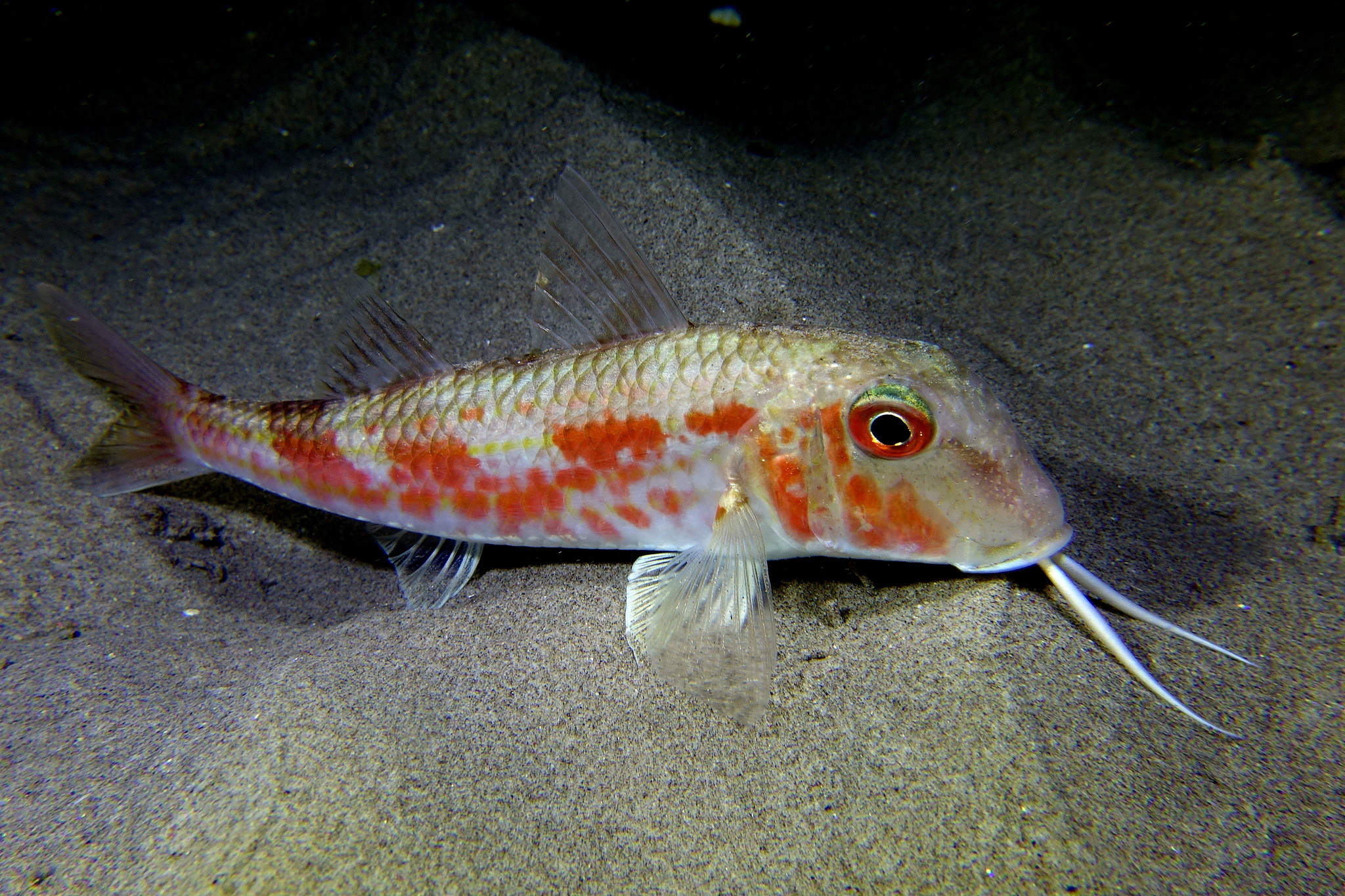
Blunt-snouted mullet
- Family
- Mullidae
- Depth
- 10–328 m
- Season
- Feb, Mar, Apr, May, Jun, Jul, Aug, Sep, Oct
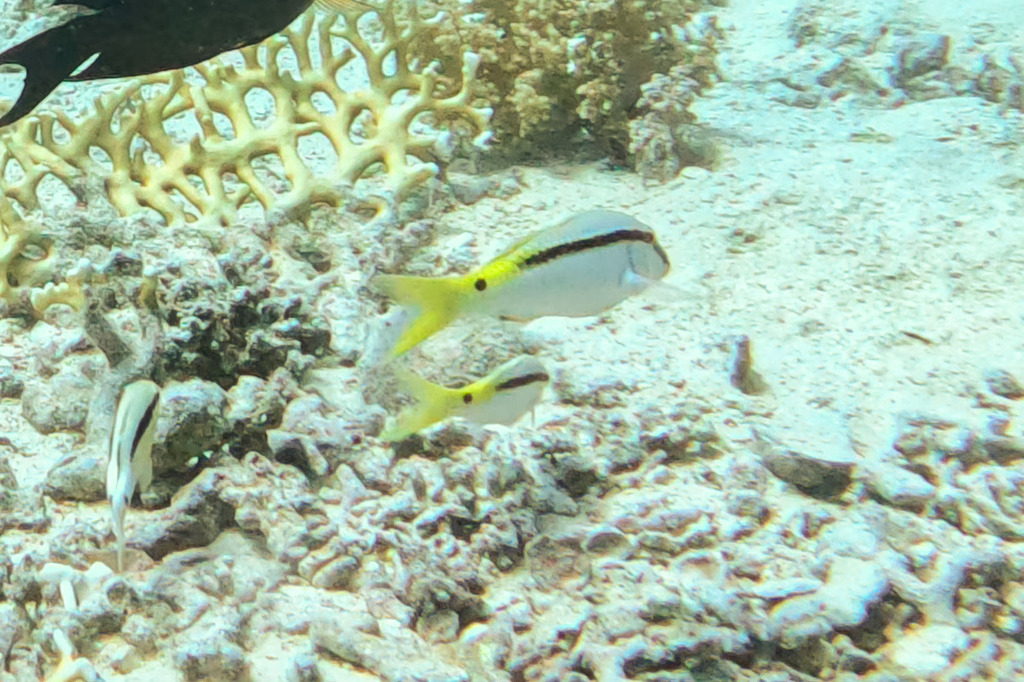
Forsskål's goatfish
- Family
- Mullidae
- Depth
- 1–45 m

Manybar goatfish
- Family
- Mullidae
- Depth
- 0–161 m
- Season
- Jan, Feb, Mar, Apr, May, Jun, Jul, Aug, Sep, Oct, Nov, Dec
Guides for this water
Technique, gear and safety guides that fit Whitesaddle goatfish.