
Crescent sweetlips
Crescent sweetlips is a reef haemulid of the Indo-West Pacific, from the Arabian Sea to southern Japan, with Taiwan and the Penghu Islands inside its range. It is a tropical fish that reaches 60 cm TL and feeds on fish. No depth band is recorded for it, and IUCN lists it as Least Concern.
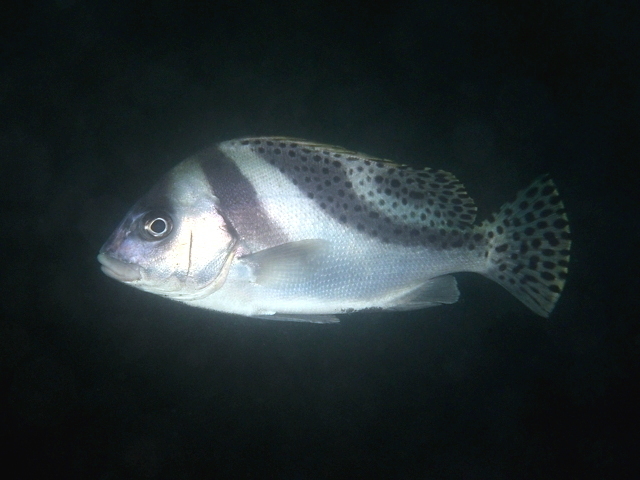
Crescent sweetlips (Plectorhinchus cinctus) is a fish of the family Haemulidae. FishBase gives its range as: Indo-West Pacific: Arabian Sea to southern Japan. The fin formula is XII dorsal spines with 15–17 soft rays and III anal spines with 7–8 soft rays, with 53–57 lateral-line scales. It is recorded in tropical water. The recorded maximum is 60 cm TL. Diet includes fishes. IUCN status: Least Concern (LC). Chinese name: .
Identification
The market name is the first identification problem. The Taiwan Fish Database fish database lists this haemulid as and then gives the names it is sold under: , , , (Taitung), and (Penghu). Two of those are actively misleading. puts the fish in the rock-bream group (Sparidae), and is a market alias that carries no taxonomic information. FishBase's English list is equally loose, running from "Crescent sweetlips" to "Dark-banded sweetlip", "Grunt" and "Yellow spotted grunt". A market name does not carry the identification.
The body is the test. The Taiwan Fish Database description gives three oblique dark bands: one through the eye to the mouth corner, one from the dorsal origin back to the anal base, and one from beneath dorsal spines III–VI to the caudal base, with many small black dots on the upper body and on the dorsal and caudal fins. The fin formula is XII dorsal spines with 15–17 soft rays and III anal spines with 7–8 soft rays, with 53–57 lateral-line scales. FishBase gives a 60 cm TL maximum and a maturity range starting at 34 cm; common length, weight and age are absent. The Taiwan Fish Database page also prints 60 cm. A 60 cm ceiling is a record, not a market size; the farmed product sold under the same names may never approach it.
Habitat and distribution
The FishBase environment line reads marine, reef-associated and tropical, with habitat keywords reef, rocky and coastal, but no depth figures. The Taiwan Fish Database fills that gap with 3–50 m and describes coastal rocky reef, adding that Taiwan region's artificial reefs hold many of them. The range is Indo-West Pacific from the Arabian Sea to southern Japan, with an eight-territory country and territory list from China and Hong Kong SAR through Korea, the Ogasawara Islands, Sri Lanka, Taiwan region and Vietnam. The Taiwan Fish Database account extends it from the Ryukyus to the South China Sea, Sri Lanka and the Arabian Sea, and records it in the west, north and south of Taiwan region and Penghu. The two ranges agree at the broad scale; the depth figure exists in only one of them.
Season and fishing approach
FishBase has no spawning month; the Taiwan Fish Database gives May–June and says the fish is a carnivore taking crustaceans and small fish. That is the only dated run in the three sources, and it is local to Taiwan, China. The usable structure is the 3–50 m rocky reef band and the artificial reefs: fish close to rock, not over clean sand, and work the deeper half of the band when the shallows are empty. Baits should imitate crustaceans or small fish. Because the species is also farmed, the fish in the market may never have seen a reef; do not use a market specimen's size or colour as a model for the wild fish. Keep the first trip as a depth-and-bottom survey, and note which band produced the fish.
Edibility and regulations
Two uses appear on FishBase: commercial landings and commercial aquaculture; the Taiwan Fish Database page adds that the flesh is high-value and takes well to pan-frying or steaming. The Red List category, from an assessment dated 15 July 2020, is Least Concern. The same Taiwan Fish Database page states that the species is not on the IUCN endangered list, but it gives no legal minimum, no take cap and no closure, and the eight-territory FishBase table names no national instrument either. That gap matters more than usual here because is a name shared with the rock bream: a rule written for does not automatically cover this haemulid.
Where these facts come from
Check these pages before you rely on a size, range or protection status.
- FishBase — Plectorhinchus cinctus — FishBase · T2
- GBIF — Plectorhinchus cinctus occurrence records — GBIF · T2
- IUCN Red List — Plectorhinchus cinctus — IUCN · T1
- Photo record — iNaturalist — iNaturalist · T3
Fish in the same water
These fish live in the same place.
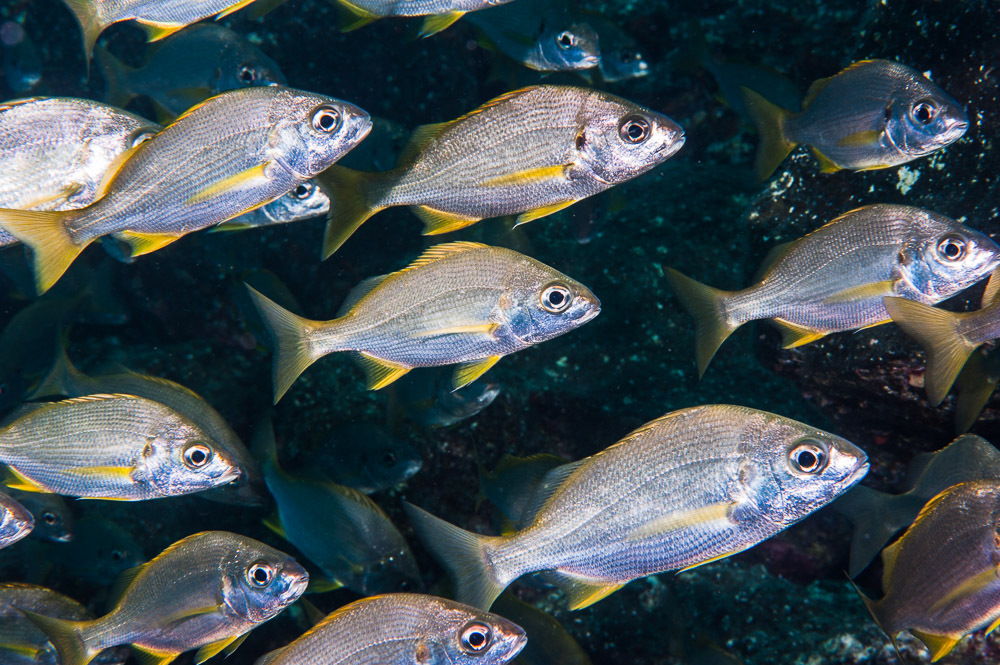
Bastard grunt
- Family
- Haemulidae
- Depth
- 10–100 m
- Season
- Jun, Jul, Aug
Cabinza grunt
- Family
- Haemulidae
- Depth
- 0–50 m
- Season
- Jan, Oct, Nov, Dec
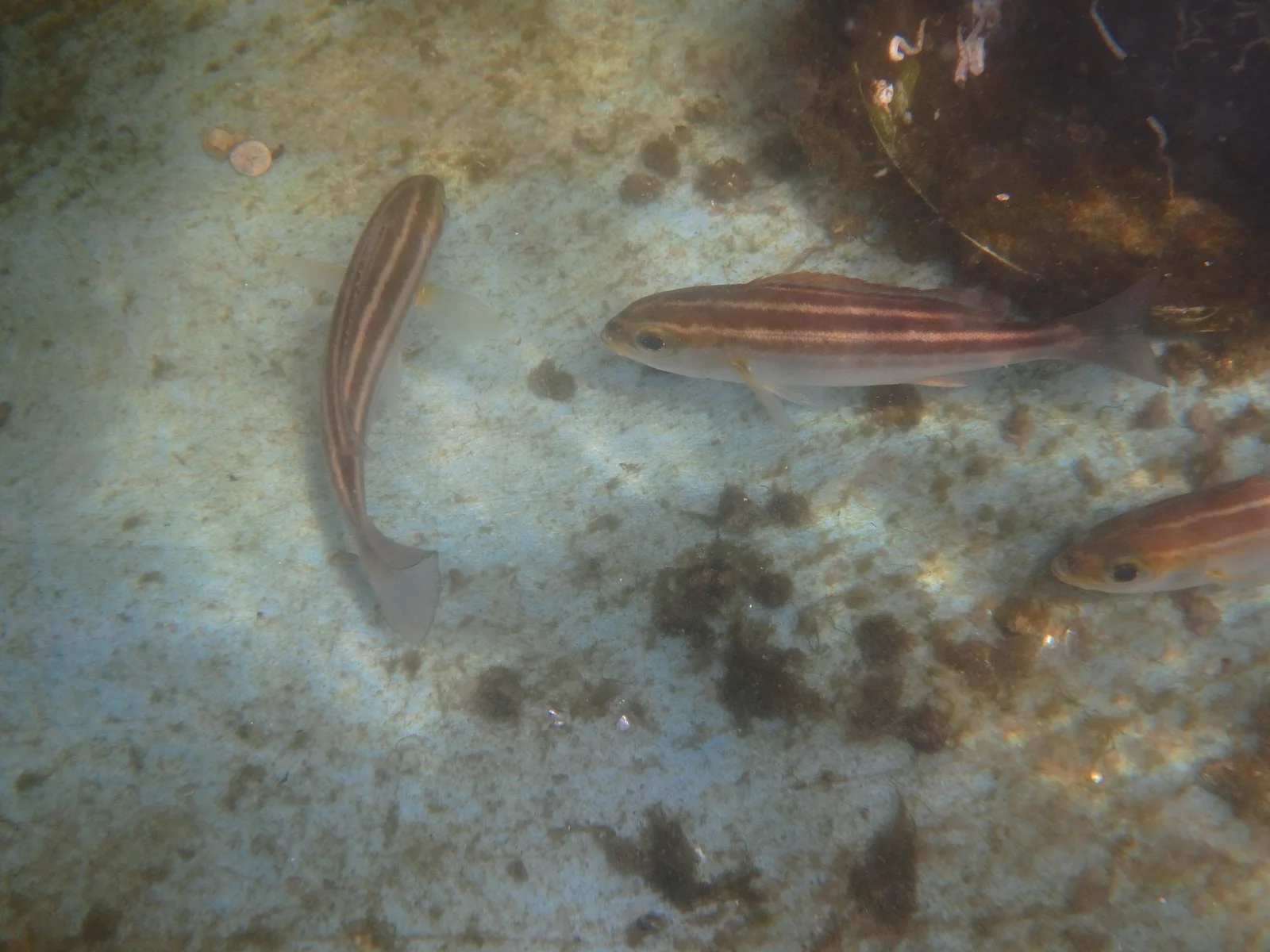
Chicken grunt
- Family
- Haemulidae
- Season
- Jun, Jul, Aug
Guides for this water
Technique, gear and safety guides that fit Crescent sweetlips.