
Spotted coral grouper
Spotted coral grouper is a western Pacific reef grouper, from Thailand, Singapore, the Philippines, Indonesia, Papua New Guinea, the Arafura Sea and the Solomon Islands to Australia (Houtman Abrolhos to Gladstone). It lives on coastal reefs at 5–100 m, preferring mixed algae and coral, common on inshore reefs and scarce on clear offshore reefs; juveniles use shallow coral rubble, and adults make short spawning migrations and aggregate.
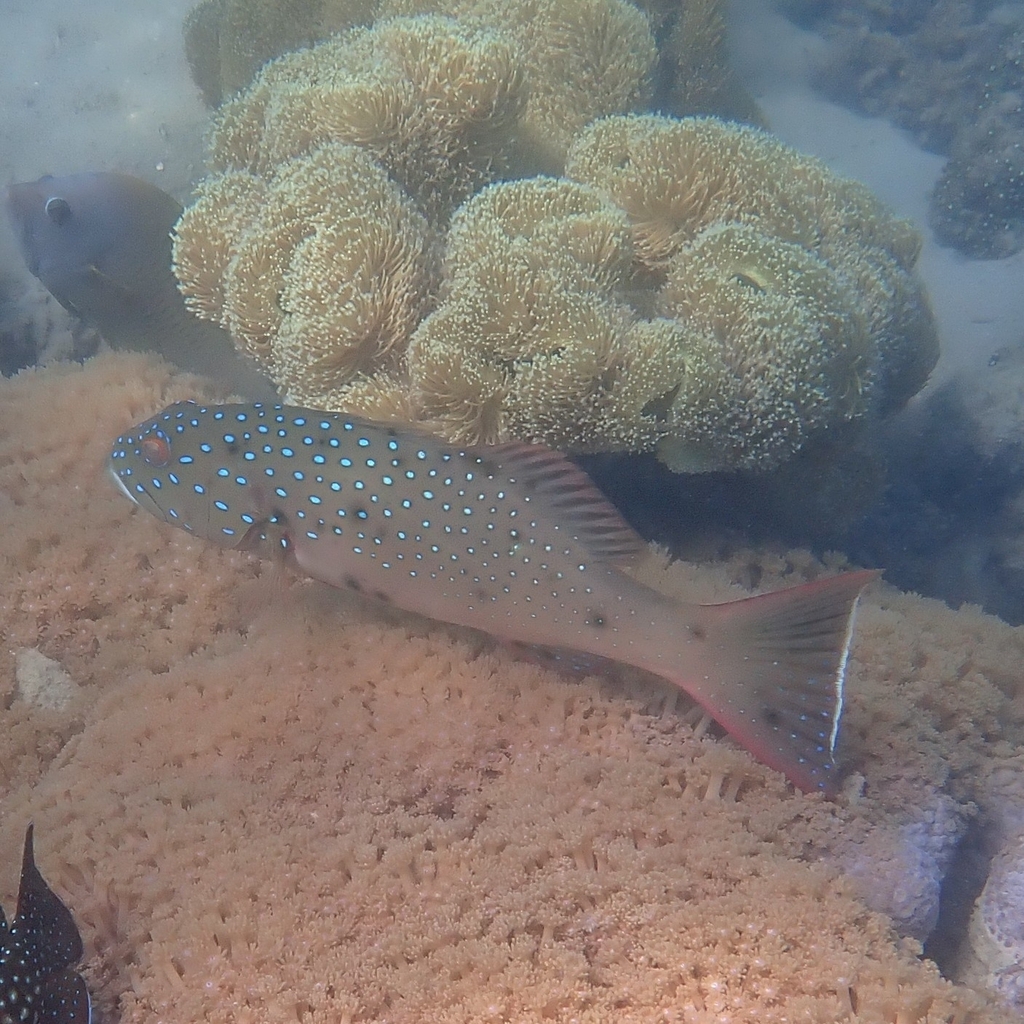
Spotted coral grouper is a western Pacific reef grouper, from Thailand, Singapore, the Philippines, Indonesia, Papua New Guinea, the Arafura Sea and the Solomon Islands to Australia (Houtman Abrolhos to Gladstone). It lives on coastal reefs at 5–100 m, preferring mixed algae and coral, common on inshore reefs and scarce on clear offshore reefs; juveniles use shallow coral rubble, and adults make short spawning migrations and aggregate. FishBase gives a maximum of 125 cm total length and 25 kg. IUCN lists it as Least Concern, assessed in 2018. The Chinese name follows FishBase's table, which gives , with the master plan's kept as an alias.
Reading the spines
The dorsal fin has 7–8 spines and 10–12 soft rays; the anal fin has 3 spines and 8 soft rays. The body is fusiform with an oval cross-section. The colour is reddish brown to orange-red, with dense small blue spots on the head, body and fins; the operculum and cheek have dark bands or blotches; the caudal fin is truncate or slightly concave. Identification in Plectropomus depends on cheek pattern, dorsal-spine count and colour: P. maculatus has dark cheek bands and dense spots; P. leopardus has larger spots and a different cheek pattern; P. areolatus is more slender. Check the cheek, spot density and spine count, not just the red colour.
A coastal coral-trout
FishBase's range is the western Pacific: Thailand, Singapore, the Philippines, Indonesia, Papua New Guinea, the Arafura Sea, the Solomon Islands and Australia. The country table includes Australia, Cambodia, the Cocos Islands, Hong Kong SAR, Indonesia, Japan, Malaysia, Papua New Guinea, the Philippines, Singapore, the Solomon Islands, Taiwan region, Thailand and Vietnam. GBIF's 10,537 records are led by Australia (10,069), Indonesia (56), Thailand (56), the Philippines (54) and Malaysia (20). It lives on protected coastal reefs with mixed algae and coral, common inshore and scarce on clear offshore reefs; juveniles use shallow reef, especially coral rubble; adults make short spawning migrations and form aggregations; eggs float just below the surface; outside spawning the fish is mostly solitary; juveniles eat small fish, crustaceans and squid.
The blanks are information
FishBase gives a Great Barrier Reef spawning window of September to November, and October–November at Scott Reef off Cairns. That window is the southern spring, so the dates do not transfer to northern-hemisphere reefs; the species is tropical and catchable all year, and in Taiwan region, Hong Kong SAR and Southeast Asia late spring to autumn is the main window while monsoon winters reduce offshore trips. No temperature number is published, so follow local reef temperature. It is an ambush predator; tide and slack water concentrate baitfish along the reef slope and edge, and dawn and dusk also work. Reduce pressure on spawning aggregations.
Where to start looking
The GBIF pattern is overwhelmingly Australian, with Indonesia, Thailand and the Philippines secondary. Fish the reef edge, gully and slope, not the sandy lagoon. The source gives no coordinates; local knowledge of ledges and current lines is the real map.
Tackle and baits
Reef bottom fishing, slow-pitch jigging and heavy lure fishing all work. Bottom fishing uses live or fresh bait, large hooks and heavy leaders; slow-pitch jigs should be worked along the slope, focusing on the reef edge and gullies. The fish sprints and dives for cover, so a smooth drag and a fast lift matter. Live baits such as scad, damselfish or small squid are slow-trolled along the reef edge; large soft plastics, jigheads and heavy jigs also work. Use bite protection: 40–80 lb fluorocarbon leader and large single or heavy treble hooks. Do not challenge large fish on light tackle.
Eating, handling and the rules
The species supports commercial fisheries, commercial aquaculture and game fishing; the flesh is delicate and well regarded, good steamed, braised or in soup. Bleed, gut and ice it promptly. FishBase reports ciguatera poisoning, so large individuals, heads and organs should not be eaten often. Rules vary: Taiwan region sets minimum sizes, closed seasons and area closures for groupers, and recreational fishing must follow Fisheries Agency and local government notices; Hong Kong SAR's Fisheries Protection Ordinance regulates methods, marine parks and reserves prohibit angling and collecting; Southeast Asian states differ widely, with Malaysia, Indonesia, the Philippines and Thailand each issuing size and closed-season rules and usually prohibiting take in marine protected areas. Check the current local notice and release fish during spawning aggregations.
What the record leaves open
The page is built from FishBase taxonomy, morphology, distribution, environment, biology, reproduction, use, IUCN and ciguatera entries, with the country table for range and GBIF/iNaturalist for occurrence. The formal Chinese name follows FishBase; the master plan's is kept as an alias. Spawning, temperature, local size limits and ciguatera monitoring are not standardised, so the text stays conservative.
How to catch it
Bottom fishing
Fished with the listed approach, matched to the recorded depth and size.
Lure fishing
Fished with the listed approach, matched to the recorded depth and size.
Trolling
Fished with the listed approach, matched to the recorded depth and size.
Where these facts come from
Check these pages before you rely on a size, range or protection status.
- FishBase — Plectropomus maculatus — FishBase · T2
- GBIF — Plectropomus maculatus occurrence records — GBIF · T2
- IUCN Red List — Plectropomus maculatus — IUCN · T1
- Photo record — iNaturalist — iNaturalist · T3
Fish in the same water
These fish live in the same place.
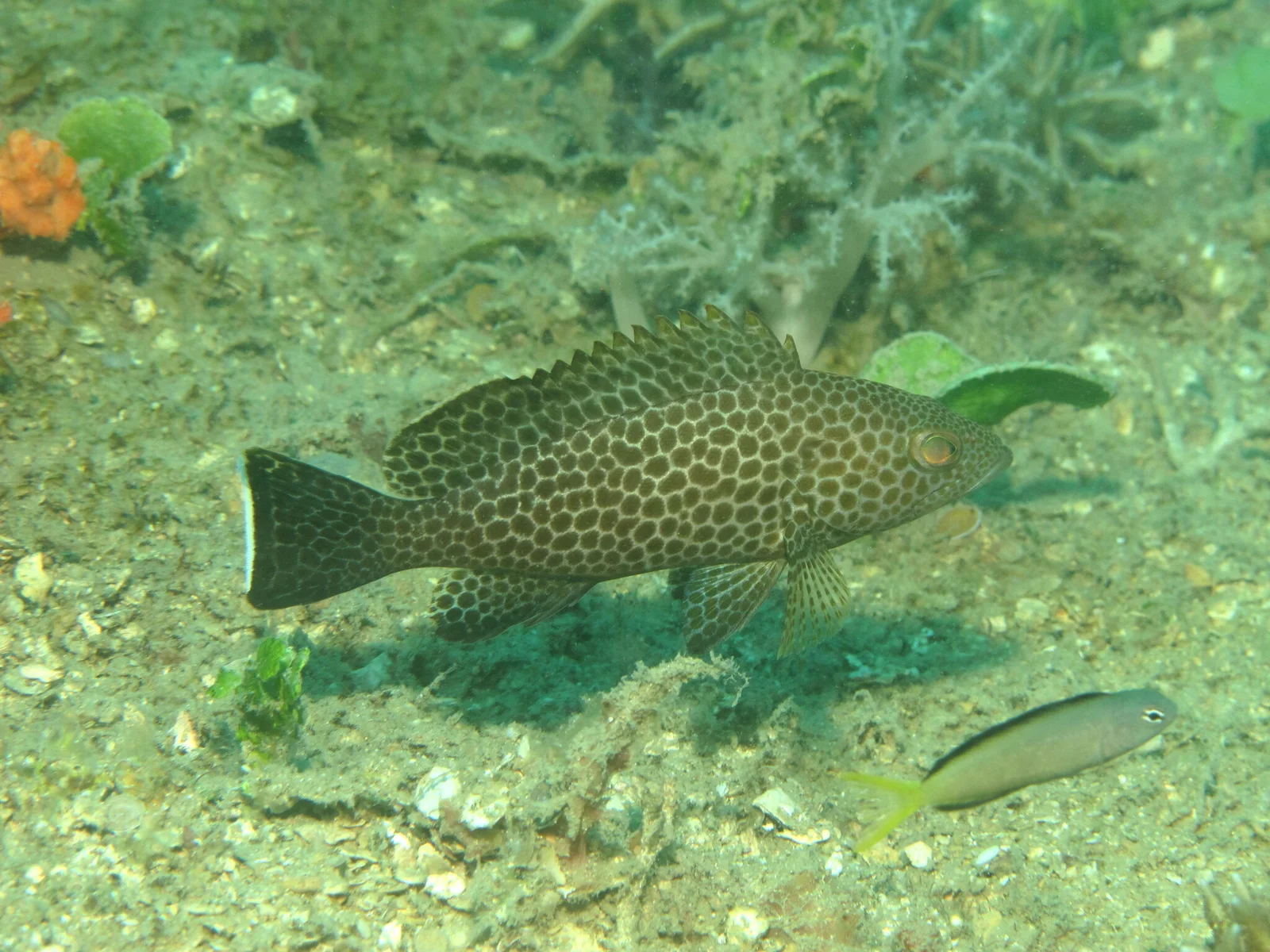
Areolate grouper
- Family
- Epinephelidae
- Depth
- 6–200 m
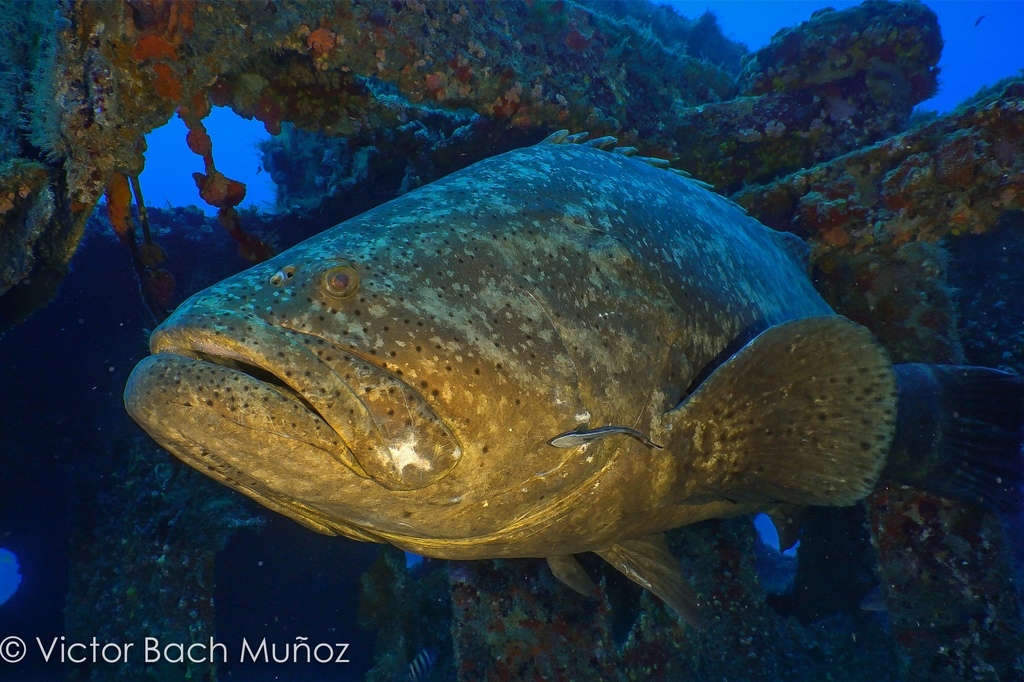
Atlantic goliath grouper
- Family
- Epinephelidae
- Depth
- 0–100 m
- Season
- Jan, Feb, Jun, Jul, Aug, Sep

Black grouper
- Family
- Epinephelidae
- Depth
- 60–250 m
- Season
- Jan, Feb, Mar, Apr, May, Jun, Jul, Aug, Sep, Oct, Nov, Dec
Guides for this water
Technique, gear and safety guides that fit Spotted coral grouper.