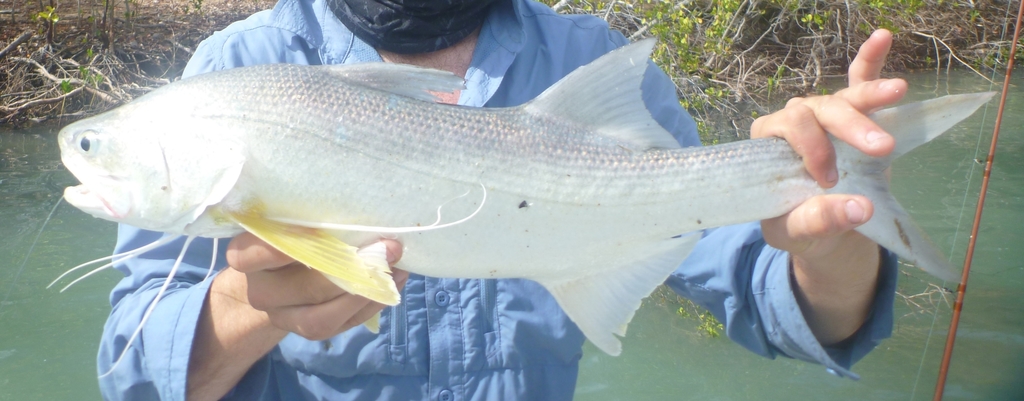
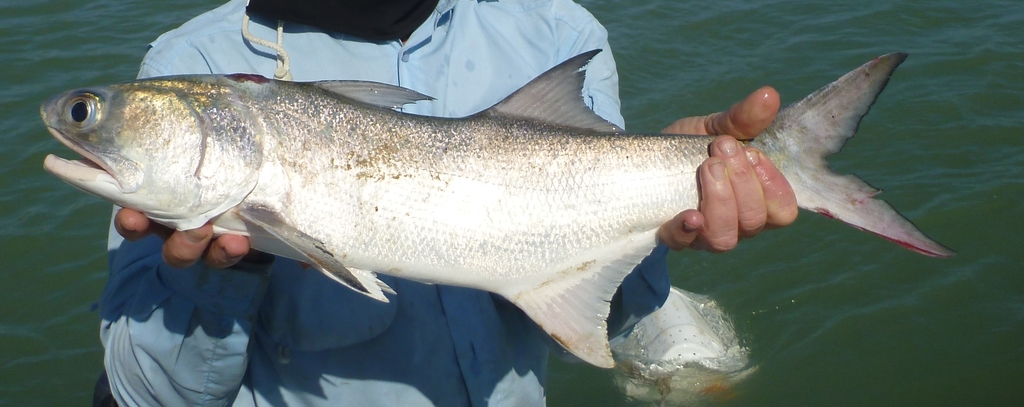
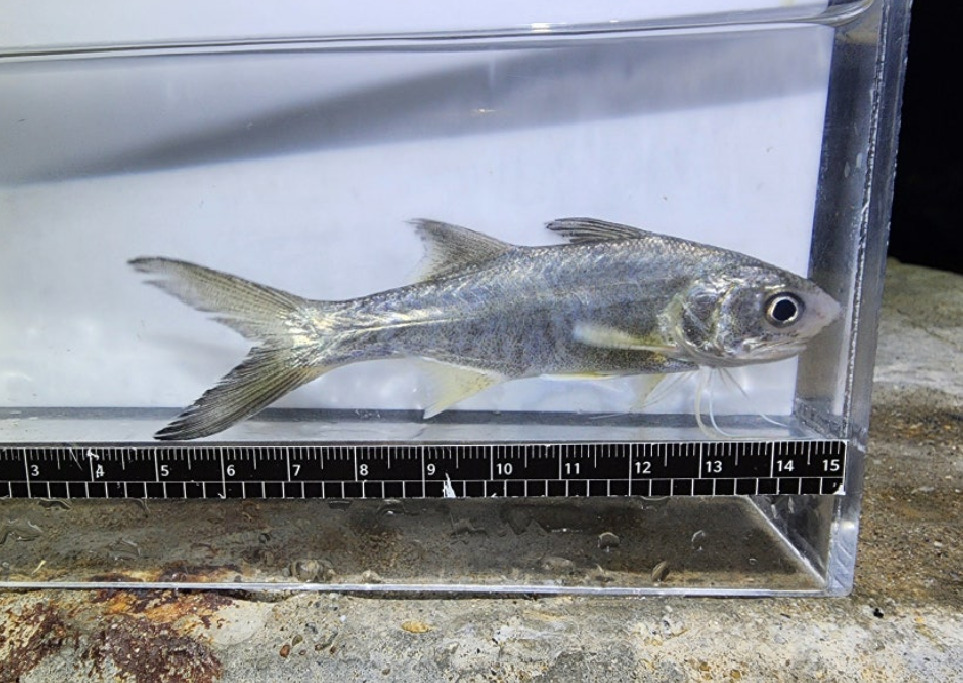
The king threadfin reaches 170 cm and 45 kg in water that is often less than six metres deep, and it is a sport fish recorded in fresh water as well as at sea. Its record is thin in one respect: 25 iNaturalist observations against 1,234 GBIF records.
170 cm, 45 kg, and 20 years
The maximum length is 170 cm FL, the common length 48.0 cm FL, the maximum published weight 45.0 kg, and the maximum reported age 20 years. The common length is less than a third of the maximum, so most fish landed sit far below the 170 cm headline figure.
No maturity length is published, so the page cannot supply a release size. The species is a threadfin of the family Polynemidae, and the page publishes no filament count. No fin-ray or vertebral count is given either, so identification rests on the recorded names and body shape rather than on a formula.
The whole depth range fits inside six metres
The depth range is 0–6 m. That is the entire vertical record, not a usual band: the species is a shallow-water fish, and the page gives no deeper figure. The climate is tropical, from 1°N to 28°S and 121°E to 154°E.
The habitat note places it in shallow, turbid coastal waters, estuaries, mangrove creeks and mangrove-lined rivers, over sandbanks and mud. The terrain list — estuary, muddy bottom, coastal — matches that description. The environment line flags marine, brackish and freshwater, which is unusual for a fish page and is central to how this species is fished.
1,203 of 1,234 records are Australian
GBIF holds 1,234 records: 1,203 from Australia, 17 from Indonesia and 5 from Papua New Guinea. FishBase gives the range as the Indo-West Pacific, from Irian Jaya in Indonesia and Papua New Guinea to southern Queensland. Wikipedia gives the same span in shorter form: southern New Guinea and northern Australia.
Australia's share is 97.5 percent of the GBIF total. That does not mean the fish is absent elsewhere; it means the records are Australian. The 25 iNaturalist observations are few, which is normal for an estuarine fish that is caught for the table more often than it is photographed.
Catadromous, and at home in fresh water
The environment line calls the species catadromous, meaning it moves between fresh and salt water as part of its life cycle. It is recorded from marine, brackish and freshwater, and the habitat note names mangrove-lined rivers as well as estuaries. For an angler, that widens the water to include the upper reaches of tidal rivers, not just the mouth.
The page does not publish which part of the cycle happens where. It also publishes no salinity or temperature tolerance, so the freshwater record is a distribution statement rather than a rule for how far upstream to fish. What it does support is a simple plan: start at the mouth and work upstream until the water turns fresh.
Two spawning windows in the north
The spawning table marks January–March and October–December, all from northern Australia. That is two windows with a gap between them, and both are summer-side months in the southern hemisphere.
No other region has a row, and no temperature is published. The two windows are the only seasonal signal on the page, and they should not be extended to southern Queensland without a local check. A closed season, if one applies, is set by the state and not by this table.
Shore, boat and lure all work
Boat bottom fishing and shore casting are both mainstream, with lure fishing secondary. With a maximum depth of 6 m, a shore angler can cover the whole range from a bank or a bridge, and a boat is only needed for reach. The species forms loose schools, though larger fish are more often seen in pairs or singly.
The diet is prawns and fish. A bottom rig with prawn or fish bait is the direct match; a lure works because the fish is a predator in turbid water, not because the page recommends one. Fishing the last of the run-out tide around a creek mouth concentrates both bait and fish, though that is a reading of the habitat note rather than a published pattern.
Protandrous, unassessed, and still a target
The biology note states that the species is a protandrous hermaphrodite, starting as male and changing to female. That matters for size selection: a large fish is likely to be female, and the page publishes no size at which the change happens.
IUCN lists the species as Not Evaluated. CITES and CMS are also Not Evaluated, and the species is harmless to humans. FishBase records a commercial fishery and gamefish status, and Wikipedia describes it as a threadfin of southern New Guinea and northern Australia. No stock assessment is published on the page, so the absence of a category is not a statement of health.
It is landed for the table, and the page publishes no flesh-quality, handling or cooking note.
Seven states, and the marine-park overlay
Recreational fishing in Australia is managed state by state: NSW through DPIRD Fisheries, Queensland through DAF, Western Australia through DPIRD, Victoria through VFA, Tasmania through NRE Tas, South Australia through PIRSA and the Northern Territory through DPIR. Bag and possession limits, minimum sizes and netting rules differ, and the species is estuarine, so the state line can fall in the middle of a nursery.
Commonwealth waters add the Great Barrier Reef Marine Park, zoned by GBRMPA, where no-take and sanctuary zones are closed to fishing, and the Australian Marine Parks managed by Parks Australia. A creek mouth can sit inside a marine-park zone, so the zoning map needs checking before the boat goes in.
No bag number, size limit or closed date is given here. Check the current state rule for the water you will fish, and check the GBRMPA and Australian Marine Parks zoning for the same trip.
Regulations before you keep it
These are the published regulations for this fish. Read the number first. The notice below it is the actual regulation.
Minimum size2
≥65 cm (east coast) · ≥60 cm (Gulf)
Australia — Queensland · AU-QLD
Queensland sets a 65 cm minimum size for king threadfin on the east coast and 60 cm in the Gulf of Carpentaria.
King threadfin - Queensland east coast | Min: 65cm | Limit: 5 ... King threadfin - Gulf of Carpentaria | Min: 60cm | Limit: 5
≥450 mm
Australia — Western Australia · AU-WA
Western Australia sets a 450 mm minimum legal size for king threadfin.
"Threadfin, king Polydactylus macrochir 450 mm 2"
Bag limit2
5 fish possession limit
Australia — Queensland · AU-QLD
Queensland sets a possession limit of 5 king threadfin (65 cm east coast, 60 cm Gulf of Carpentaria). The "Limit" column is a possession limit, not a daily bag limit.
King threadfin - Queensland east coast | Min: 65cm | Limit: 5 ... King threadfin - Gulf of Carpentaria | Min: 60cm | Limit: 5
2 fish per person per day
Australia — Western Australia · AU-WA
Western Australia allows 2 king threadfin per fisher per day.
"Threadfin, king Polydactylus macrochir 450 mm 2"
Possession limit1
3 fish
Australia — Northern Territory · AU-NT
The Northern Territory allows a personal possession limit of 3 king threadfin. In Kakadu National Park, the Mary River Fish Management Zone and the Daly River Fish Management Zone there is also a 90 cm maximum fork length and a vessel limit of one fish over 90 cm fork length.
King threadfin | 3 | Kakadu National Park, Mary and Daly River Fish Management Zones: 90cm maximum size (fork length). Vessel limit of one fish over 90cm (fork length).
Every record above names its source and the date it was retrieved. See the regulation register for the full list, or how to read these regulations.
Where these facts come from
Check these pages before you rely on a size, range or protection status.
-
FishBase — Polydactylus macrochir
— FishBase · T2
-
GBIF — Polydactylus macrochir occurrence records
— GBIF · T2
-
IUCN Red List — Polydactylus macrochir
— IUCN · T1
-
Photo record — iNaturalist
— iNaturalist · T3