
Pacific threadfin
The name comes from the pectoral filaments: there are six, and the tip of the uppermost reaches to, or slightly past, the rear tip of the upper pectoral fin. The body is uniformly golden silver, sometimes with several faint dark stripes running along the scale rows above and below the lateral line. The build is short and deep rather than streamlined, and the cross-section is compressed.

The name comes from the pectoral filaments: there are six, and the tip of the uppermost reaches to, or slightly past, the rear tip of the upper pectoral fin. The body is uniformly golden silver, sometimes with several faint dark stripes running along the scale rows above and below the lateral line. The build is short and deep rather than streamlined, and the cross-section is compressed. Fin counts are nine dorsal spines with thirteen soft rays, and three anal spines with eleven soft rays. Those filaments are the field mark to look for; a fish held in the hand shows them plainly, and a fish in the water shows the golden flash first.
Island shores, not continents
FishBase describes the range as the Indo-Pacific, mainly around oceanic islands, and the detail matters: this is not a continental-shelf fish. It is known from Mauritius, the Seychelles, Kenya and many islands of the northern Indian Ocean, then from Indonesia north to the Ryukyu, Ogasawara and Yaeyama islands, and east to Hawaii, French Polynesia and Pitcairn. The record notes it has not been collected in Australia, which is a useful negative when reading the map. Depth is 1 to 50 m, usually 20 to 50 m, and the species is reef-associated but uses sand: it schools along sandy and rocky shorelines and over sandy lagoon bottoms, often in zones of turbulence. It also enters river mouths and brackish mangrove estuaries, so the shoreline end of the range overlaps with estuarine water. GBIF holds the taxon under usage key 2393295, but no occurrence total is given in the packet, so no count is quoted here.
The moon, not the calendar
No spawning months are recorded, but FishBase does note a lunar spawning rhythm close to shore. That is a different kind of information from a month table: it says the timing is tied to the moon rather than to a season, and it fits a fish that spawns near the beach. The species is tropical and its latitudinal range runs from 34°N to 23°S, so water temperature is not the limiting factor across most of its range. In Hawaii, the fixed calendar event is regulatory rather than biological: the fishery is closed from June to August. The closure is a management measure, not a spawning date, and it should not be read as the spawning season. For planning, watch the moon and the surf rather than the month, and check the closure before anything else.
Reading the shorebreak
Because the fish schools over sand and rubble and uses turbulent water, the productive zone is usually the wash and the small troughs just behind the shorebreak rather than the far horizon. Small crabs, shrimp and worms match a diet of crustaceans, polychaete worms and other benthic invertebrates, and whole small fish are also taken. A light surf rig with a small hook and just enough weight to hold bottom lets the wash move the bait; a bait that rolls naturally is better than one pinned in place. Small soft plastics or metal lures worked slowly across sandy gaps cover water when the fish are scattered. The mouth is small, so downsize the hook rather than the bait, and keep the point exposed. Fish the edge of the school rather than the middle; moi move in groups, and a hooked fish often pulls the school with it.
Light surf tackle
The recorded maximum is 61 cm and 3.2 kg, which is a modest fish, and the 11-inch minimum means many kept fish will be much smaller. A light to medium surf rod, a small reel and a fine braid or monofilament main line are enough. Use a short leader and a small hook, with a light weight that the wash can move; heavy sinkers kill the natural drift that this fish responds to. A sand spike or a rod holder is useful when bait fishing, but keep the rod in hand when the school is close, because takes can be quick. Carry a measuring device: the difference between 11 inches and just under is the difference between keeping and releasing. Sandy beaches and rubble flats do not demand a heavy leader, so keep the terminal tackle light and the bait presentation clean.
Moi seasons and limits
Hawaii's rules are specific: the moi fishery is closed from June to August, the minimum size is 11 inches, and the daily bag is 15 fish per person. Those three numbers govern the trip more than any habitat advice. Non-residents need an NRMFL to fish recreationally, and a CML is required to sell catch. The closure prohibits taking during the stated period, and the dates follow the current DAR notice rather than a permanent calendar. FishBase records that the species has been studied for aquaculture potential, which is a separate matter from the wild fishery and does not change the recreational rules. Measure every fish, count the bag, and check the notice before the first cast.
Gaps in the record
The entry relies on FishBase for taxonomy, range, size, depth, diet and life history, on GBIF for the taxon record, and on the DAR pages for the closure and limits. iNaturalist has no resolved taxon page for this species in the packet, so no observation count is used. Maximum age and length at maturity beyond the 12–15 cm male and 18–24 cm female figures are not recorded. Spawning months are absent, so the season field is empty and the seasonality array is all zeros even though a lunar rhythm is documented. The closure dates are the most consequential and most changeable fact in the entry; confirm them with DAR before travelling.
How to catch it
Boat fishing
Fished with the listed approach, matched to the recorded depth and size.
Shore fishing
Fished with the listed approach, matched to the recorded depth and size.
Where these facts come from
Check these pages before you rely on a size, range or protection status.
- FishBase — Polydactylus sexfilis — FishBase · T2
- GBIF — Polydactylus sexfilis occurrence records — GBIF · T2
- IUCN Red List — Polydactylus sexfilis — IUCN · T1
- Photo record — iNaturalist — iNaturalist · T3
Fish in the same water
These fish live in the same place.
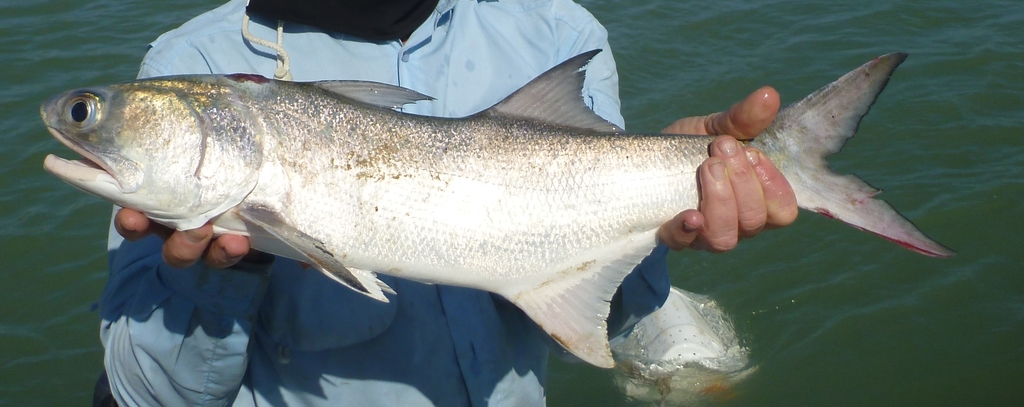
Fourfinger threadfin
- Family
- Polynemidae
- Depth
- 0–23 m
- Season
- Jan, Feb, Mar, Apr, May, Jun, Jul, Aug, Sep, Oct, Nov, Dec
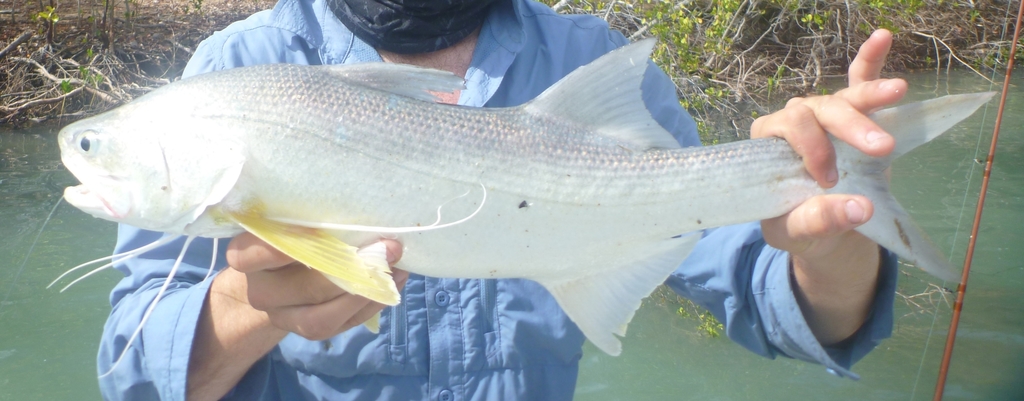
King threadfin
- Family
- Polynemidae
- Depth
- 0–6 m
- Season
- Jan, Feb, Mar, Oct, Nov, Dec
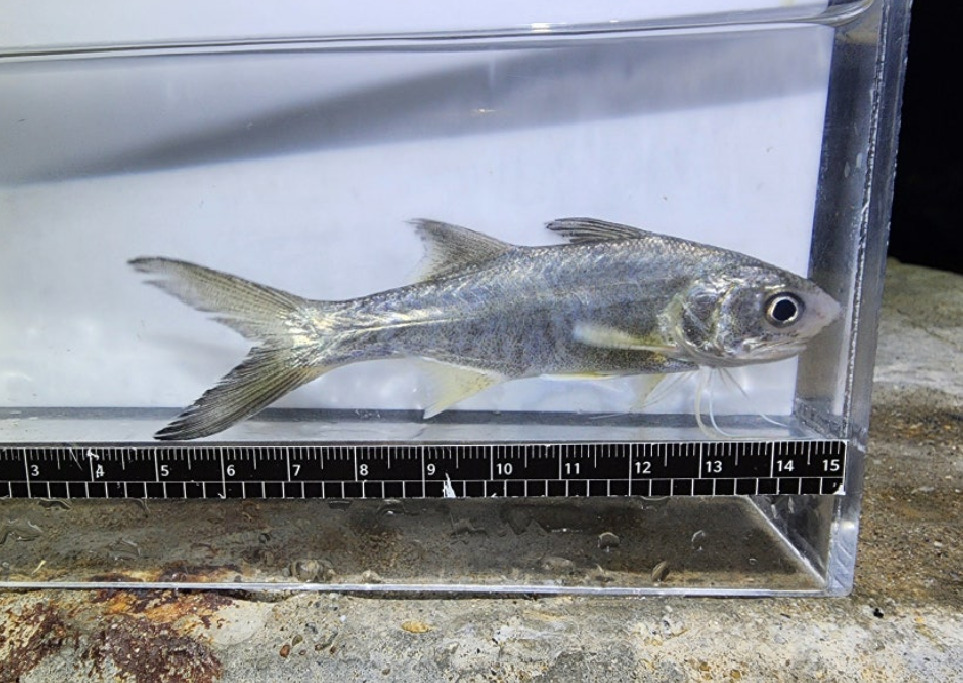
Striped threadfin
- Family
- Polynemidae
- Depth
- ≤ 122 m
Guides for this water
Technique, gear and safety guides that fit Pacific threadfin.