
Striped threadfin
On a threadfin, identification does not stop at the body. The pectoral fin carries free filaments, the rays are unbranched, and in this species the fourth or fifth filament is the longest, running 22 to 40 per cent of standard length. That is a structure nearly half the length of the fish, thinner than a leader, and it is the first thing a hand reaches for when the fish comes aboard.
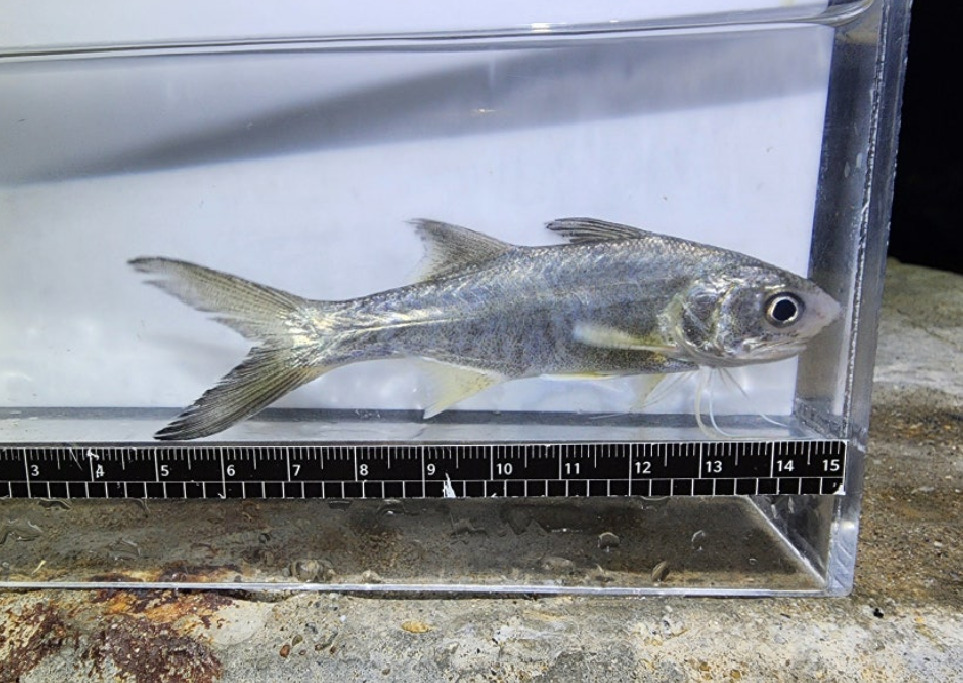
On a threadfin, identification does not stop at the body. The pectoral fin carries free filaments, the rays are unbranched, and in this species the fourth or fifth filament is the longest, running 22 to 40 per cent of standard length. That is a structure nearly half the length of the fish, thinner than a leader, and it is the first thing a hand reaches for when the fish comes aboard. It is also the character that separates this species from its relatives, which is why the measurement belongs in the fishing plan and not only in a key.
Stripes first, then rays
Above the lateral line, each longitudinal scale row carries a dark line, producing seven or eight prominent stripes; below the lateral line there are seven to nine fainter ones. The body is elongated, the maxilla reaches to about the rear margin of the adipose eyelid, and the fin formula is D IX, 13 with A II, 11-12. The stripes get you to a threadfin quickly. The filament length and the ray counts decide which one.
Mud, not coral
The species is demersal and lives over muddy bottoms of the continental shelf, from estuaries to coastal beaches and down to 122 m. The minimum depth is not stated in the record. It forms loosely associated schools and feeds on small crustaceans, fishes and other benthic organisms. On a map, that means river mouths, the muddy belt outside them, and the shallow shelf that continues offshore. Reef marks are the wrong habitat, however good the structure looks.
Two length figures that do not compare
The maximum length is 45 cm standard length, the usual size in catches is 30 cm total length, and the maximum recorded weight is 1.7 kg. Standard length stops at the caudal base, total length includes the tail, so 45 SL and 30 TL are not points on the same ruler. The gap between them is larger than it looks. Rig around 30 cm and treat a 45 cm SL fish as exceptional rather than as the design case.
Small baits on a moving bottom
A loosely schooled fish over mud is usually feeding on things that are trying to stay buried. A long-shank hook with prawn or sandworm, and a flat sinker that does not plough into the mud, is the basic rig. Keep the bait moving slowly rather than dead still: a threadfin hunting on a mud flat responds to movement, and a bait that sits untouched for five minutes is usually invisible in the silt. Search in a fan from one anchor position before moving.
Handling the fish you identified by a thread
The filament is the identification and the weakest part of the fish. Do not lift a threadfin by the pectoral fin, and do not grab the head with dry hands. Wet hands or a damp cloth under the body, a hook-out, and a quick measurement are enough. If the filament breaks, the fish is fine; the next identification is not. That is an argument for photographing the pectoral fin before release, with a scale in the frame.
Farmed, angled, and Not Evaluated
FishBase lists commercial fishing, commercial aquaculture and gamefishing, an unusual combination for a coastal species. Its IUCN status is Not Evaluated. The ciguatera field carries no case for this species, and it is marked harmless. Resilience is high and the stock can double in under 15 months, and 12 cm fish can be caught in large numbers, so a net full of small fish is not automatically a recruitment failure for this species. Tioman, Redang and Perhentian marine-park cores are no-take in Malaysia, and states add size and gear rules to the 1985 Fisheries Act, with the detail differing by coast. Singapore's recreational fishing and catch rules sit across several agencies, so the current notice is the only reliable version. In Indonesia, MPA zoning applies and reef-fish exports and size limits fall under ministerial decree. Twelve-centimetre fish can be caught in large numbers, and FishBase records it without treating it as a problem. For a species that can double in under 15 months, a big year-class of small fish is what recovery looks like. The judgement call is not whether small fish exist but whether they are the only size present: a catch of 12 cm fish with no 25 to 30 cm fish in it is worth reporting, a mixed catch is not.
Two names in two databases
iNaturalist places this species under Filistriatus plebeius, while FishBase still uses the older combination Polydactylus plebeius. Both names describe the same fish, but a search on one will miss observations filed under the other. That is a small thing until you are trying to work out whether a fish in a photograph from Singapore is the species you think it is.
How to catch it
Boat bottom fishing
Fished with the listed approach, matched to the recorded depth and size.
Shore casting
Fished with the listed approach, matched to the recorded depth and size.
Where these facts come from
Check these pages before you rely on a size, range or protection status.
- FishBase — Filistriatus plebeius — FishBase · T2
- GBIF — Filistriatus plebeius occurrence records — GBIF · T2
- IUCN Red List — Filistriatus plebeius — IUCN · T1
- Photo record — iNaturalist — iNaturalist · T3
Fish in the same water
These fish live in the same place.
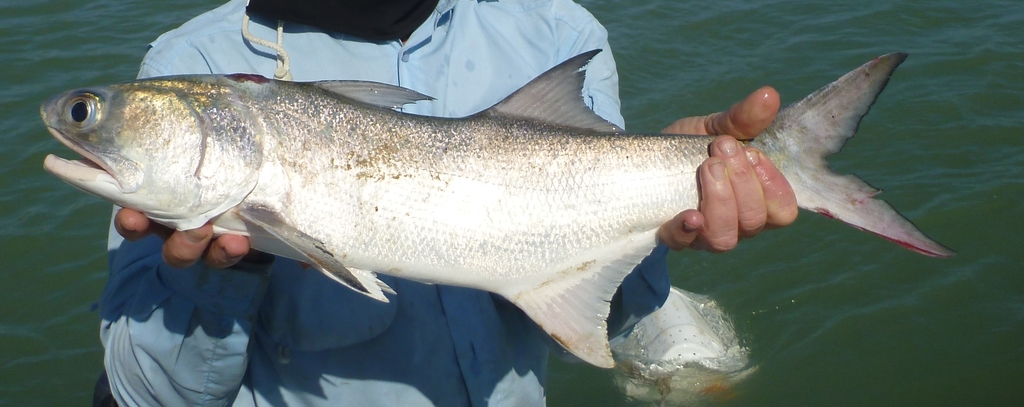
Fourfinger threadfin
- Family
- Polynemidae
- Depth
- 0–23 m
- Season
- Jan, Feb, Mar, Apr, May, Jun, Jul, Aug, Sep, Oct, Nov, Dec
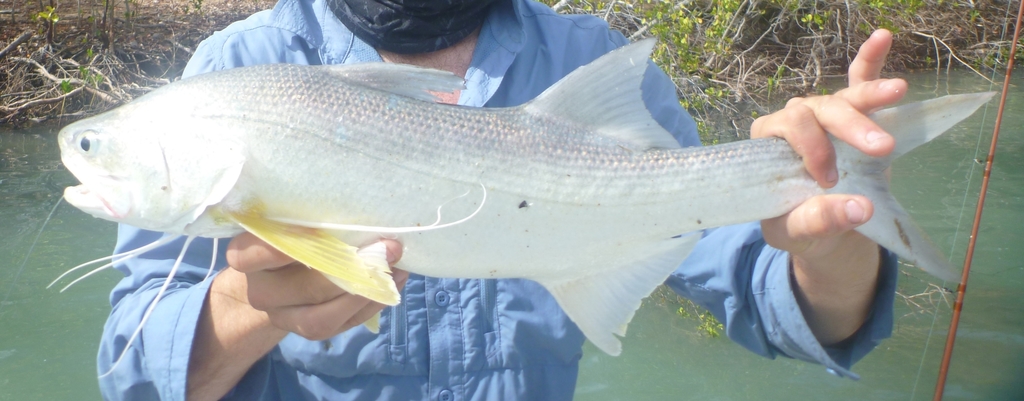
King threadfin
- Family
- Polynemidae
- Depth
- 0–6 m
- Season
- Jan, Feb, Mar, Oct, Nov, Dec

Pacific threadfin
- Family
- Polynemidae
- Depth
- 1–50 m
Guides for this water
Technique, gear and safety guides that fit Striped threadfin.