Javelin fish is an Indo-West Pacific haemulid, from the Red Sea and East Africa to Southeast Asia, north to Taiwan region and south to Queensland, with a Persian Gulf record. It lives over turbid inshore sand and mud to 75 m, enters estuaries, tolerates low salinity and is often associated with inshore wrecks; it feeds on crustaceans and fish, and spawning shoals gather near river mouths in winter. FishBase gives a maximum of 80 cm total length, a common length of 50 cm and maturity at about 35 cm. IUCN lists it as Least Concern, assessed in 2020.
Reading the spines
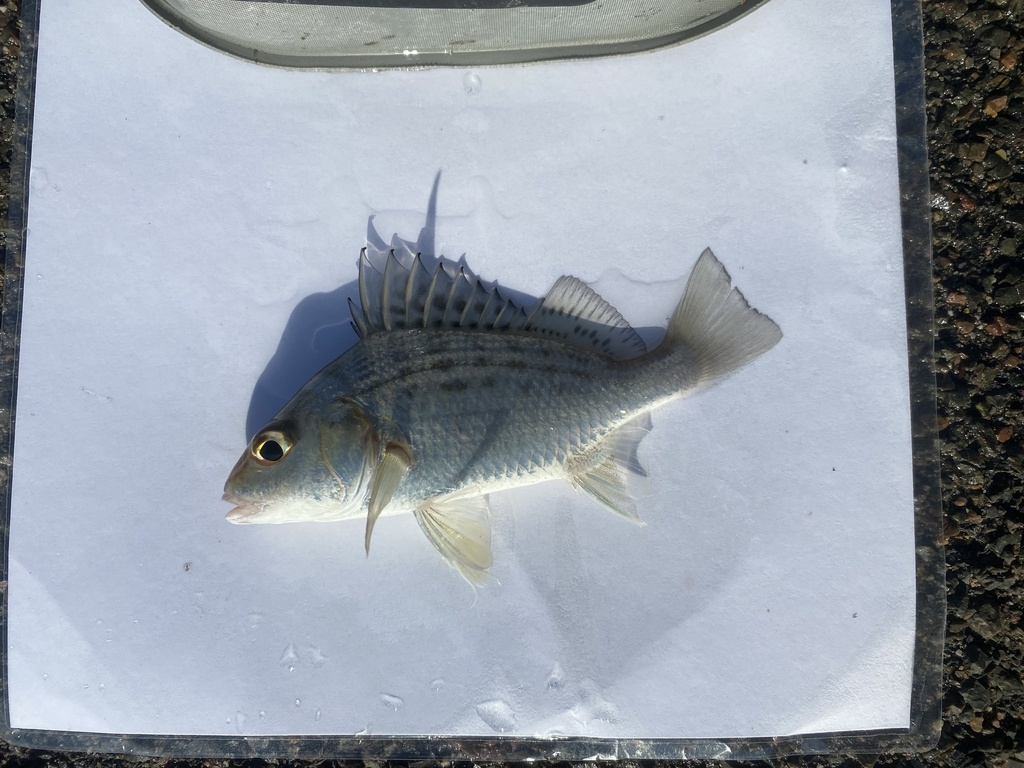
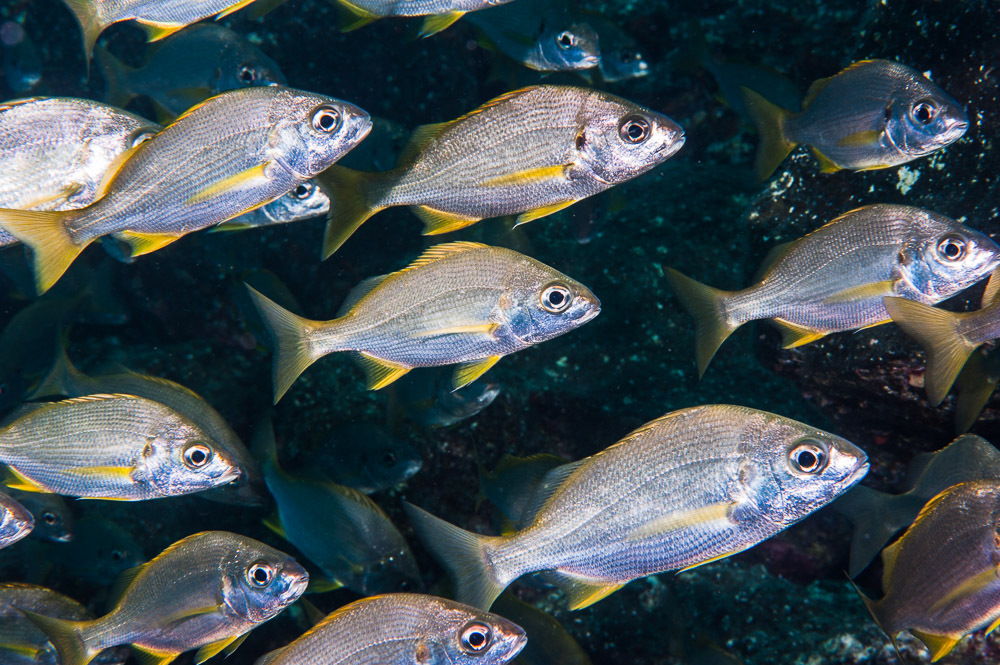
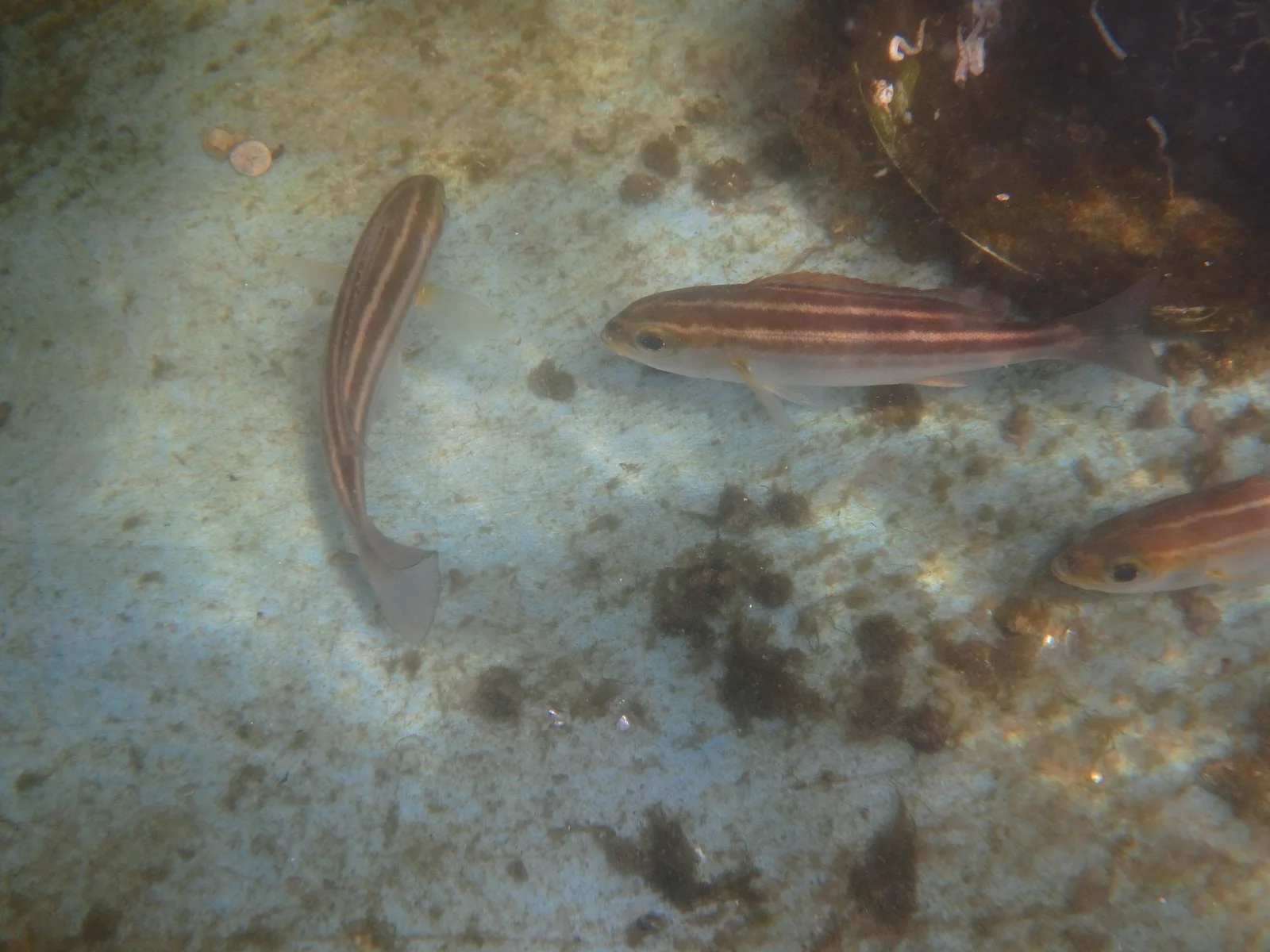
The dorsal fin has 12 spines and 13–15 soft rays (usually 14½); the anal fin has 3 spines and 7 soft rays. The chin has two pores with a median pit. Scales are ctenoid and rough to the touch; lateral-line scales number 43–50; there are 7 scale rows between the lateral line and the dorsal-fin origin; 20 scales around the caudal peduncle, 9 above and 9 below the lateral line. Body depth is 2.5–3 times in standard length. The head is blunt with a convex upper profile, the mouth is small and the maxilla reaches the eye, the jaws have villiform bands of teeth, and the swim bladder lacks anterolateral horn-like extensions. Juveniles are brilliant silvery green above, golden silver on the sides and silvery white below, with 12 or more faint vertical bars made of small dark brown spots; adults are darker and the spots are less obvious. The two chin pores with a median pit, small mouth and rough scales are the practical check. The faint spotted bars belong to juveniles and weaken as the fish grows, so a large fish is identified by the chin pores, the blunt head and the rough scales rather than by pattern.
A turbid-water grunt
FishBase's range is the Indo-West Pacific: the Red Sea and East Africa to Southeast Asia, north to Taiwan region, south to Queensland, and the Persian Gulf. The country table includes the Andaman and Nicobar Islands, Australia, Bahrain, the Comoros, Djibouti, Egypt, Hong Kong SAR, India, Indonesia, Iran, Japan, Kenya, Kuwait, Madagascar, Malaysia, Micronesia, Mozambique, Oman, Pakistan, Palau, Papua New Guinea, the Philippines, Qatar, Saudi Arabia, Seychelles, Socotra, Somalia, South Africa, Taiwan region, Tanzania, Thailand, Timor-Leste, the UAE and Yemen. GBIF's 19,533 records are led by Australia (17,560), Mozambique (1,239), Taiwan region (344), Indonesia (47), South Africa (42), Malaysia (37), India (34) and Thailand (24). It inhabits turbid inshore sand and mud to 75 m, enters estuaries, tolerates low salinity and is often associated with inshore wrecks.
The blanks are information
FishBase states that spawning shoals form near river mouths in winter. The species is tropical to subtropical and catchable all year; in Taiwan region, Hong Kong SAR and southern China, late autumn to spring is the river-mouth and inshore window, while summer fish move deeper or offshore. No temperature number is published, so follow local estuary and inshore temperature. Tide and slack water concentrate food around turbid river-mouth edges and wrecks; dawn, dusk and night also work. It often feeds on the dirty edge after rain, so do not ignore coloured water.
Where to start looking
The GBIF pattern is overwhelmingly Australian, with Mozambique and Taiwan region secondary. Fish the wreck, the river-mouth bar and the muddy channel edge, not the clear reef. The source gives no coordinates; local knowledge of snags and channels is the real map.
Tackle and baits
Handline, set net, trap and spear take this fish commercially; recreational fishing is mostly bottom fishing. Prawn, crab meat, fish chunk and sandworm are the baits. The mouth is small, so use small hooks and moderate leaders. A sinker matched to current holds the bait on the bottom without burying it. Soft plastics, jigheads and small jigs can be slow-dragged around snags. When winter spawning shoals gather, finding the school outside the river mouth beats guarding one spot.
Eating, handling and the rules
Javelin fish supports commercial fisheries, commercial aquaculture and game fishing; the flesh is white and fine, good steamed, braised or in soup, sold fresh and sometimes salted or smoked. Bleed, gut and ice it promptly; estuary fish can carry a muddy note, which bleeding and clean ice reduce. Ciguatera is mainly a reef-predator issue, so this species is lower risk, but organs should not be eaten in quantity. Rules vary: Taiwan region manages inshore fishing through closed areas, seasons and gear restrictions, and recreational fishing must follow Fisheries Agency and local government notices; Hong Kong SAR's Fisheries Protection Ordinance regulates methods, with no angling or collecting in marine parks and reserves; Southeast Asian states differ widely, with Malaysia, Indonesia, the Philippines and Thailand issuing size and closed-season rules and usually prohibiting take in marine protected areas. Check the current local notice.
What the record leaves open
The page is built from FishBase taxonomy, morphology, distribution, environment, biology, reproduction, use and IUCN entries, with the country table for range and GBIF/iNaturalist for occurrence. Water temperature, local size limits and ciguatera monitoring are not standardised, so the text stays conservative. and are local aliases; the formal name remains .
How to catch it
Bottom fishing
Fished with the listed approach, matched to the recorded depth and size.
Lure fishing
Fished with the listed approach, matched to the recorded depth and size.
Regulations before you keep it
These are the published regulations for this fish. Read the number first. The notice below it is the actual regulation.
Minimum size1
≥40 cm whole or 26 cm fillet
Australia — Queensland · AU-QLD
Queensland sets a 40 cm minimum size for barred javelin (26 cm minimum fillet length).
Barred javelin (spotted grunter) - Queensland east coast | Min: 40cm (whole or head/tail removed), or Min fillet length: 26cm (skin left on while on board a boat) | Limit: 10
Bag limit1
10 fish possession limit (Gulf: 10 whole fish or 20 fillets)
Australia — Queensland · AU-QLD
Queensland sets a possession limit of 10 Javelin fish (Gulf: 10 whole fish or 20 fillets).
A possession limit is the total number of fish you may keep at any time, including fish at home or in the freezer; it is not a daily take limit.
Barred javelin (spotted grunter) - Queensland east coast ... Limit: 10 ... Gulf of Carpentaria ... Limit: 10 whole fish, or 20 fillets
Every record above names its source and the date it was retrieved. See the regulation register for the full list, or how to read these regulations.
Where these facts come from
Check these pages before you rely on a size, range or protection status.
-
FishBase — Pomadasys kaakan
— FishBase · T2
-
GBIF — Pomadasys kaakan occurrence records
— GBIF · T2
-
IUCN Red List — Pomadasys kaakan
— IUCN · T1
-
Photo record — iNaturalist
— iNaturalist · T3