
Whitespotted char
A cold-water salmonid that needs water below 15°C. Resident forms live in mountain streams and sea-run forms migrate through the north Pacific, and Japanese names separate the two. It is a lean, pale fish, valued far more as a sport fish than as food, and its freshwater rules are set prefecture by prefecture.

A cold-water salmonid that needs water below 15°C. Resident forms live in mountain streams and sea-run forms migrate through the north Pacific, and Japanese names separate the two. It is a lean, pale fish, valued far more as a sport fish than as food, and its freshwater rules are set prefecture by prefecture.
White spots and no red band
Salvelinus leucomaenis is elongate and slightly compressed, with a large mouth and a slightly pointed snout. White or pale yellow spots are scattered over the back and flanks, which is what the name refers to. Colour shifts with habitat: stream residents are dark brown with whiter spots, sea-run fish are more silver with paler spots. The caudal fin is slightly emarginate and an adipose fin is present. The usual confusion is with masu salmon, which carries a red longitudinal band and small black dots, and with yamame, which keeps parr marks. This fish has neither a red band nor parr marks, and its spots are mostly white. In Japan the resident form is called ezowina and the sea-run form amemasu; they differ in shape and ecology but are one species.
Two forms, one species, two kinds of water
FishBase records the species from the northwest Pacific: Japan and the northeastern Korean peninsula, through Sakhalin and the Kurils to Kamchatka. The Japanese account extends the ascents to rivers north of the Tone River in Chiba and north of Yamaguchi on the Japan Sea side, and on the Asian side from eastern Korea to the Lena River in Siberia, with migrations across the north Pacific and into the Arctic Ocean. The fish needs water below 15°C and lives in the riffles and pools of mountain streams, and in lakes. Residents stay in the upper reaches; sea-run fish drop to the sea and come back to spawn. That gives two distinct fisheries: headwater stream fishing in Honshu, and the lower reaches of sea-run rivers in Hokkaido and the Russian Far East.
Spawning moves from north to south
Spawning shifts with latitude: late September to mid-October in Hokkaido, October to early November in Honshu. Eggs are laid and hatch in the river; sea-run fish then feed at sea before ascending again, and Honshu also holds resident populations in which Japanese sources say males predominate. For an angler, the autumn before spawning is the main stream window, while Hokkaido's sea-run fish enter the estuary and lower river on the run. In summer heat the fish retreat to upper tributaries fed by cold springs, and sections above 15°C produce markedly fewer fish. The available sources give no spawning temperature, and none is supplied here.
Stream fish and estuary fish need different approaches
In Honshu streams the targets are small resident fish, taken on fly, lure or bait. In Hokkaido and the Russian Far East the sea-run fish take lures and flies, and at river mouths spoons and small fish baits. The fish is wary, so slow deep pools, water under fallen trees and the shadow of rocks come first. Bait fishing with stream insects or earthworms works, but many streams are managed by fishery cooperatives, and both the bait question and the angling ticket have to be settled before the first cast. Sea-run fish at the mouth respond to silver spoons; heavier in fast water, smaller in slow.
A short rod in the trees, a longer one in the big river
Stream tackle is a 3.6 to 4.5 m soft stream rod, or a 3 to 4 weight fly rod, with 0.8 to 1.2 nylon main line, 0.6 to 0.8 leader and stream sleeve hooks in sizes 3 to 5. For Hokkaido sea-run fish, use a 2.4 to 3.0 m lure rod, PE 0.8 to 1.2 and a 2 to 3 leader. In the stream, a short rod and a short line are what make casting under trees possible. On a sea-run river the water is wide and the fish are large, so the leader cannot be too fine. Fly fishers are better served by a 5 to 7 weight rod, adjusted to the size of fish expected.
Pale flesh, and rules written prefecture by prefecture
The flesh is pale and low in fat. The Japanese account rates it as pale among the salmonids, with a price to match; salt-grilling, meunière and frying are the usual treatments, and Hokkaido also puts it in hot pot and miso soup. Bleed and ice the fish quickly to keep a muddy note out of the flesh. Japan has no nationwide recreational rule for freshwater: inland waters fall under prefectural inland fishery adjustment rules and instructions from the inland fishery management committees, and many prefectures set a minimum size, a closed season and a ticket system for iwana. The numbers differ by prefecture, were not checked one by one here, and are marked deferred. On the Russian Far East side the basin rules set a minimum for the char group by oblast at 45, 35, 20 and 26 cm, with a separate freshwater resident tier at 15, 11 and 15 cm; the sea-run and resident forms of this species fall into different tiers, and the table has to be read per oblast and water type.
Where each fact came from, and the rules left unmerged
Taxonomy, distribution, length and Red List status come from FishBase. The Japanese distribution, spawning periods, the resident and sea-run distinction and the eating assessment come from the market encyclopedia; the Russian figures from table 4 of the Far East basin rules, char group. The Japanese inland rules are given only as a framework, without merging prefectural numbers into one.
How to catch it
Fly fishing
Fished with the listed approach, matched to the recorded depth and size.
Lure fishing
Fished with the listed approach, matched to the recorded depth and size.
Shore fishing
Fished with the listed approach, matched to the recorded depth and size.
Where these facts come from
Check these pages before you rely on a size, range or protection status.
- FishBase — Salvelinus leucomaenis — FishBase · T2
- GBIF — Salvelinus leucomaenis occurrence records — GBIF · T2
- IUCN Red List — Salvelinus leucomaenis — IUCN · T1
- Photo record — iNaturalist — iNaturalist · T3
Fish in the same water
These fish live in the same place.

Masu salmon
- Family
- Salmoniformes
- Depth
- 0–200 m
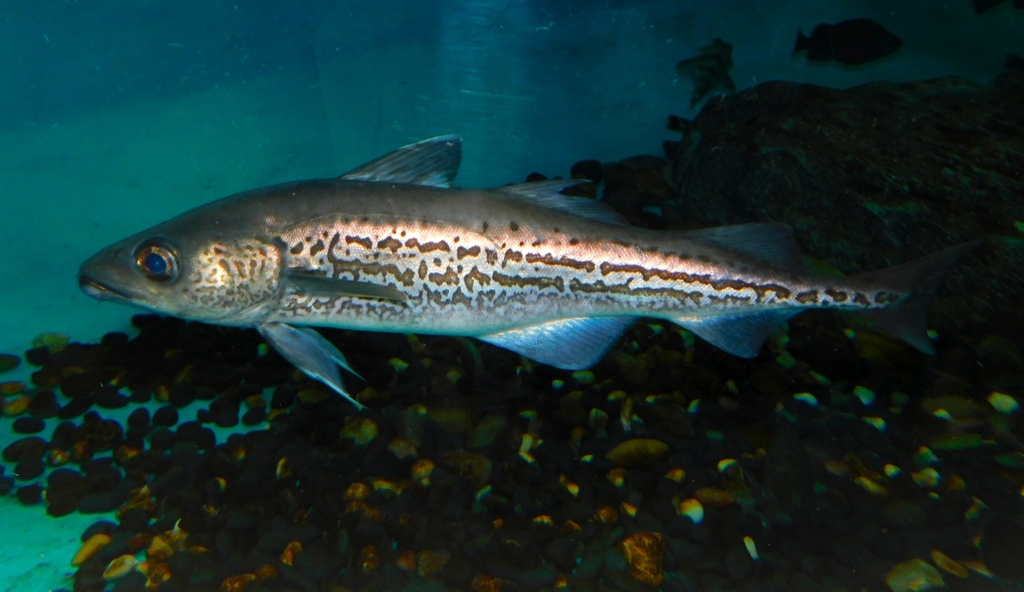
Alaska pollock
- Family
- Gadidae
- Depth
- 0–1280 m
- Season
- Jan, Feb, Mar, Apr, May, Jun, Jul, Aug

Albacore
- Family
- Scombridae
- Depth
- 0–600 m
- Season
- Jan, Feb, Mar, Apr, May, Jun, Jul, Aug, Oct, Nov, Dec
Guides for this water
Technique, gear and safety guides that fit Whitespotted char.