
Brown rockfish
Brown rockfish has XIII dorsal spines and 12–15 soft rays, III anal spines and 5–8 soft rays, and 26–27 vertebrae. Head spines are strong, the supraoculars are absent, the interorbital space is flat to barely convex, and the caudal fin is rounded.
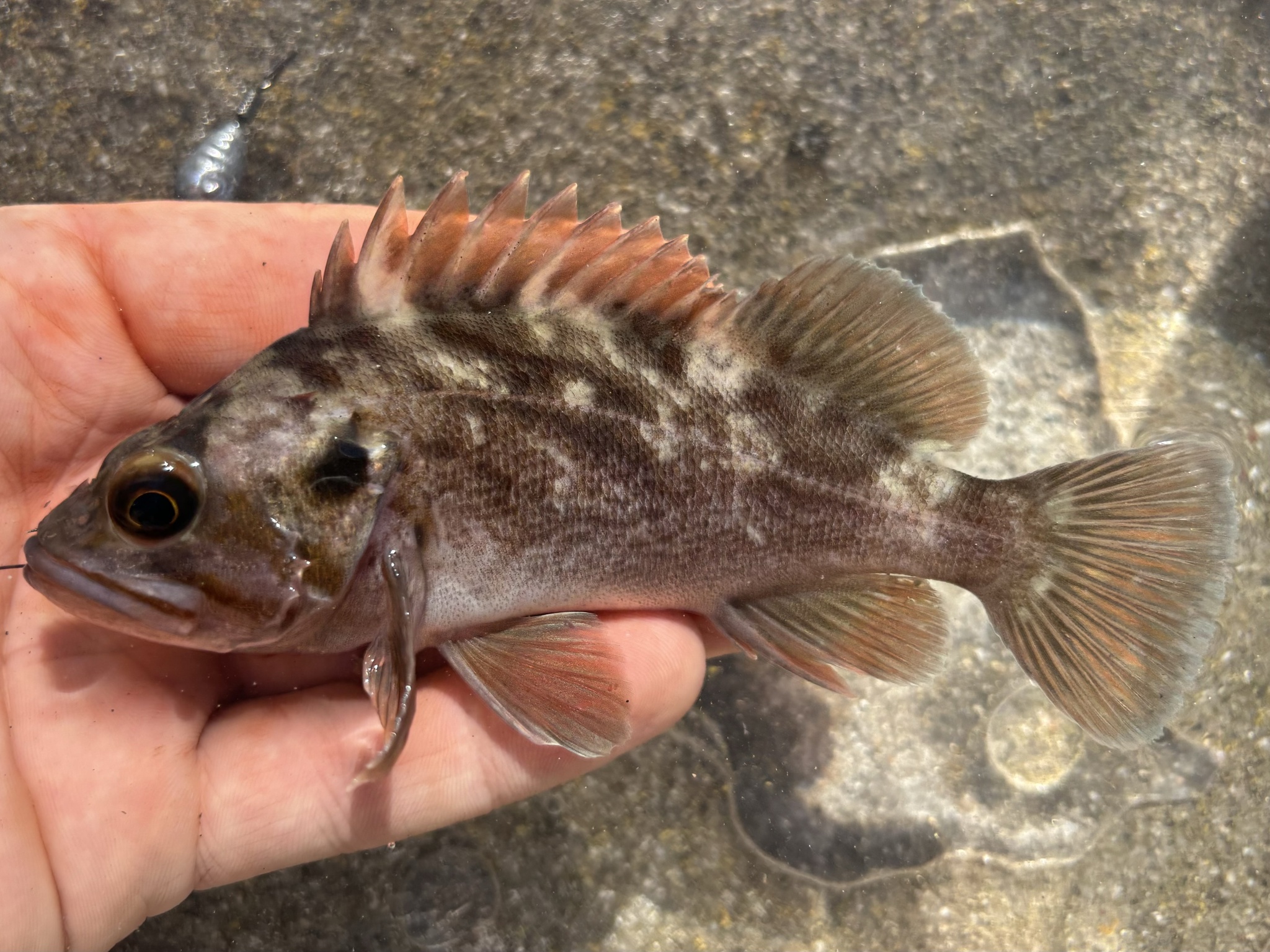
Brown rockfish has XIII dorsal spines and 12–15 soft rays, III anal spines and 5–8 soft rays, and 26–27 vertebrae. Head spines are strong, the supraoculars are absent, the interorbital space is flat to barely convex, and the caudal fin is rounded. The body is light brown, mottled in one or two darker shades, with vague dark bars above and a dark brown blotch on the upper gill cover; the fins and the underside of the throat and lower jaw are pinkish. The head spines are venomous, so use pliers rather than a bare hand. The symphyseal knob is weak or absent, and there are 7 branchiostegal rays.
Habitat and behaviour
The range runs from Prince William Sound, Alaska, to central Baja California, Mexico. The country table lists Alaska, Canada, Mexico and the contiguous United States. It is demersal from the surface down to 128 m, over rock, kelp edges and gravel-sand transitions. GBIF holds 74762 records, 74045 from the United States, 565 from Canada and 106 from Mexico; iNaturalist has 1136 observations. The species is recorded as a minor commercial catch and as a gamefish, and it also appears in public aquariums.
Seasonal window
Spawning is recorded from February to May, including the California Current region. Southeast Alaska does not list the species separately, so it falls under the nearshore rockfish group and the current announcement. British Columbia allows 3 rockfish a day except yelloweye. Washington's coastal bottomfish season runs from the second Saturday in March to the third Saturday in October. The practical window is late spring to early autumn. No reliable temperature series exists, so no figure is given. In California the RCG complex is open under the current summary, which sets the bag but not a season for this species.
Gear and approach
At 56 cm maximum, and with most fish smaller, a medium-light boat rod or a shore rod with a sensitive tip is enough. Braid with a short abrasion leader suits rock; cut back and retie after contact. Circle or wide-gap hooks make release easier. Lead is set by depth and current rather than a fixed size. Carry a descending device, as required for rockfish in Alaska and California. A flat sinker rolls less than a round one and keeps the bait moving after it reaches the bottom.
Edibility and regulations
The flesh is white and firm; bleed, gill and ice the fish on the boat. The catch is utilized fresh, and the flesh holds up to gentle cooking. Southeast Alaska does not list the species, so it is managed with other nearshore rockfish; treat this as unverified. British Columbia: 3 rockfish a day except yelloweye. Washington coast: 9 bottomfish a day in total and 7 rockfish; in Puget Sound only black, blue (deacon), yellowtail and widow may be kept, and brown rockfish is not on that list. California: 10 fish a day in the RCG complex, with no minimum size for rockfish. IUCN Not Evaluated; CITES and CMS Not Evaluated.
Where to look
FishBase supplies taxonomy, morphology, distribution, spawning and use; GBIF supplies occurrence records; iNaturalist supplies observations and images. Regulations come from the four agencies' public summaries, and the Alaska entry is an inference. The seasonality curve is an editorial reading of spawning and open seasons, not catch data. Nothing in the record gives a temperature range or a catch rate, so both are left out. The Chinese name follows the approved list, with the FishBase name kept as an alias.
How to catch it
Boat bottom fishing
Fished with the listed approach, matched to the recorded depth and size.
Drift fishing
Fished with the listed approach, matched to the recorded depth and size.
Shore fishing
Fished with the listed approach, matched to the recorded depth and size.
Where these facts come from
Check these pages before you rely on a size, range or protection status.
- FishBase — Sebastes auriculatus — FishBase · T2
- GBIF — Sebastes auriculatus occurrence records — GBIF · T2
- IUCN Red List — Sebastes auriculatus — IUCN · T1
- Photo record — iNaturalist — iNaturalist · T3
Fish in the same water
These fish live in the same place.

Guides for this water
Technique, gear and safety guides that fit Brown rockfish.