
Shortraker rockfish
Dorsal fin with 13 spines and 13 soft rays, anal fin with 3 spines and 7 soft rays, and 27–31 vertebrae. Fewer than 2 spines sit on the lower orbital rim, and the pores on the lower jaw are very large, which separates it from close relatives. Colour is reddish pink to orange red, the mouth is red and may carry black blotches, and the caudal fin is moderately indented.
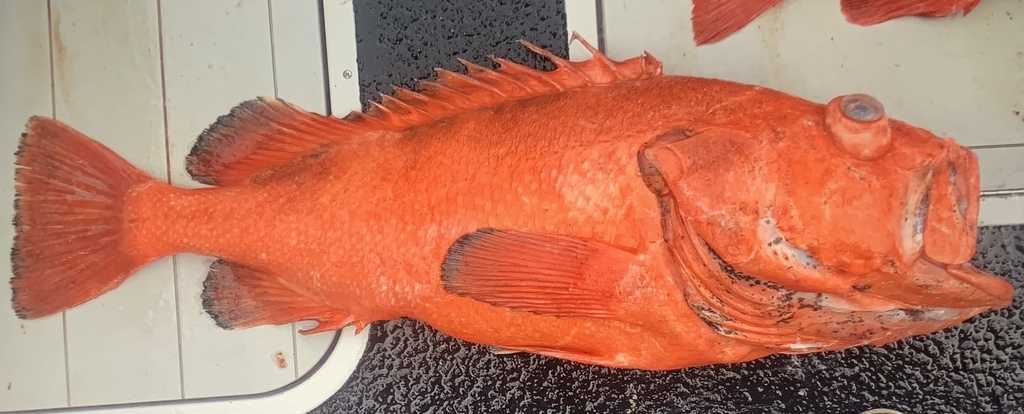
Dorsal fin with 13 spines and 13 soft rays, anal fin with 3 spines and 7 soft rays, and 27–31 vertebrae. Fewer than 2 spines sit on the lower orbital rim, and the pores on the lower jaw are very large, which separates it from close relatives. Colour is reddish pink to orange red, the mouth is red and may carry black blotches, and the caudal fin is moderately indented. Maximum length is 108 cm TL, the recorded maximum weight is 16.2 kg, maturity is near 47 cm and the oldest fish reached 157 years. The very large pores on the lower jaw are the quickest check on a big fish, and the red mouth is visible when the jaw is opened.
Habitat and behaviour
It ranges from southern Japan and southeastern Kamchatka through Navarin Canyon, Stalemate and Bowers Banks and the Aleutians south to Point Conception, California. This is a demersal deep-water species, recorded from the surface down to 1200 m, usually on steep slope and canyon wall hard bottom. Diet includes squid, fish, amphipods, crabs and shrimp. GBIF holds 5538 records, 3453 from the United States and 2057 from Canada. Large size and long life make it one of the slowest species to recover on the slope. Most sport effort stays well above the maximum depth, because the gear needed to fish the deepest ground is specialised.
Seasonal window
Spawning is documented in May off north-central California. Alaska lists shortraker rockfish in the slope non-pelagic group at 1 per day and 2 in possession, with a deep-release device required aboard. British Columbia allows 3 rockfish per day, closes yelloweye and shuts Area 29 entirely. Late spring to early autumn is the working window; winter weather and poor release survival rule out cold-season targeting. No usable water-temperature series exists for the species. A single May record is the only spawning data in the summary, and it covers one part of the coast.
Gear and approach
Use a stiff rod with real lifting power, braided main line and a long carbon leader for abrasion resistance. Set lead for the current and leave a margin at depth so the rig does not hover mid-water. Large circle or heavy-gauge hooks hold big fish and survive the fight. Send every released fish back down on a descending device and keep air exposure short, because large shortrakers take a long time to handle. Lifting a heavy fish from deep water is slow work, so a reliable release device should be ready before the first drop. A back-up release weight lives in the console, because the first one is easily lost over the side.
Edibility and regulations
Thick flesh suits steaks, pan-frying and soup, and the fin edges are gelatinous; bleed, gill and chill in ice water to limit softness and off-flavour. Alaska: slope non-pelagic rockfish, 1 per day and 2 in possession. British Columbia: 3 per day, yelloweye closed, Area 29 closed. Washington: coastal rockfish 7 in total, yelloweye closed. California: 10 fish in the RCG aggregate, descending device required. IUCN Not Evaluated; no CITES or CMS listing. Fillets are thick enough to grill, and the frame makes a good stock.
Where to look
Fish steep slope edges and canyon walls with hard bottom, from the surface down to 1200 m, though most effort is much shallower. GBIF records split between Alaska and British Columbia, and iNaturalist photos are few, so check the lower jaw pores and orbital spines before confirming the fish. Large individuals are the oldest and the most valuable to release. Because the largest fish are also the oldest, a quick photo and a clean release is the best outcome for the stock.
How to catch it
Boat bottom fishing
Fished with the listed approach, matched to the recorded depth and size.
Slow pitch jigging
Fished with the listed approach, matched to the recorded depth and size.
Where these facts come from
Check these pages before you rely on a size, range or protection status.
- FishBase — Sebastes borealis — FishBase · T2
- GBIF — Sebastes borealis occurrence records — GBIF · T2
- IUCN Red List — Sebastes borealis — IUCN · T1
- Photo record — iNaturalist — iNaturalist · T3
Fish in the same water
These fish live in the same place.

Guides for this water
Technique, gear and safety guides that fit Shortraker rockfish.