
Silvergray rockfish
Dorsal fin with 13 spines and 15–17 soft rays, anal fin with 3 spines and 7–8 soft rays, and 33–36 vertebrae. Head spines are weak, with only the nasal, preocular and parietal spines obvious; the lower jaw is long and protrudes past the upper, and the maxillary reaches behind the eye. Colour is greenish to silver gray, white tinged with orange or pink below, and the lips are dusky.
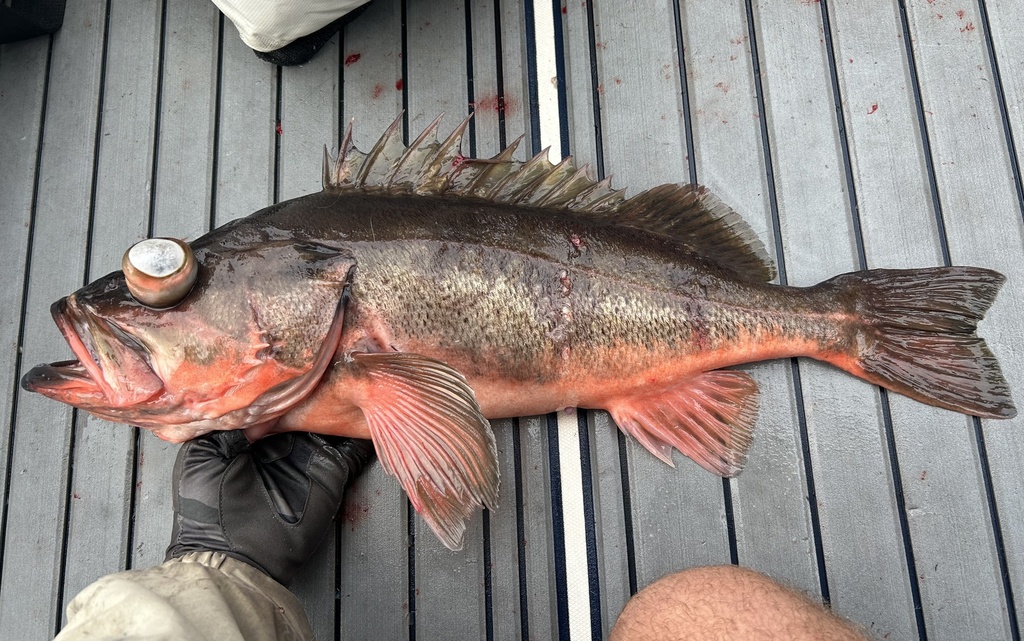
Dorsal fin with 13 spines and 15–17 soft rays, anal fin with 3 spines and 7–8 soft rays, and 33–36 vertebrae. Head spines are weak, with only the nasal, preocular and parietal spines obvious; the lower jaw is long and protrudes past the upper, and the maxillary reaches behind the eye. Colour is greenish to silver gray, white tinged with orange or pink below, and the lips are dusky. Maximum length is 71 cm TL, maturity is near 46 cm and the recorded maximum weight is 4.7 kg. Weak head spines and the protruding lower jaw separate it from other gray-green rockfish in the same depth band.
Habitat and behaviour
It ranges from the Bering Sea coast of Alaska to Baja California, Mexico. The species is demersal from the surface down to 375 m, mostly over rock and rubble on the middle slope. GBIF holds 38605 records, 38119 from Canada and 454 from the United States. Off British Columbia it is a common slope fish for both trawlers and sport anglers. The depth range overlaps shallower shelf species, so identification matters when limits differ between groups. Canadian records dominate by a wide margin, which matches the centre of abundance.
Seasonal window
Spawning is documented in May off north-central California. British Columbia keeps rockfish open all year at 3 per day with yelloweye closed, and Area 29 is shut to all rockfish. Southeast Alaska manages it as slope non-pelagic rockfish at 1 per day and 2 in possession. It turns up across a wide depth band, and late spring to early autumn is the main window. No water-temperature series is available, so no temperature guidance is offered here. Weather, not spawning, sets the season on the outer coast, and settled summer days are the most reliable. A falling tide on the outer coast often brings cleaner water and easier drifts.
Gear and approach
A medium-heavy boat rod, braided main line and carbon leader are enough. Choose lead for the current and keep a light bottom contact; short leaders reduce tangles. The mouth is large but the bite is soft, so use a wide hook gap without adding bulk. Send released fish back down on a descending device, especially undersized or non-target fish, and keep handling time short. Lighter gear is enough, which makes repeated drops less tiring on a long day. Check the leader after every fish, since rock abrasion is the usual cause of failure.
Edibility and regulations
White, mild flesh is good steamed, fried or in soup; bleed, gill and ice the fish to keep it firm. Alaska: slope non-pelagic rockfish, 1 per day and 2 in possession. British Columbia: 3 per day, yelloweye closed, Area 29 closed. Washington: coastal rockfish 7 in total, with copper, quillback and vermilion closed from May to July. California: 10 fish in the RCG aggregate, descending device required. IUCN Not Evaluated; no CITES or CMS listing. Fillets hold together well in soup and are a good use for fish that are modest in size.
Where to look
Work rock and rubble on the middle slope, from the surface down to 375 m, and keep the bait on the contour. GBIF records are almost entirely Canadian, and iNaturalist photos are moderate in number, so check the long lower jaw and weak head spines before confirming a catch. The species grows slowly and reaches 82 years, so large fish are worth releasing. Because the range runs into Mexico, the southern end of the distribution is outside the areas covered by these rules. On the northern grounds, the same slope edges that hold shortraker also hold silvergray.
How to catch it
Boat bottom fishing
Fished with the listed approach, matched to the recorded depth and size.
Slow pitch jigging
Fished with the listed approach, matched to the recorded depth and size.
Where these facts come from
Check these pages before you rely on a size, range or protection status.
- FishBase — Sebastes brevispinis — FishBase · T2
- GBIF — Sebastes brevispinis occurrence records — GBIF · T2
- IUCN Red List — Sebastes brevispinis — IUCN · T1
- Photo record — iNaturalist — iNaturalist · T3
Fish in the same water
These fish live in the same place.

Guides for this water
Technique, gear and safety guides that fit Silvergray rockfish.