
Black-and-yellow rockfish
Black-and-yellow rockfish is close in shape to the gopher rockfish and is separated in the field mainly by colour: a near-black body with bold yellow blotches. The FishBase summary carries no fin-ray or vertebral counts for this species, so counts serve only as a secondary check. Maximum total length is 39 cm, maturity is near 15 cm, and the recorded maximum age is 22 years.
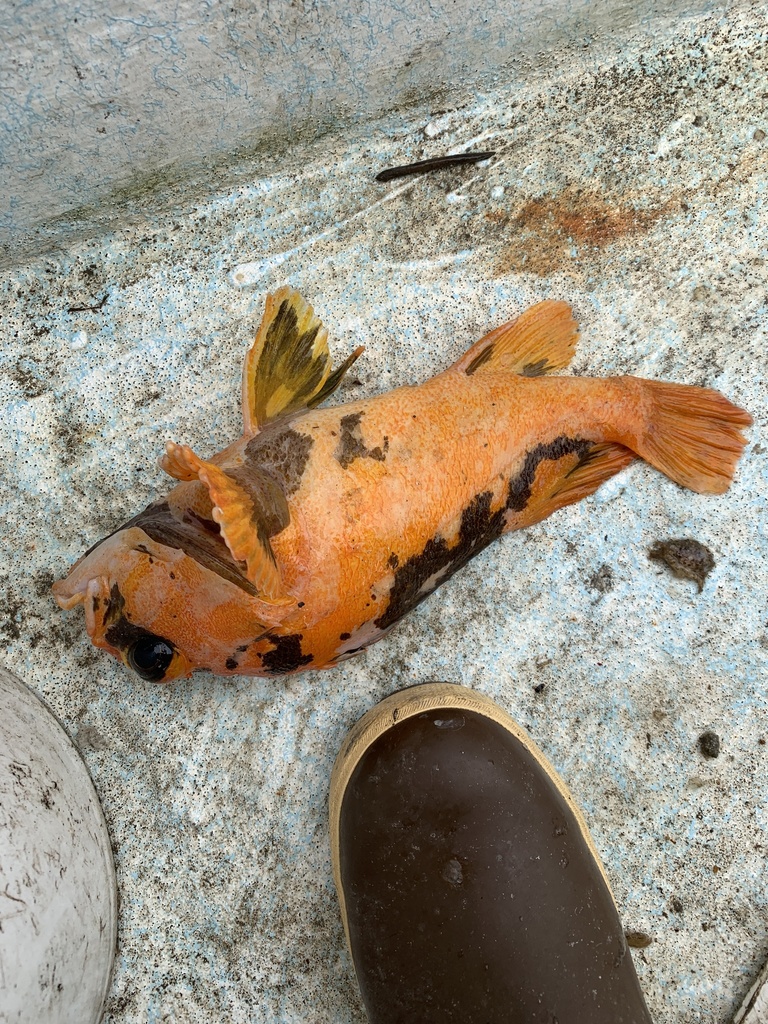
Black-and-yellow rockfish is close in shape to the gopher rockfish and is separated in the field mainly by colour: a near-black body with bold yellow blotches. The FishBase summary carries no fin-ray or vertebral counts for this species, so counts serve only as a secondary check. Maximum total length is 39 cm, maturity is near 15 cm, and the recorded maximum age is 22 years. The head is blunt with strong spines, the mouth is moderate, and the body is a little deeper than a gopher rockfish. The yellow blotches sit over a dark olive to black ground and stay visible in poor light, which is why divers use the pattern before they count fin rays.
Habitat and behaviour
Eastern Pacific from Eureka in northern California to central Baja California, Mexico, overlapping the gopher rockfish almost entirely. It is demersal from the surface down to 37 m, mostly 0–18 m, over shallow rock and kelp. GBIF holds 83419 records, 83370 from the United States, 33 from Mexico and 5 from Canada. iNaturalist lists 478 observations. It stays close to crevices and kelp holdfasts and moves little between marks, so the same headland produces again. Kelp holdfasts and the shaded side of boulders are the most reliable spots, and fish rarely move far from them.
Seasonal window
Spawning is recorded in February and March, with the clearest records from north-central California. FishBase gives no temperature range, so the window follows the spawning block and the open season rather than measured water temperature. The California RCG complex is open all year; late winter and early spring are the steadiest window on shallow rock, while summer fish spread out and the bite lightens. Dirty water after swell shuts the shallow bite down. A clear week after rain usually brings the best visibility on these shallow marks, and the fish are easier to spot before the sun is high.
Gear and approach
A medium-light boat rod is enough for shallow reef. Use braided main line and a fluorocarbon leader; the leader matters more than a fine main line around rock. Wide-gap hooks suit the hard mouth, and the weight only needs to hold bottom. Keep the leader short in kelp. A slow lift beats a hard strike on this fish. Lift the fish clear of the reef before it can turn back into a crevice.
Edibility and regulations
The flesh is white with a mild flavour, good steamed or pan-fried; bleed, gill and ice the fish promptly. Alaska: outside the range, no specific rule, so check the current announcement. British Columbia: outside the range, no specific rule, so check the current announcement. Washington: outside the usual range, no specific rule, so check the current announcement. California: RCG complex 10 per day in aggregate, no minimum size for rockfish, bronzespotted, cowcod, quillback and yelloweye prohibited, and a descending device must be on board. IUCN Not Evaluated; CITES and CMS Not Evaluated.
Where to look
Fish shallow rock, kelp edges and boulder fields from the surface to about 18 m. The dense GBIF cluster along central California matches the main range. Work the shaded side of a rock or the edge of a kelp bed, and repeat a mark that produced before, as this species is not a long-distance mover. Fish the first hours of light; the same shallow reef that holds fish at dawn empties as the sun climbs. When the kelp is thick, drop into the gaps rather than casting over the canopy. A small swimbait on a light head covers water faster when the fish are spread.
How to catch it
Boat bottom fishing
Fished with the listed approach, matched to the recorded depth and size.
Shore fishing
Fished with the listed approach, matched to the recorded depth and size.
Jigging
Fished with the listed approach, matched to the recorded depth and size.
Where these facts come from
Check these pages before you rely on a size, range or protection status.
- FishBase — Sebastes chrysomelas — FishBase · T2
- GBIF — Sebastes chrysomelas occurrence records — GBIF · T2
- IUCN Red List — Sebastes chrysomelas — IUCN · T1
- Photo record — iNaturalist — iNaturalist · T3
Fish in the same water
These fish live in the same place.

Guides for this water
Technique, gear and safety guides that fit Black-and-yellow rockfish.